

61
Chapter three: Exercise energetics
Despite accounting for upwards of 60% of total foraging costs, the energetic payoff of
the lunge feeding foraging strategy is high, with each lunge providing 6–237 times more
energy consumed than expended during foraging by blue whales (Goldbogen et al. 2011).
3.3 Toolbox
The methods for assessing energetic costs in active marine mammals are changing quickly
as advances in microprocessor technology afford new opportunities and finer scale monitoring of free-ranging animals. Combined with traditional methods of direct and indirect
calorimetry, it is now possible to evaluate the energetics of marine mammals on many
scales from instantaneous to prolonged intervals that range from seconds to daily, seasonal, and annual periods of time.
3.3.1 Measuring oxygen consumption
One of the most common methods that sets the foundation for evaluating the energetic cost of exercise in marine mammals is the determination of the rate of oxygen
consumption (VO 2
) using open-flow respirometry. Details of the methods and calibrations are provided in Fedak et al. (1981) and Davis et al. (1985) for marine mammals as
modified from Withers (1977) who developed many of the techniques for open-flow
respirometry on terrestrial species.
VO 2 during rest, swimming, and diving has been
directly measured for a wide variety of marine mammals using this method (Table 3.1)
by training or directing animals to breathe into an appropriately-sized metabolic chamber to capture exhalations. A Plexiglas skylight floating on the water surface often suffices as a respiratory chamber and has been used to measure
VO 2 of sea otters to killer
whales. Creative placement of the metabolic chamber above load cells (Williams et al.
1993), pools (Worthy 1987; Thometz et al. 2014), flumes (Davis et al. 1985; Fedak 1986;
Feldkamp 1987; Rosen and Trites 2002), diving towers (Yeates et al. 2007), open water
(Fahlman et al. 2008), and even breathing holes in the polar ice (Castellini et al. 1992;
Williams et al. 2004) have allowed measurement of the metabolic rates of resting and
exercising marine mammals.
The technique involves drawing air through the metabolic chamber with a vacuum
pump at flow rates that maintain the fractional concentration of oxygen in the metabolic
chamber above 0.2000 to avoid hypoxic conditions for the animals. Samples of expired
air from the exhaust port of the chamber are usually dried with Drierite and scrubbed
of carbon dioxide with Sodasorb before entering an oxygen analyzer (e.g., Sable Systems
International, Inc., Las Vegas, Nevada).
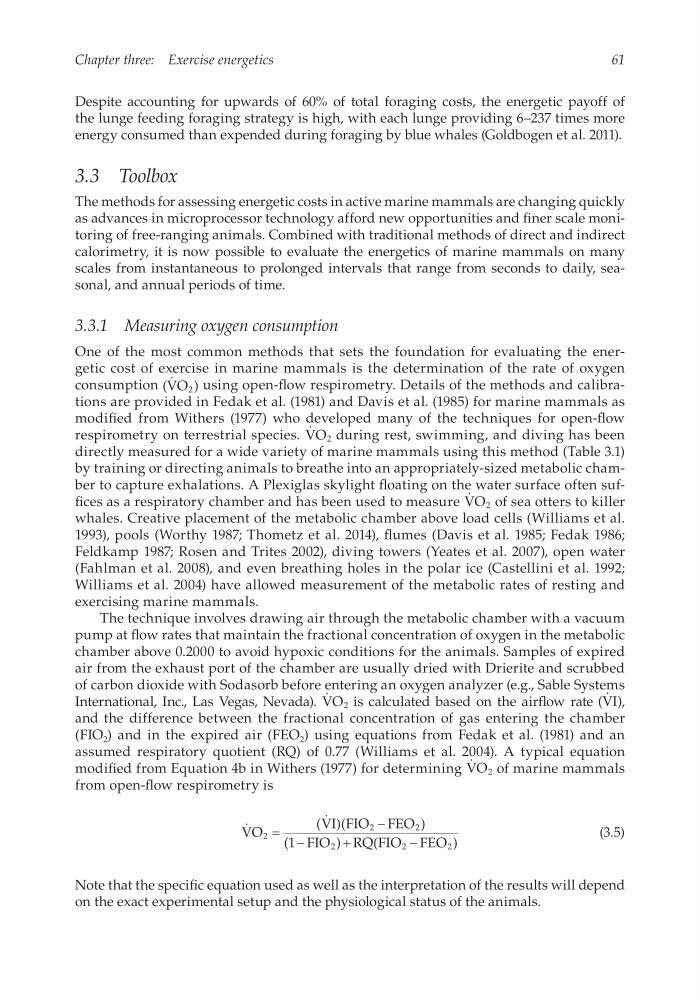
VO 2 is calculated based on the airflow rate (VI) ,
and the difference between the fractional concentration of gas entering the chamber
(FIO 2 ) and in the expired air (FEO 2 ) using equations from Fedak et al. (1981) and an
assumed respiratory quotient (RQ) of 0.77 (Williams et al. 2004). A typical equation
modified from Equation 4b in Withers (1977) for determining
VO 2 of marine mammals
from open-flow respirometry is
VO
VI FIO FEO
1 FIO
RQ FIO FEO
2
2
2
2
2
2
=
-
-
+
-
( )(
)
(
)
(
)
(3.5)
Note that the specific equation used as well as the interpretation of the results will depend
on the exact experimental setup and the physiological status of the animals.
Chapter three: Exercise energetics
Despite accounting for upwards of 60% of total foraging costs, the energetic payoff of
the lunge feeding foraging strategy is high, with each lunge providing 6–237 times more
energy consumed than expended during foraging by blue whales (Goldbogen et al. 2011).
3.3 Toolbox
The methods for assessing energetic costs in active marine mammals are changing quickly
as advances in microprocessor technology afford new opportunities and finer scale monitoring of free-ranging animals. Combined with traditional methods of direct and indirect
calorimetry, it is now possible to evaluate the energetics of marine mammals on many
scales from instantaneous to prolonged intervals that range from seconds to daily, seasonal, and annual periods of time.
3.3.1 Measuring oxygen consumption
One of the most common methods that sets the foundation for evaluating the energetic cost of exercise in marine mammals is the determination of the rate of oxygen
consumption (VO 2
) using open-flow respirometry. Details of the methods and calibrations are provided in Fedak et al. (1981) and Davis et al. (1985) for marine mammals as
modified from Withers (1977) who developed many of the techniques for open-flow
respirometry on terrestrial species.
VO 2 during rest, swimming, and diving has been
directly measured for a wide variety of marine mammals using this method (Table 3.1)
by training or directing animals to breathe into an appropriately-sized metabolic chamber to capture exhalations. A Plexiglas skylight floating on the water surface often suffices as a respiratory chamber and has been used to measure
VO 2 of sea otters to killer
whales. Creative placement of the metabolic chamber above load cells (Williams et al.
1993), pools (Worthy 1987; Thometz et al. 2014), flumes (Davis et al. 1985; Fedak 1986;
Feldkamp 1987; Rosen and Trites 2002), diving towers (Yeates et al. 2007), open water
(Fahlman et al. 2008), and even breathing holes in the polar ice (Castellini et al. 1992;
Williams et al. 2004) have allowed measurement of the metabolic rates of resting and
exercising marine mammals.
The technique involves drawing air through the metabolic chamber with a vacuum
pump at flow rates that maintain the fractional concentration of oxygen in the metabolic
chamber above 0.2000 to avoid hypoxic conditions for the animals. Samples of expired
air from the exhaust port of the chamber are usually dried with Drierite and scrubbed
of carbon dioxide with Sodasorb before entering an oxygen analyzer (e.g., Sable Systems
International, Inc., Las Vegas, Nevada).
VO 2 is calculated based on the airflow rate (VI) ,
and the difference between the fractional concentration of gas entering the chamber
(FIO 2 ) and in the expired air (FEO 2 ) using equations from Fedak et al. (1981) and an
assumed respiratory quotient (RQ) of 0.77 (Williams et al. 2004). A typical equation
modified from Equation 4b in Withers (1977) for determining
VO 2 of marine mammals
from open-flow respirometry is
VO
VI FIO FEO
1 FIO
RQ FIO FEO
2
2
2
2
2
2
=
-
-
+
-
( )(
)
(
)
(
)
(3.5)
Note that the specific equation used as well as the interpretation of the results will depend
on the exact experimental setup and the physiological status of the animals.