

59
Chapter three: Exercise energetics
Interestingly, marine mammals will take advantage of waves generated from a variety of
sources including wind, currents, and even larger whales (Woodcock and McBride 1951;
Caldwell and Fields 1959; Würsig and Würsig 1979) in addition to the wake of ships in
order to save energy by surfing.
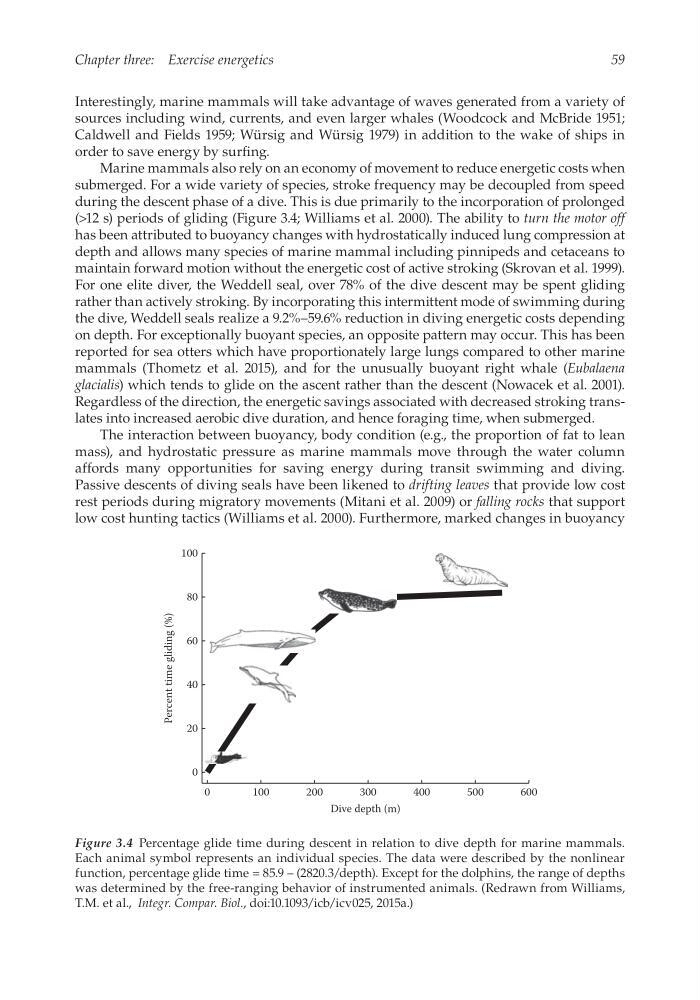
Marine mammals also rely on an economy of movement to reduce energetic costs when
submerged. For a wide variety of species, stroke frequency may be decoupled from speed
during the descent phase of a dive. This is due primarily to the incorporation of prolonged
(>12 s) periods of gliding (Figure 3.4; Williams et al. 2000). The ability to turn the motor off
has been attributed to buoyancy changes with hydrostatically induced lung compression at
depth and allows many species of marine mammal including pinnipeds and cetaceans to
maintain forward motion without the energetic cost of active stroking (Skrovan et al. 1999).
For one elite diver, the Weddell seal, over 78% of the dive descent may be spent gliding
rather than actively stroking. By incorporating this intermittent mode of swimming during
the dive, Weddell seals realize a 9.2%–59.6% reduction in diving energetic costs depending
on depth. For exceptionally buoyant species, an opposite pattern may occur. This has been
reported for sea otters which have proportionately large lungs compared to other marine
mammals (Thometz et al. 2015), and for the unusually buoyant right whale (Eubalaena
glacialis) which tends to glide on the ascent rather than the descent (Nowacek et al. 2001).
Regardless of the direction, the energetic savings associated with decreased stroking translates into increased aerobic dive duration, and hence foraging time, when submerged.
The interaction between buoyancy, body condition (e.g., the proportion of fat to lean
mass), and hydrostatic pressure as marine mammals move through the water column
affords many opportunities for saving energy during transit swimming and diving.
Passive descents of diving seals have been likened to drifting leaves that provide low cost
rest periods during migratory movements (Mitani et al. 2009) or falling rocks that support
low cost hunting tactics (Williams et al. 2000). Furthermore, marked changes in buoyancy
100
80
60
40
20
0
0
100
200
300
Dive depth (m)
Percent time gliding (%)
400
500
600
Figure 3.4 Percentage glide time during descent in relation to dive depth for marine mammals.
Each animal symbol represents an individual species. The data were described by the nonlinear
function, percentage glide time = 85.9 – (2820.3/depth). Except for the dolphins, the range of depths
was determined by the free-ranging behavior of instrumented animals. (Redrawn from Williams,
T.M. et al., Integr. Compar. Biol., doi:10.1093/icb/icv025, 2015a.)
Chapter three: Exercise energetics
Interestingly, marine mammals will take advantage of waves generated from a variety of
sources including wind, currents, and even larger whales (Woodcock and McBride 1951;
Caldwell and Fields 1959; Würsig and Würsig 1979) in addition to the wake of ships in
order to save energy by surfing.
Marine mammals also rely on an economy of movement to reduce energetic costs when
submerged. For a wide variety of species, stroke frequency may be decoupled from speed
during the descent phase of a dive. This is due primarily to the incorporation of prolonged
(>12 s) periods of gliding (Figure 3.4; Williams et al. 2000). The ability to turn the motor off
has been attributed to buoyancy changes with hydrostatically induced lung compression at
depth and allows many species of marine mammal including pinnipeds and cetaceans to
maintain forward motion without the energetic cost of active stroking (Skrovan et al. 1999).
For one elite diver, the Weddell seal, over 78% of the dive descent may be spent gliding
rather than actively stroking. By incorporating this intermittent mode of swimming during
the dive, Weddell seals realize a 9.2%–59.6% reduction in diving energetic costs depending
on depth. For exceptionally buoyant species, an opposite pattern may occur. This has been
reported for sea otters which have proportionately large lungs compared to other marine
mammals (Thometz et al. 2015), and for the unusually buoyant right whale (Eubalaena
glacialis) which tends to glide on the ascent rather than the descent (Nowacek et al. 2001).
Regardless of the direction, the energetic savings associated with decreased stroking translates into increased aerobic dive duration, and hence foraging time, when submerged.
The interaction between buoyancy, body condition (e.g., the proportion of fat to lean
mass), and hydrostatic pressure as marine mammals move through the water column
affords many opportunities for saving energy during transit swimming and diving.
Passive descents of diving seals have been likened to drifting leaves that provide low cost
rest periods during migratory movements (Mitani et al. 2009) or falling rocks that support
low cost hunting tactics (Williams et al. 2000). Furthermore, marked changes in buoyancy
100
80
60
40
20
0
0
100
200
300
Dive depth (m)
Percent time gliding (%)
400
500
600
Figure 3.4 Percentage glide time during descent in relation to dive depth for marine mammals.
Each animal symbol represents an individual species. The data were described by the nonlinear
function, percentage glide time = 85.9 – (2820.3/depth). Except for the dolphins, the range of depths
was determined by the free-ranging behavior of instrumented animals. (Redrawn from Williams,
T.M. et al., Integr. Compar. Biol., doi:10.1093/icb/icv025, 2015a.)