

56
Marine Mammal Physiology: Requisites for Ocean Living
otters to 1310 kg walruses (Odobenus rosmarus), we find that field energy expenditure in
the smallest marine mammals is higher than would be predicted for a terrestrial mammal. Conversely, FMR is lower than would be predicted in the largest marine mammals
(Figure 3.2b). When the comparison is made between marine mammals and only terrestrial carnivores, the differences in field metabolic rates often disappear (Maresh 2014).
Although the intercept for the FMR to body mass relationships are not significantly different between the groups, the slope as indicated by the exponent is shallower for marine
mammals (exponent = 0.45) than that for terrestrial mammals (exponent = 0.72). Based on
this, it appears that mass-specific field metabolic rates decline with increasing body size at
a faster rate in marine mammals than in terrestrial mammals, as proposed by Boyd (2002).
The implication is that energy expenditure in marine mammals will be elevated above
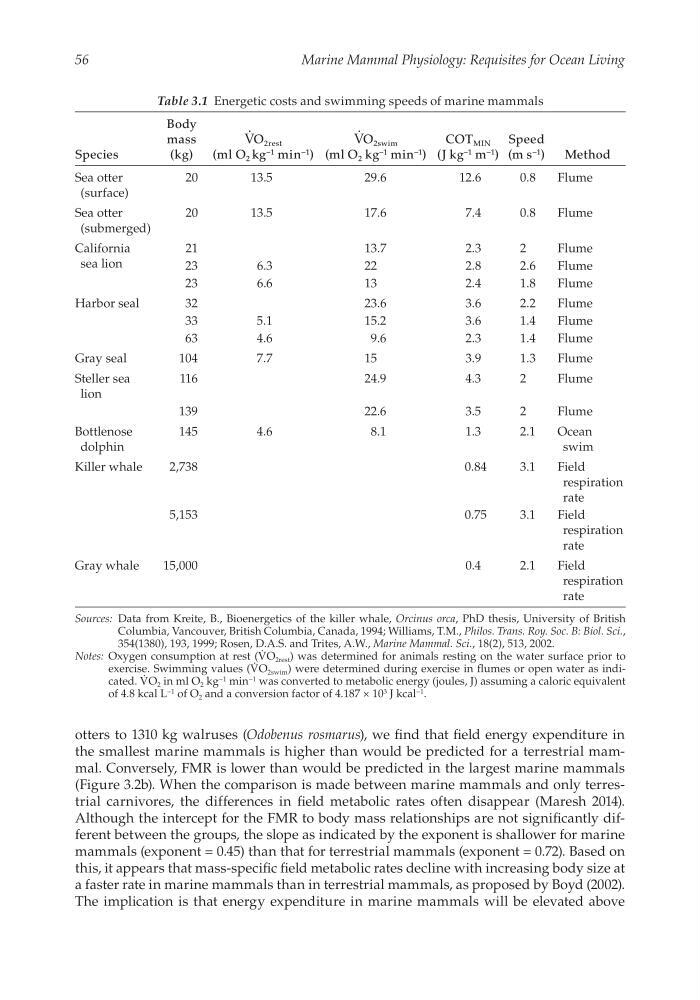
Table 3.1 Energetic costs and swimming speeds of marine mammals
Species
Body
mass
(kg)
V
. O 2rest
(ml O 2 kg −1 min −1 )
V
. O 2swim
(ml O 2 kg −1 min −1 )
COT MIN
(J kg −1 m −1 )
Speed
(m s −1 )
Method
Sea otter
(surface)
20
13.5
29.6
12.6
0.8
Flume
Sea otter
(submerged)
20
13.5
17.6
7.4
0.8
Flume
California
sea lion
21
13.7
2.3
2
Flume
23
6.3
22
2.8
2.6
Flume
23
6.6
13
2.4
1.8
Flume
Harbor seal
32
23.6
3.6
2.2
Flume
33
5.1
15.2
3.6
1.4
Flume
63
4.6
9.6
2.3
1.4
Flume
Gray seal
104
7.7
15
3.9
1.3
Flume
Steller sea
lion
116
24.9
4.3
2
Flume
139
22.6
3.5
2
Flume
Bottlenose
dolphin
145
4.6
8.1
1.3
2.1
Ocean
swim
Killer whale
2,738
0.84
3.1
Field
respiration
rate
5,153
0.75
3.1
Field
respiration
rate
Gray whale
15,000
0.4
2.1
Field
respiration
rate
Sources: Data from Kreite, B., Bioenergetics of the killer whale, Orcinus orca, PhD thesis, University of British
Columbia, Vancouver, British Columbia, Canada, 1994; Williams, T.M., Philos. Trans. Roy. Soc. B: Biol. Sci.,
354(1380), 193, 1999; Rosen, D.A.S. and Trites, A.W., Marine Mammal. Sci., 18(2), 513, 2002.
Notes: Oxygen consumption at rest (V
. O 2rest ) was determined for animals resting on the water surface prior to
exercise. Swimming values (V
. O 2swim ) were determined during exercise in flumes or open water as indicated. V
. O 2 in ml O 2 kg −1 min −1 was converted to metabolic energy (joules, J) assuming a caloric equivalent
of 4.8 kcal L −1 of O 2 and a conversion factor of 4.187 × 10 3 J kcal −1 .
Marine Mammal Physiology: Requisites for Ocean Living
otters to 1310 kg walruses (Odobenus rosmarus), we find that field energy expenditure in
the smallest marine mammals is higher than would be predicted for a terrestrial mammal. Conversely, FMR is lower than would be predicted in the largest marine mammals
(Figure 3.2b). When the comparison is made between marine mammals and only terrestrial carnivores, the differences in field metabolic rates often disappear (Maresh 2014).
Although the intercept for the FMR to body mass relationships are not significantly different between the groups, the slope as indicated by the exponent is shallower for marine
mammals (exponent = 0.45) than that for terrestrial mammals (exponent = 0.72). Based on
this, it appears that mass-specific field metabolic rates decline with increasing body size at
a faster rate in marine mammals than in terrestrial mammals, as proposed by Boyd (2002).
The implication is that energy expenditure in marine mammals will be elevated above
Table 3.1 Energetic costs and swimming speeds of marine mammals
Species
Body
mass
(kg)
V
. O 2rest
(ml O 2 kg −1 min −1 )
V
. O 2swim
(ml O 2 kg −1 min −1 )
COT MIN
(J kg −1 m −1 )
Speed
(m s −1 )
Method
Sea otter
(surface)
20
13.5
29.6
12.6
0.8
Flume
Sea otter
(submerged)
20
13.5
17.6
7.4
0.8
Flume
California
sea lion
21
13.7
2.3
2
Flume
23
6.3
22
2.8
2.6
Flume
23
6.6
13
2.4
1.8
Flume
Harbor seal
32
23.6
3.6
2.2
Flume
33
5.1
15.2
3.6
1.4
Flume
63
4.6
9.6
2.3
1.4
Flume
Gray seal
104
7.7
15
3.9
1.3
Flume
Steller sea
lion
116
24.9
4.3
2
Flume
139
22.6
3.5
2
Flume
Bottlenose
dolphin
145
4.6
8.1
1.3
2.1
Ocean
swim
Killer whale
2,738
0.84
3.1
Field
respiration
rate
5,153
0.75
3.1
Field
respiration
rate
Gray whale
15,000
0.4
2.1
Field
respiration
rate
Sources: Data from Kreite, B., Bioenergetics of the killer whale, Orcinus orca, PhD thesis, University of British
Columbia, Vancouver, British Columbia, Canada, 1994; Williams, T.M., Philos. Trans. Roy. Soc. B: Biol. Sci.,
354(1380), 193, 1999; Rosen, D.A.S. and Trites, A.W., Marine Mammal. Sci., 18(2), 513, 2002.
Notes: Oxygen consumption at rest (V
. O 2rest ) was determined for animals resting on the water surface prior to
exercise. Swimming values (V
. O 2swim ) were determined during exercise in flumes or open water as indicated. V
. O 2 in ml O 2 kg −1 min −1 was converted to metabolic energy (joules, J) assuming a caloric equivalent
of 4.8 kcal L −1 of O 2 and a conversion factor of 4.187 × 10 3 J kcal −1 .