

50
Marine Mammal Physiology: Requisites for Ocean Living
3.2.1 Resting metabolic rates and costs
Resting Metabolic Rate, sometimes termed basal metabolic rate, is a measure of the minimum energy requirements for an animal that is awake and alert but otherwise not engaged
in any activity that might elevate metabolism above baseline maintenance levels (Kleiber
1975). In this physiological state, the animal is a non-reproductive adult (e.g., no growing,
pregnancy, or lactation costs), inactive, fasted (e.g., post-prandial), relaxed but not asleep,
and in a thermally neutral environment. For accurate inter-species comparisons, it is critical that these so-called Kleiber standards are met during metabolic measurements.
Heart rate (beats per min)
Oxygen consumption (ml O
2 kg
–1
min
–1
)
(d)
20
0
5
10
15
20
25
30
35
40
60
80
100
120
CA sea lion
(30 kg)
Harbor seal
(40 kg) (25 kg)
Dolphin
(200 kg)
140
180
160
Maximum dive depth (m)
(c)
–100
0
10
Minimum heart rate (bpm)
20
30
40
50
60
0
100
200
300
(106)
(43)
(103)
(93)
(116)
(5)
400
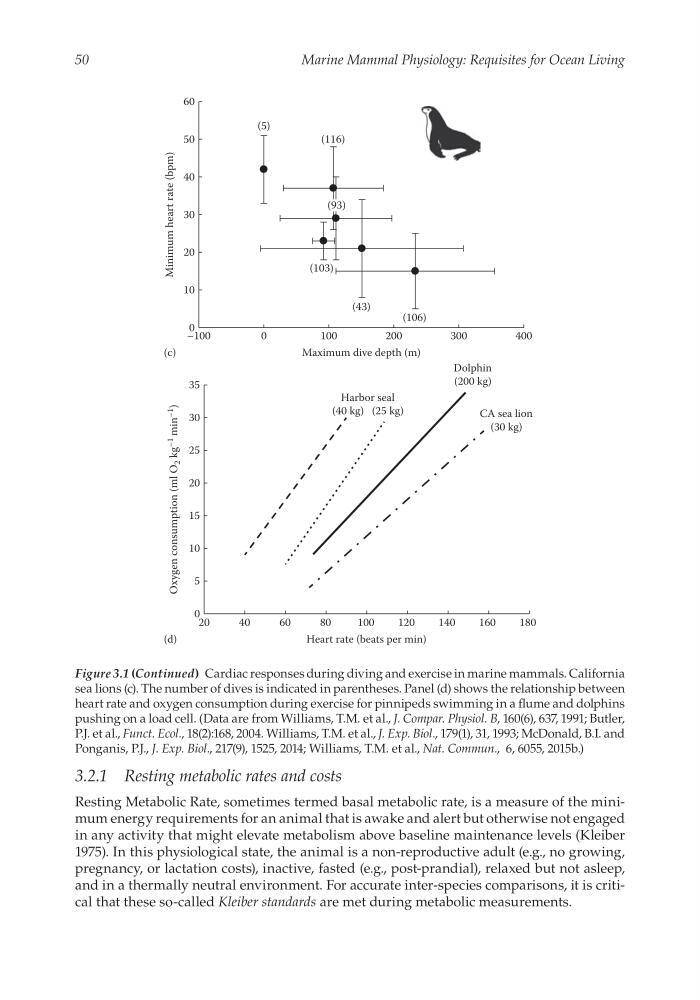
Figure 3.1 (Continued) Cardiac responses during diving and exercise in marine mammals. California
sea lions (c). The number of dives is indicated in parentheses. Panel (d) shows the relationship between
heart rate and oxygen consumption during exercise for pinnipeds swimming in a flume and dolphins
pushing on a load cell. (Data are from Williams, T.M. et al., J. Compar. Physiol. B, 160(6), 637, 1991; Butler,
P.J. et al., Funct. Ecol., 18(2):168, 2004. Williams, T.M. et al., J. Exp. Biol., 179(1), 31, 1993; McDonald, B.I. and
Ponganis, P.J., J. Exp. Biol., 217(9), 1525, 2014; Williams, T.M. et al., Nat. Commun., 6, 6055, 2015b.)
Marine Mammal Physiology: Requisites for Ocean Living
3.2.1 Resting metabolic rates and costs
Resting Metabolic Rate, sometimes termed basal metabolic rate, is a measure of the minimum energy requirements for an animal that is awake and alert but otherwise not engaged
in any activity that might elevate metabolism above baseline maintenance levels (Kleiber
1975). In this physiological state, the animal is a non-reproductive adult (e.g., no growing,
pregnancy, or lactation costs), inactive, fasted (e.g., post-prandial), relaxed but not asleep,
and in a thermally neutral environment. For accurate inter-species comparisons, it is critical that these so-called Kleiber standards are met during metabolic measurements.
Heart rate (beats per min)
Oxygen consumption (ml O
2 kg
–1
min
–1
)
(d)
20
0
5
10
15
20
25
30
35
40
60
80
100
120
CA sea lion
(30 kg)
Harbor seal
(40 kg) (25 kg)
Dolphin
(200 kg)
140
180
160
Maximum dive depth (m)
(c)
–100
0
10
Minimum heart rate (bpm)
20
30
40
50
60
0
100
200
300
(106)
(43)
(103)
(93)
(116)
(5)
400
Figure 3.1 (Continued) Cardiac responses during diving and exercise in marine mammals. California
sea lions (c). The number of dives is indicated in parentheses. Panel (d) shows the relationship between
heart rate and oxygen consumption during exercise for pinnipeds swimming in a flume and dolphins
pushing on a load cell. (Data are from Williams, T.M. et al., J. Compar. Physiol. B, 160(6), 637, 1991; Butler,
P.J. et al., Funct. Ecol., 18(2):168, 2004. Williams, T.M. et al., J. Exp. Biol., 179(1), 31, 1993; McDonald, B.I. and
Ponganis, P.J., J. Exp. Biol., 217(9), 1525, 2014; Williams, T.M. et al., Nat. Commun., 6, 6055, 2015b.)