

31
Chapter two: Oxygen stores and diving
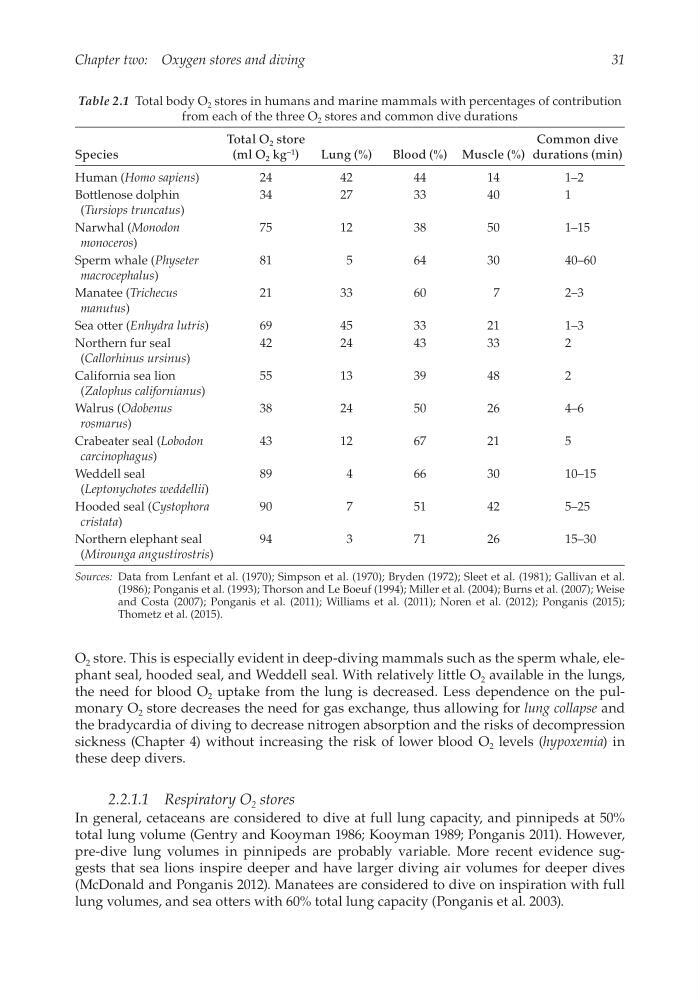
O 2 store. This is especially evident in deep-diving mammals such as the sperm whale, elephant seal, hooded seal, and Weddell seal. With relatively little O 2 available in the lungs,
the need for blood O 2 uptake from the lung is decreased. Less dependence on the pulmonary O 2 store decreases the need for gas exchange, thus allowing for lung collapse and
the bradycardia of diving to decrease nitrogen absorption and the risks of decompression
sickness (Chapter 4) without increasing the risk of lower blood O 2 levels (hypoxemia) in
these deep divers.
2.2.1.1 Respiratory O 2 stores
In general, cetaceans are considered to dive at full lung capacity, and pinnipeds at 50%
total lung volume (Gentry and Kooyman 1986; Kooyman 1989; Ponganis 2011). However,
pre-dive lung volumes in pinnipeds are probably variable. More recent evidence suggests that sea lions inspire deeper and have larger diving air volumes for deeper dives
(McDonald and Ponganis 2012). Manatees are considered to dive on inspiration with full
lung volumes, and sea otters with 60% total lung capacity (Ponganis et al. 2003).
Table 2.1 Total body O 2 stores in humans and marine mammals with percentages of contribution
from each of the three O 2 stores and common dive durations
Species
Total O 2 store
(ml O 2 kg −1 )
Lung (%)
Blood (%) Muscle (%)
Common dive
durations (min)
Human (Homo sapiens)
24
42
44
14
1–2
Bottlenose dolphin
(Tursiops truncatus)
34
27
33
40
1
Narwhal (Monodon
monoceros)
75
12
38
50
1–15
Sperm whale (Physeter
macrocephalus)
81
5
64
30
40–60
Manatee (Trichecus
manutus)
21
33
60
7
2–3
Sea otter (Enhydra lutris)
69
45
33
21
1–3
Northern fur seal
(Callorhinus ursinus)
42
24
43
33
2
California sea lion
(Zalophus californianus)
55
13
39
48
2
Walrus (Odobenus
rosmarus)
38
24
50
26
4–6
Crabeater seal (Lobodon
carcinophagus)
43
12
67
21
5
Weddell seal
(Leptonychotes weddellii)
89
4
66
30
10–15
Hooded seal (Cystophora
cristata)
90
7
51
42
5–25
Northern elephant seal
(Mirounga angustirostris)
94
3
71
26
15–30
Sources: Data from Lenfant et al. (1970); Simpson et al. (1970); Bryden (1972); Sleet et al. (1981); Gallivan et al.
(1986); Ponganis et al. (1993); Thorson and Le Boeuf (1994); Miller et al. (2004); Burns et al. (2007); Weise
and Costa (2007); Ponganis et al. (2011); Williams et al. (2011); Noren et al. (2012); Ponganis (2015);
Thometz et al. (2015).
Chapter two: Oxygen stores and diving
O 2 store. This is especially evident in deep-diving mammals such as the sperm whale, elephant seal, hooded seal, and Weddell seal. With relatively little O 2 available in the lungs,
the need for blood O 2 uptake from the lung is decreased. Less dependence on the pulmonary O 2 store decreases the need for gas exchange, thus allowing for lung collapse and
the bradycardia of diving to decrease nitrogen absorption and the risks of decompression
sickness (Chapter 4) without increasing the risk of lower blood O 2 levels (hypoxemia) in
these deep divers.
2.2.1.1 Respiratory O 2 stores
In general, cetaceans are considered to dive at full lung capacity, and pinnipeds at 50%
total lung volume (Gentry and Kooyman 1986; Kooyman 1989; Ponganis 2011). However,
pre-dive lung volumes in pinnipeds are probably variable. More recent evidence suggests that sea lions inspire deeper and have larger diving air volumes for deeper dives
(McDonald and Ponganis 2012). Manatees are considered to dive on inspiration with full
lung volumes, and sea otters with 60% total lung capacity (Ponganis et al. 2003).
Table 2.1 Total body O 2 stores in humans and marine mammals with percentages of contribution
from each of the three O 2 stores and common dive durations
Species
Total O 2 store
(ml O 2 kg −1 )
Lung (%)
Blood (%) Muscle (%)
Common dive
durations (min)
Human (Homo sapiens)
24
42
44
14
1–2
Bottlenose dolphin
(Tursiops truncatus)
34
27
33
40
1
Narwhal (Monodon
monoceros)
75
12
38
50
1–15
Sperm whale (Physeter
macrocephalus)
81
5
64
30
40–60
Manatee (Trichecus
manutus)
21
33
60
7
2–3
Sea otter (Enhydra lutris)
69
45
33
21
1–3
Northern fur seal
(Callorhinus ursinus)
42
24
43
33
2
California sea lion
(Zalophus californianus)
55
13
39
48
2
Walrus (Odobenus
rosmarus)
38
24
50
26
4–6
Crabeater seal (Lobodon
carcinophagus)
43
12
67
21
5
Weddell seal
(Leptonychotes weddellii)
89
4
66
30
10–15
Hooded seal (Cystophora
cristata)
90
7
51
42
5–25
Northern elephant seal
(Mirounga angustirostris)
94
3
71
26
15–30
Sources: Data from Lenfant et al. (1970); Simpson et al. (1970); Bryden (1972); Sleet et al. (1981); Gallivan et al.
(1986); Ponganis et al. (1993); Thorson and Le Boeuf (1994); Miller et al. (2004); Burns et al. (2007); Weise
and Costa (2007); Ponganis et al. (2011); Williams et al. (2011); Noren et al. (2012); Ponganis (2015);
Thometz et al. (2015).