

200
150
100
50
0
10
Gray whaleBowhead whaleConcentration of selenium in liver (ng/g) dw
White-beaked dolphinPacific
NarwhalRinged
BelugaLong-finned pilot whaleBottlenose dolphinStriped dolphinHarbor porpoise20
26
Chronic toxicity in dogs (Puls 1996)
Chronic toxicity in cattle (Puls 1996)
114 44
Species
38
26
112
10
77
15
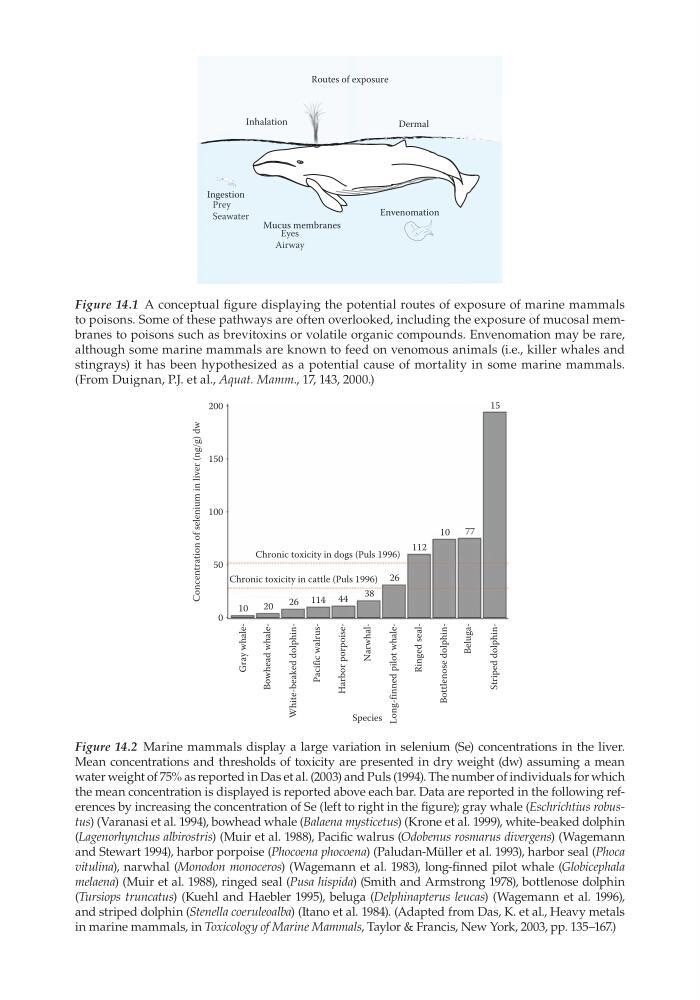
Figure 14.2 Marine mammals display a large variation in selenium (Se) concentrations in the liver.
Mean concentrations and thresholds of toxicity are presented in dry weight (dw) assuming a mean
water weight of 75% as reported in Das et al. (2003) and Puls (1994). The number of individuals for which
the mean concentration is displayed is reported above each bar. Data are reported in the following references by increasing the concentration of Se (left to right in the figure); gray whale (Eschrichtius robustus) (Varanasi et al. 1994), bowhead whale (Balaena mysticetus) (Krone et al. 1999), white-beaked dolphin
(Lagenorhynchus albirostris) (Muir et al. 1988), Pacific walrus (Odobenus rosmarus divergens) (Wagemann
and Stewart 1994), harbor porpoise (Phocoena phocoena) (Paludan-Müller et al. 1993), harbor seal (Phoca
vitulina), narwhal (Monodon monoceros) (Wagemann et al. 1983), long-finned pilot whale (Globicephala
melaena) (Muir et al. 1988), ringed seal (Pusa hispida) (Smith and Armstrong 1978), bottlenose dolphin
(Tursiops truncatus) (Kuehl and Haebler 1995), beluga (Delphinapterus leucas) (Wagemann et al. 1996),
and striped dolphin (Stenella coeruleoalba) (Itano et al. 1984). (Adapted from Das, K. et al., Heavy metals
in marine mammals, in Toxicology of Marine Mammals, Taylor & Francis, New York, 2003, pp. 135–167.)
Ingestion
Inhalation
Envenomation
Mucus membranes
Eyes
Airway
Prey
Seawater
Routes of exposure
Dermal
Figure 14.1 A conceptual figure displaying the potential routes of exposure of marine mammals
to poisons. Some of these pathways are often overlooked, including the exposure of mucosal membranes to poisons such as brevitoxins or volatile organic compounds. Envenomation may be rare,
although some marine mammals are known to feed on venomous animals (i.e., killer whales and
stingrays) it has been hypothesized as a potential cause of mortality in some marine mammals.
(From Duignan, P.J. et al., Aquat. Mamm., 17, 143, 2000.)
150
100
50
0
10
Gray whaleBowhead whaleConcentration of selenium in liver (ng/g) dw
White-beaked dolphinPacific
NarwhalRinged
BelugaLong-finned pilot whaleBottlenose dolphinStriped dolphinHarbor porpoise20
26
Chronic toxicity in dogs (Puls 1996)
Chronic toxicity in cattle (Puls 1996)
114 44
Species
38
26
112
10
77
15
Figure 14.2 Marine mammals display a large variation in selenium (Se) concentrations in the liver.
Mean concentrations and thresholds of toxicity are presented in dry weight (dw) assuming a mean
water weight of 75% as reported in Das et al. (2003) and Puls (1994). The number of individuals for which
the mean concentration is displayed is reported above each bar. Data are reported in the following references by increasing the concentration of Se (left to right in the figure); gray whale (Eschrichtius robustus) (Varanasi et al. 1994), bowhead whale (Balaena mysticetus) (Krone et al. 1999), white-beaked dolphin
(Lagenorhynchus albirostris) (Muir et al. 1988), Pacific walrus (Odobenus rosmarus divergens) (Wagemann
and Stewart 1994), harbor porpoise (Phocoena phocoena) (Paludan-Müller et al. 1993), harbor seal (Phoca
vitulina), narwhal (Monodon monoceros) (Wagemann et al. 1983), long-finned pilot whale (Globicephala
melaena) (Muir et al. 1988), ringed seal (Pusa hispida) (Smith and Armstrong 1978), bottlenose dolphin
(Tursiops truncatus) (Kuehl and Haebler 1995), beluga (Delphinapterus leucas) (Wagemann et al. 1996),
and striped dolphin (Stenella coeruleoalba) (Itano et al. 1984). (Adapted from Das, K. et al., Heavy metals
in marine mammals, in Toxicology of Marine Mammals, Taylor & Francis, New York, 2003, pp. 135–167.)
Ingestion
Inhalation
Envenomation
Mucus membranes
Eyes
Airway
Prey
Seawater
Routes of exposure
Dermal
Figure 14.1 A conceptual figure displaying the potential routes of exposure of marine mammals
to poisons. Some of these pathways are often overlooked, including the exposure of mucosal membranes to poisons such as brevitoxins or volatile organic compounds. Envenomation may be rare,
although some marine mammals are known to feed on venomous animals (i.e., killer whales and
stingrays) it has been hypothesized as a potential cause of mortality in some marine mammals.
(From Duignan, P.J. et al., Aquat. Mamm., 17, 143, 2000.)