

310
Marine Mammal Physiology: Requisites for Ocean Living
are attributed to biotoxins (see Table 14.1). In fact, several biotoxin-related UMEs, such as
domoic acid in California sea lions (Zalophus californianus) and brevitoxin in Florida manatees (Trichechus manatus) now cause strandings and die-offs on a more-or-less predictable
basis, leading to their reclassification as repeated mortality events, as they are no longer, in
fact, unusual (F. Gulland, 2014, pers. comm.).
The occurrence of these toxins has likely co-evolved along with host defense systems
in the canonical evolutionary chemical arms race that has been described in a number of species and ecosystems, and perhaps has contributed to their overt toxicity (Dawkins 1987).
Despite an undoubtedly long history of exposure to marine biotoxins, the interaction
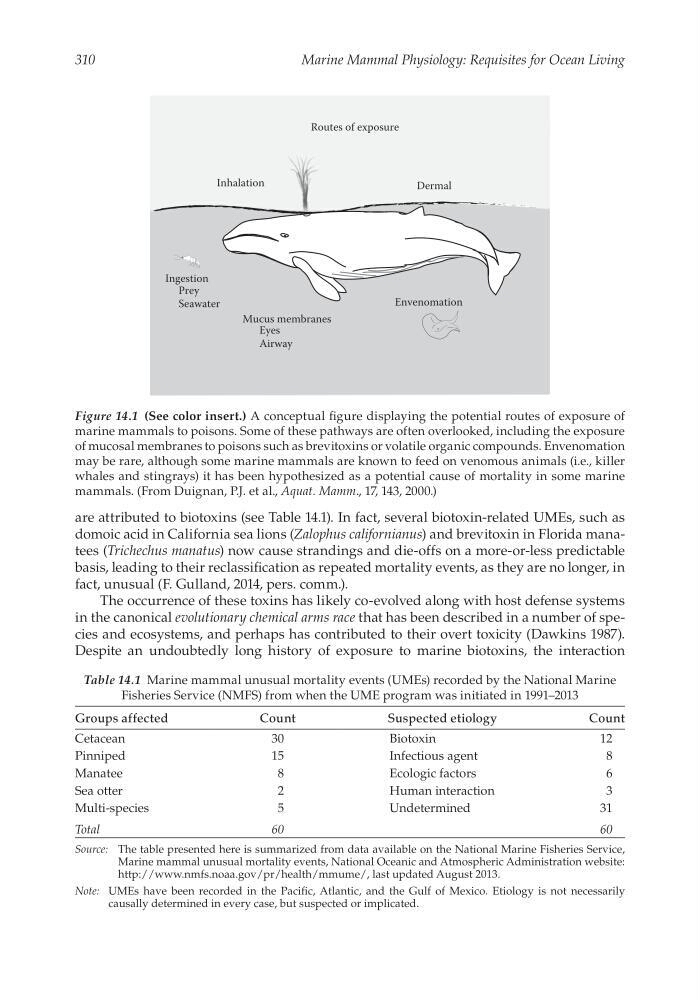
Ingestion
Prey
Seawater
Inhalation
Envenomation
Mucus membranes
Eyes
Airway
Routes of exposure
Dermal
Figure 14.1 (See color insert.) A conceptual figure displaying the potential routes of exposure of
marine mammals to poisons. Some of these pathways are often overlooked, including the exposure
of mucosal membranes to poisons such as brevitoxins or volatile organic compounds. Envenomation
may be rare, although some marine mammals are known to feed on venomous animals (i.e., killer
whales and stingrays) it has been hypothesized as a potential cause of mortality in some marine
mammals. (From Duignan, P.J. et al., Aquat. Mamm., 17, 143, 2000.)
Table 14.1 Marine mammal unusual mortality events (UMEs) recorded by the National Marine
Fisheries Service (NMFS) from when the UME program was initiated in 1991–2013
Groups affected
Count
Suspected etiology
Count
Cetacean
30
Biotoxin
12
Pinniped
15
Infectious agent
8
Manatee
8
Ecologic factors
6
Sea otter
2
Human interaction
3
Multi-species
5
Undetermined
31
Total
60
60
Source: The table presented here is summarized from data available on the National Marine Fisheries Service,
Marine mammal unusual mortality events, National Oceanic and Atmospheric Administration website:
http://www.nmfs.noaa.gov/pr/health/mmume/, last updated August 2013.
Note: UMEs have been recorded in the Pacific, Atlantic, and the Gulf of Mexico. Etiology is not necessarily
causally determined in every case, but suspected or implicated.
Marine Mammal Physiology: Requisites for Ocean Living
are attributed to biotoxins (see Table 14.1). In fact, several biotoxin-related UMEs, such as
domoic acid in California sea lions (Zalophus californianus) and brevitoxin in Florida manatees (Trichechus manatus) now cause strandings and die-offs on a more-or-less predictable
basis, leading to their reclassification as repeated mortality events, as they are no longer, in
fact, unusual (F. Gulland, 2014, pers. comm.).
The occurrence of these toxins has likely co-evolved along with host defense systems
in the canonical evolutionary chemical arms race that has been described in a number of species and ecosystems, and perhaps has contributed to their overt toxicity (Dawkins 1987).
Despite an undoubtedly long history of exposure to marine biotoxins, the interaction
Ingestion
Prey
Seawater
Inhalation
Envenomation
Mucus membranes
Eyes
Airway
Routes of exposure
Dermal
Figure 14.1 (See color insert.) A conceptual figure displaying the potential routes of exposure of
marine mammals to poisons. Some of these pathways are often overlooked, including the exposure
of mucosal membranes to poisons such as brevitoxins or volatile organic compounds. Envenomation
may be rare, although some marine mammals are known to feed on venomous animals (i.e., killer
whales and stingrays) it has been hypothesized as a potential cause of mortality in some marine
mammals. (From Duignan, P.J. et al., Aquat. Mamm., 17, 143, 2000.)
Table 14.1 Marine mammal unusual mortality events (UMEs) recorded by the National Marine
Fisheries Service (NMFS) from when the UME program was initiated in 1991–2013
Groups affected
Count
Suspected etiology
Count
Cetacean
30
Biotoxin
12
Pinniped
15
Infectious agent
8
Manatee
8
Ecologic factors
6
Sea otter
2
Human interaction
3
Multi-species
5
Undetermined
31
Total
60
60
Source: The table presented here is summarized from data available on the National Marine Fisheries Service,
Marine mammal unusual mortality events, National Oceanic and Atmospheric Administration website:
http://www.nmfs.noaa.gov/pr/health/mmume/, last updated August 2013.
Note: UMEs have been recorded in the Pacific, Atlantic, and the Gulf of Mexico. Etiology is not necessarily
causally determined in every case, but suspected or implicated.