

280
Marine Mammal Physiology: Requisites for Ocean Living
sea lion (Dehnhardt 1990, 1994; Dehnhardt and Dücker 1996), and the manatee (Trichechus
manatus latirostris; Bachteler and Dehnhardt 1999; Bauer et al. 2012) revealed that these
animals are able to discriminate objects on the basis of their form, texture or size only by
means of their vibrissae. Harbor seals can perform discriminations of size and texture
equivalent to the other marine mammals, and their vibrissal system functions in air and
underwater with the same precision and irrespective of ambient temperature (Dehnhardt
and Kaminski 1995; Dehnhardt et al. 1997, 1998; Grant et al. 2013). Altogether these studies
reveal abilities in marine mammals that compare to, for example, the tactile abilities of
terrestrial species.
As movement between the touch organ and the inspected object is characteristic for
any active touch process, pinnipeds usually perform head movements in order to judge
object parameters while their vibrissae are protruded to the most frontal position but
remain motionless (Dehnhardt 1994). The vibrissae of harbor seals also take this frontal and motionless position during hydrodynamic trail-following (Hanke et al. 2010).
This surprises as hydrodynamic vortices should shed from the vibrissae thus leading to
vibrations. However, measurements with particle image velocimetry (see Section 12.3.3)
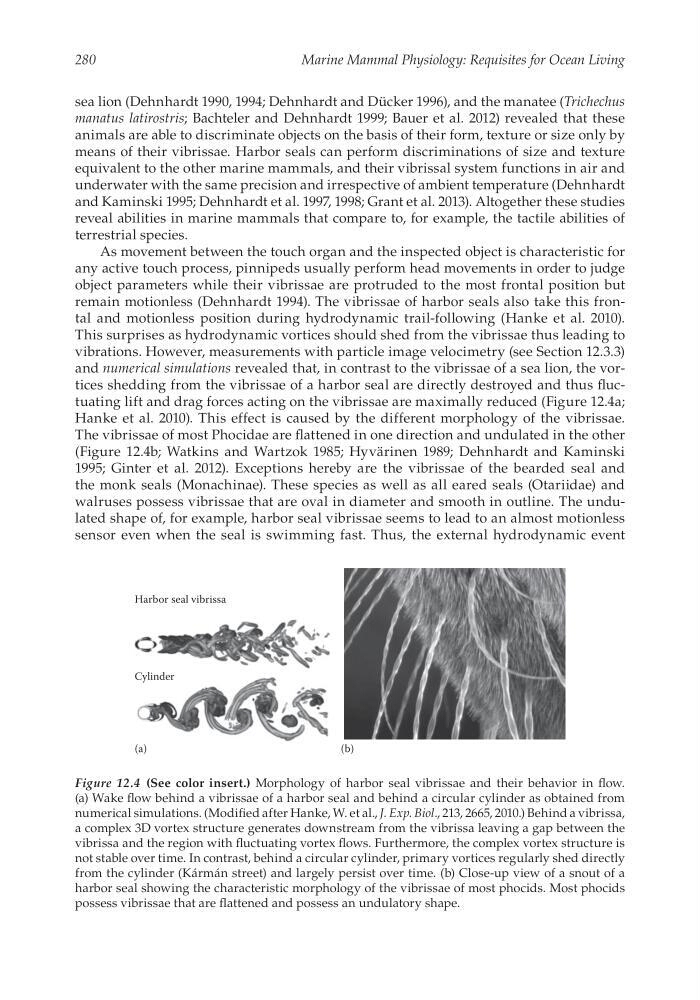
and numerical simulations revealed that, in contrast to the vibrissae of a sea lion, the vortices shedding from the vibrissae of a harbor seal are directly destroyed and thus fluctuating lift and drag forces acting on the vibrissae are maximally reduced (Figure 12.4a;
Hanke et al. 2010). This effect is caused by the different morphology of the vibrissae.
The vibrissae of most Phocidae are flattened in one direction and undulated in the other
(Figure 12.4b; Watkins and Wartzok 1985; Hyvärinen 1989; Dehnhardt and Kaminski
1995; Ginter et al. 2012). Exceptions hereby are the vibrissae of the bearded seal and
the monk seals (Monachinae). These species as well as all eared seals (Otariidae) and
walruses possess vibrissae that are oval in diameter and smooth in outline. The undulated shape of, for example, harbor seal vibrissae seems to lead to an almost motionless
sensor even when the seal is swimming fast. Thus, the external hydrodynamic event
(b)
Harbor seal vibrissa
(a)
Cylinder
Figure 12.4 (See color insert.) Morphology of harbor seal vibrissae and their behavior in flow.
(a) Wake flow behind a vibrissae of a harbor seal and behind a circular cylinder as obtained from
numerical simulations. (Modified after Hanke, W. et al., J. Exp. Biol., 213, 2665, 2010.) Behind a vibrissa,
a complex 3D vortex structure generates downstream from the vibrissa leaving a gap between the
vibrissa and the region with fluctuating vortex flows. Furthermore, the complex vortex structure is
not stable over time. In contrast, behind a circular cylinder, primary vortices regularly shed directly
from the cylinder (Kármán street) and largely persist over time. (b) Close-up view of a snout of a
harbor seal showing the characteristic morphology of the vibrissae of most phocids. Most phocids
possess vibrissae that are flattened and possess an undulatory shape.
Marine Mammal Physiology: Requisites for Ocean Living
sea lion (Dehnhardt 1990, 1994; Dehnhardt and Dücker 1996), and the manatee (Trichechus
manatus latirostris; Bachteler and Dehnhardt 1999; Bauer et al. 2012) revealed that these
animals are able to discriminate objects on the basis of their form, texture or size only by
means of their vibrissae. Harbor seals can perform discriminations of size and texture
equivalent to the other marine mammals, and their vibrissal system functions in air and
underwater with the same precision and irrespective of ambient temperature (Dehnhardt
and Kaminski 1995; Dehnhardt et al. 1997, 1998; Grant et al. 2013). Altogether these studies
reveal abilities in marine mammals that compare to, for example, the tactile abilities of
terrestrial species.
As movement between the touch organ and the inspected object is characteristic for
any active touch process, pinnipeds usually perform head movements in order to judge
object parameters while their vibrissae are protruded to the most frontal position but
remain motionless (Dehnhardt 1994). The vibrissae of harbor seals also take this frontal and motionless position during hydrodynamic trail-following (Hanke et al. 2010).
This surprises as hydrodynamic vortices should shed from the vibrissae thus leading to
vibrations. However, measurements with particle image velocimetry (see Section 12.3.3)
and numerical simulations revealed that, in contrast to the vibrissae of a sea lion, the vortices shedding from the vibrissae of a harbor seal are directly destroyed and thus fluctuating lift and drag forces acting on the vibrissae are maximally reduced (Figure 12.4a;
Hanke et al. 2010). This effect is caused by the different morphology of the vibrissae.
The vibrissae of most Phocidae are flattened in one direction and undulated in the other
(Figure 12.4b; Watkins and Wartzok 1985; Hyvärinen 1989; Dehnhardt and Kaminski
1995; Ginter et al. 2012). Exceptions hereby are the vibrissae of the bearded seal and
the monk seals (Monachinae). These species as well as all eared seals (Otariidae) and
walruses possess vibrissae that are oval in diameter and smooth in outline. The undulated shape of, for example, harbor seal vibrissae seems to lead to an almost motionless
sensor even when the seal is swimming fast. Thus, the external hydrodynamic event
(b)
Harbor seal vibrissa
(a)
Cylinder
Figure 12.4 (See color insert.) Morphology of harbor seal vibrissae and their behavior in flow.
(a) Wake flow behind a vibrissae of a harbor seal and behind a circular cylinder as obtained from
numerical simulations. (Modified after Hanke, W. et al., J. Exp. Biol., 213, 2665, 2010.) Behind a vibrissa,
a complex 3D vortex structure generates downstream from the vibrissa leaving a gap between the
vibrissa and the region with fluctuating vortex flows. Furthermore, the complex vortex structure is
not stable over time. In contrast, behind a circular cylinder, primary vortices regularly shed directly
from the cylinder (Kármán street) and largely persist over time. (b) Close-up view of a snout of a
harbor seal showing the characteristic morphology of the vibrissae of most phocids. Most phocids
possess vibrissae that are flattened and possess an undulatory shape.