

9
Chapter one: Hydrodynamics
significant friction drag. Moreover, pressure drag is not eliminated by extreme fineness since the boundary layer—and hence the turbulent wake—would also increase.
In order to achieve minimum total body drag, rather than just pressure or friction
drag, body fineness is limited to a range of 5.5–7.2, depending on body mass (in the
10 3 –10 5 kg range) (Ahlborn et al. 2009).
1.2.4 Lift and propulsion
As further explored in the next section, paddling involves using pressure drag as a means
to generate propulsion. This is a low-speed approach to swimming, however, which can
only work for travel over relatively short distances. For long-range swimmers, thrust is
generated more efficiently using flippers and flukes that act as lift-producing hydrofoils.
These hydrodynamic lifting surfaces generate propulsion when oscillated or raised and
lowered in rhythmic fashion orthogonal to direction of transport. More specifically, thrust
is produced via the combination of the lift and drag forces that the hydrofoils produce.
While drag always points in a direction opposite to the body or appendage in motion, lift
is directed perpendicularly to that motion. Using a simplistic description, the lift generated by a wing or hydrofoil arises from the combination of the low-pressure region existing over the upper surface of the wing, in comparison to the higher pressure under the
wing. This is the so-called “Bernoulli lift,” created when the flow over the wing is faster
than the flow underneath. But lift is also the result of the downward deflection of the air
(or water) imparted by both the vacuum over the upper surface and the deflecting action of
the solid bottom surface (Figure 1.4a).
Aircraft wings typically have upper surfaces that are more cambered (curved) than
the lower surface because one needs upward-directed lift to compensate for the aircraft’s
weight. Flippers and flukes, on the other hand, have near-equal camber on both surfaces
Larger friction drag, but with reduced pressure drag
(c)
Friction drag larger than pressure drag
(b)
Pressure drag larger than friction drag
(a)
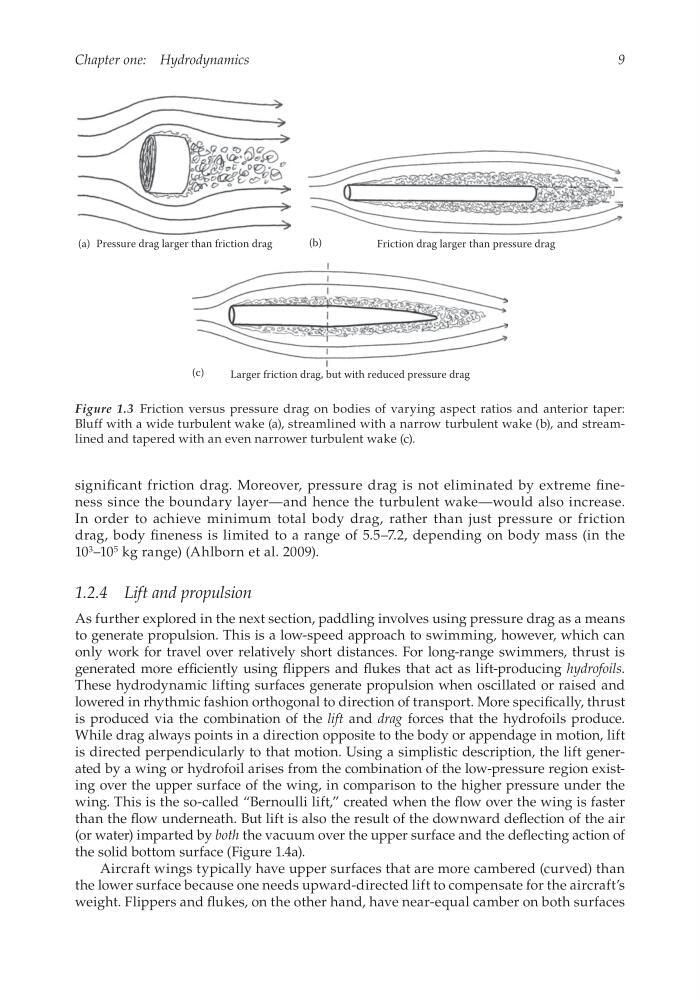
Figure 1.3 Friction versus pressure drag on bodies of varying aspect ratios and anterior taper:
Bluff with a wide turbulent wake (a), streamlined with a narrow turbulent wake (b), and streamlined and tapered with an even narrower turbulent wake (c).
Chapter one: Hydrodynamics
significant friction drag. Moreover, pressure drag is not eliminated by extreme fineness since the boundary layer—and hence the turbulent wake—would also increase.
In order to achieve minimum total body drag, rather than just pressure or friction
drag, body fineness is limited to a range of 5.5–7.2, depending on body mass (in the
10 3 –10 5 kg range) (Ahlborn et al. 2009).
1.2.4 Lift and propulsion
As further explored in the next section, paddling involves using pressure drag as a means
to generate propulsion. This is a low-speed approach to swimming, however, which can
only work for travel over relatively short distances. For long-range swimmers, thrust is
generated more efficiently using flippers and flukes that act as lift-producing hydrofoils.
These hydrodynamic lifting surfaces generate propulsion when oscillated or raised and
lowered in rhythmic fashion orthogonal to direction of transport. More specifically, thrust
is produced via the combination of the lift and drag forces that the hydrofoils produce.
While drag always points in a direction opposite to the body or appendage in motion, lift
is directed perpendicularly to that motion. Using a simplistic description, the lift generated by a wing or hydrofoil arises from the combination of the low-pressure region existing over the upper surface of the wing, in comparison to the higher pressure under the
wing. This is the so-called “Bernoulli lift,” created when the flow over the wing is faster
than the flow underneath. But lift is also the result of the downward deflection of the air
(or water) imparted by both the vacuum over the upper surface and the deflecting action of
the solid bottom surface (Figure 1.4a).
Aircraft wings typically have upper surfaces that are more cambered (curved) than
the lower surface because one needs upward-directed lift to compensate for the aircraft’s
weight. Flippers and flukes, on the other hand, have near-equal camber on both surfaces
Larger friction drag, but with reduced pressure drag
(c)
Friction drag larger than pressure drag
(b)
Pressure drag larger than friction drag
(a)
Figure 1.3 Friction versus pressure drag on bodies of varying aspect ratios and anterior taper:
Bluff with a wide turbulent wake (a), streamlined with a narrow turbulent wake (b), and streamlined and tapered with an even narrower turbulent wake (c).