

278
Marine Mammal Physiology: Requisites for Ocean Living
This coherence threshold is comparable to most other terrestrial species tested so far
(see for example, Bischof et al. 1999; Douglas et al. 2006). It remains to be determined if,
with training, harbor seals could also achieve higher motion sensitivity under the second
experimental conditions. Nevertheless, the suite of experiments showed that harbor seals
can achieve motion sensitivity at least as high as most vertebrates. Moreover, they seem
to possess a global motion integration system which means that they can integrate local
motion events such as the motion of single dots into a global percept. Global motion stimuli are most likely ecologically relevant to harbor seals. In the context of foraging, harbor
seals could benefit from a global motion integration system and sensitivity to coherent
motion when hunting pelagic as well as benthic fish. When hunting pelagic fish, such as
a school of herring, sensitivity to coherent global motion would enable the seals to assess
the motion direction of a school or the opposite to assess fish moving in a deviant manner that, consequently, might be easy prey objects. Furthermore, when hunting benthic
fish such as flatfish, harbor seals could identify the cryptically hiding fish by the coherent
movement of their body parts (Lui et al. 2012).
(a)
0
2
4
6
8
10
Time (s)
(b)
1 mm
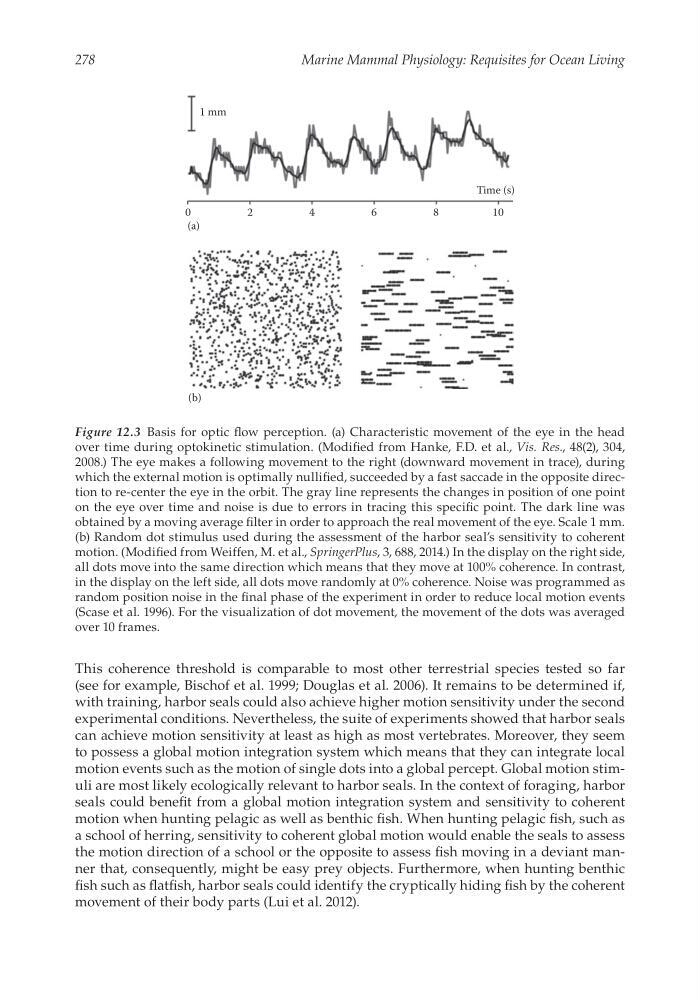
Figure 12.3 Basis for optic flow perception. (a) Characteristic movement of the eye in the head
over time during optokinetic stimulation. (Modified from Hanke, F.D. et al., Vis. Res., 48(2), 304,
2008.) The eye makes a following movement to the right (downward movement in trace), during
which the external motion is optimally nullified, succeeded by a fast saccade in the opposite direction to re-center the eye in the orbit. The gray line represents the changes in position of one point
on the eye over time and noise is due to errors in tracing this specific point. The dark line was
obtained by a moving average filter in order to approach the real movement of the eye. Scale 1 mm.
(b) Random dot stimulus used during the assessment of the harbor seal’s sensitivity to coherent
motion. (Modified from Weiffen, M. et al., SpringerPlus, 3, 688, 2014.) In the display on the right side,
all dots move into the same direction which means that they move at 100% coherence. In contrast,
in the display on the left side, all dots move randomly at 0% coherence. Noise was programmed as
random position noise in the final phase of the experiment in order to reduce local motion events
(Scase et al. 1996). For the visualization of dot movement, the movement of the dots was averaged
over 10 frames.
Marine Mammal Physiology: Requisites for Ocean Living
This coherence threshold is comparable to most other terrestrial species tested so far
(see for example, Bischof et al. 1999; Douglas et al. 2006). It remains to be determined if,
with training, harbor seals could also achieve higher motion sensitivity under the second
experimental conditions. Nevertheless, the suite of experiments showed that harbor seals
can achieve motion sensitivity at least as high as most vertebrates. Moreover, they seem
to possess a global motion integration system which means that they can integrate local
motion events such as the motion of single dots into a global percept. Global motion stimuli are most likely ecologically relevant to harbor seals. In the context of foraging, harbor
seals could benefit from a global motion integration system and sensitivity to coherent
motion when hunting pelagic as well as benthic fish. When hunting pelagic fish, such as
a school of herring, sensitivity to coherent global motion would enable the seals to assess
the motion direction of a school or the opposite to assess fish moving in a deviant manner that, consequently, might be easy prey objects. Furthermore, when hunting benthic
fish such as flatfish, harbor seals could identify the cryptically hiding fish by the coherent
movement of their body parts (Lui et al. 2012).
(a)
0
2
4
6
8
10
Time (s)
(b)
1 mm
Figure 12.3 Basis for optic flow perception. (a) Characteristic movement of the eye in the head
over time during optokinetic stimulation. (Modified from Hanke, F.D. et al., Vis. Res., 48(2), 304,
2008.) The eye makes a following movement to the right (downward movement in trace), during
which the external motion is optimally nullified, succeeded by a fast saccade in the opposite direction to re-center the eye in the orbit. The gray line represents the changes in position of one point
on the eye over time and noise is due to errors in tracing this specific point. The dark line was
obtained by a moving average filter in order to approach the real movement of the eye. Scale 1 mm.
(b) Random dot stimulus used during the assessment of the harbor seal’s sensitivity to coherent
motion. (Modified from Weiffen, M. et al., SpringerPlus, 3, 688, 2014.) In the display on the right side,
all dots move into the same direction which means that they move at 100% coherence. In contrast,
in the display on the left side, all dots move randomly at 0% coherence. Noise was programmed as
random position noise in the final phase of the experiment in order to reduce local motion events
(Scase et al. 1996). For the visualization of dot movement, the movement of the dots was averaged
over 10 frames.