

7
Chapter one: Hydrodynamics
drag generated by the fuselage. This is because very large wings are required to generate
enough lift to support the heavy payload. Because marine mammals are close to neutral
buoyancy, they do not require as much lift to “fly” above the seafloor. Thus, marine mammal
lifting surfaces are much smaller in relation to the rest of the body relative to aircraft, but they
are still important for generating forces to effect rolls, turns, or propulsive forces.
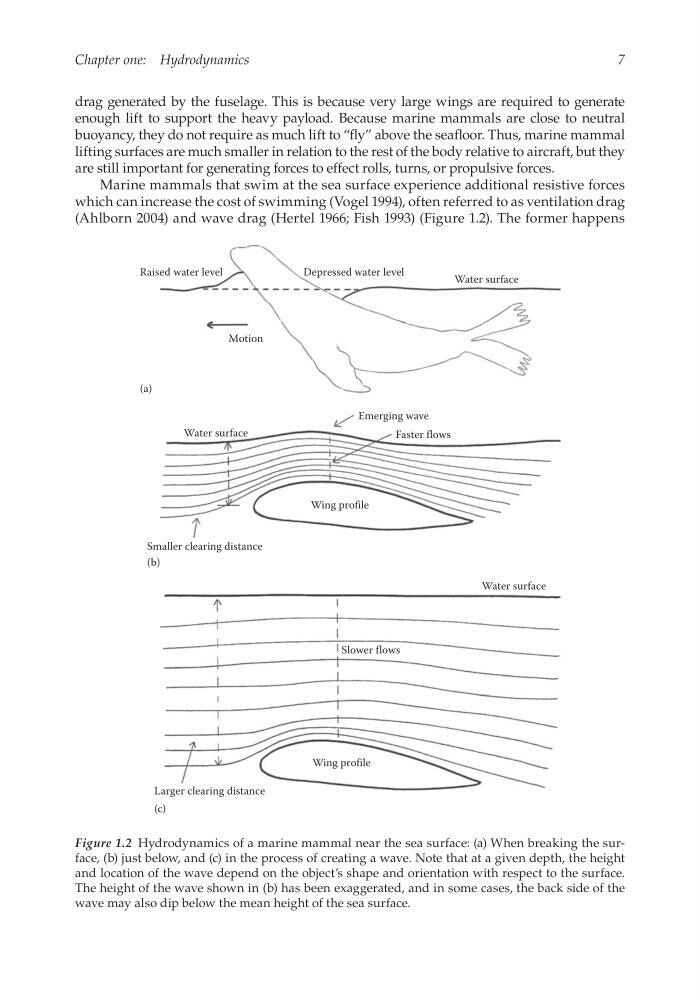
Marine mammals that swim at the sea surface experience additional resistive forces
which can increase the cost of swimming (Vogel 1994), often referred to as ventilation drag
(Ahlborn 2004) and wave drag (Hertel 1966; Fish 1993) (Figure 1.2). The former happens
Water surface
Slower flows
Wing profile
Larger clearing distance
(c)
Motion
Water surface
Depressed water level
Raised water level
(a)
Wing profile
Faster flows
Emerging wave
Water surface
Smaller clearing distance
(b)
Figure 1.2 Hydrodynamics of a marine mammal near the sea surface: (a) When breaking the surface, (b) just below, and (c) in the process of creating a wave. Note that at a given depth, the height
and location of the wave depend on the object’s shape and orientation with respect to the surface.
The height of the wave shown in (b) has been exaggerated, and in some cases, the back side of the
wave may also dip below the mean height of the sea surface.
Chapter one: Hydrodynamics
drag generated by the fuselage. This is because very large wings are required to generate
enough lift to support the heavy payload. Because marine mammals are close to neutral
buoyancy, they do not require as much lift to “fly” above the seafloor. Thus, marine mammal
lifting surfaces are much smaller in relation to the rest of the body relative to aircraft, but they
are still important for generating forces to effect rolls, turns, or propulsive forces.
Marine mammals that swim at the sea surface experience additional resistive forces
which can increase the cost of swimming (Vogel 1994), often referred to as ventilation drag
(Ahlborn 2004) and wave drag (Hertel 1966; Fish 1993) (Figure 1.2). The former happens
Water surface
Slower flows
Wing profile
Larger clearing distance
(c)
Motion
Water surface
Depressed water level
Raised water level
(a)
Wing profile
Faster flows
Emerging wave
Water surface
Smaller clearing distance
(b)
Figure 1.2 Hydrodynamics of a marine mammal near the sea surface: (a) When breaking the surface, (b) just below, and (c) in the process of creating a wave. Note that at a given depth, the height
and location of the wave depend on the object’s shape and orientation with respect to the surface.
The height of the wave shown in (b) has been exaggerated, and in some cases, the back side of the
wave may also dip below the mean height of the sea surface.