

249
Chapter eleven: Acoustics
was used to argue that the motion of the bulla relative to the ossicular chain was the
mechanism by which compressional waves were made within the cochlear fluids, not the
action of the stapes on the oval window as would be caused by activation of the ossciular
chain via motion of the tympanic membrane (McCormick et al. 1980). However, it has also
been argued that the tympanum likely maintains the role of activating the ossicular chain,
regardless of the tissue path to the tympanum as is observed in other mammals (Fleischer
1978). Little has changed in this debate, and it remains uncertain as to how sound is translated into compressional waves within the cochlear fluid.
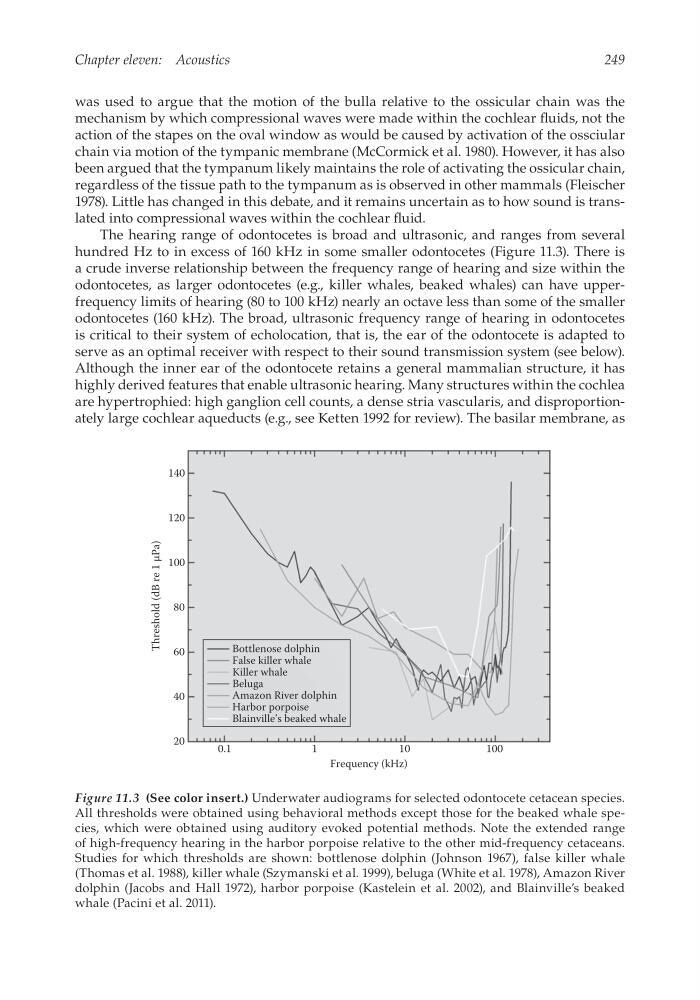
The hearing range of odontocetes is broad and ultrasonic, and ranges from several
hundred Hz to in excess of 160 kHz in some smaller odontocetes (Figure 11.3). There is
a crude inverse relationship between the frequency range of hearing and size within the
odontocetes, as larger odontocetes (e.g., killer whales, beaked whales) can have upperfrequency limits of hearing (80 to 100 kHz) nearly an octave less than some of the smaller
odontocetes (160 kHz). The broad, ultrasonic frequency range of hearing in odontocetes
is critical to their system of echolocation, that is, the ear of the odontocete is adapted to
serve as an optimal receiver with respect to their sound transmission system (see below).
Although the inner ear of the odontocete retains a general mammalian structure, it has
highly derived features that enable ultrasonic hearing. Many structures within the cochlea
are hypertrophied: high ganglion cell counts, a dense stria vascularis, and disproportionately large cochlear aqueducts (e.g., see Ketten 1992 for review). The basilar membrane, as
0.1
Bottlenose dolphin
Threshold (dB re 1 µPa)
False killer whale
Killer whale
Beluga
Amazon River dolphin
Harbor porpoise
Blainville’s beaked whale
20
40
60
80
100
120
140
1
Frequency (kHz)
10
100
Figure 11.3 (See color insert.) Underwater audiograms for selected odontocete cetacean species.
All thresholds were obtained using behavioral methods except those for the beaked whale species, which were obtained using auditory evoked potential methods. Note the extended range
of high-frequency hearing in the harbor porpoise relative to the other mid-frequency cetaceans.
Studies for which thresholds are shown: bottlenose dolphin (Johnson 1967), false killer whale
(Thomas et al. 1988), killer whale (Szymanski et al. 1999), beluga (White et al. 1978), Amazon River
dolphin (Jacobs and Hall 1972), harbor porpoise (Kastelein et al. 2002), and Blainville’s beaked
whale (Pacini et al. 2011).
Chapter eleven: Acoustics
was used to argue that the motion of the bulla relative to the ossicular chain was the
mechanism by which compressional waves were made within the cochlear fluids, not the
action of the stapes on the oval window as would be caused by activation of the ossciular
chain via motion of the tympanic membrane (McCormick et al. 1980). However, it has also
been argued that the tympanum likely maintains the role of activating the ossicular chain,
regardless of the tissue path to the tympanum as is observed in other mammals (Fleischer
1978). Little has changed in this debate, and it remains uncertain as to how sound is translated into compressional waves within the cochlear fluid.
The hearing range of odontocetes is broad and ultrasonic, and ranges from several
hundred Hz to in excess of 160 kHz in some smaller odontocetes (Figure 11.3). There is
a crude inverse relationship between the frequency range of hearing and size within the
odontocetes, as larger odontocetes (e.g., killer whales, beaked whales) can have upperfrequency limits of hearing (80 to 100 kHz) nearly an octave less than some of the smaller
odontocetes (160 kHz). The broad, ultrasonic frequency range of hearing in odontocetes
is critical to their system of echolocation, that is, the ear of the odontocete is adapted to
serve as an optimal receiver with respect to their sound transmission system (see below).
Although the inner ear of the odontocete retains a general mammalian structure, it has
highly derived features that enable ultrasonic hearing. Many structures within the cochlea
are hypertrophied: high ganglion cell counts, a dense stria vascularis, and disproportionately large cochlear aqueducts (e.g., see Ketten 1992 for review). The basilar membrane, as
0.1
Bottlenose dolphin
Threshold (dB re 1 µPa)
False killer whale
Killer whale
Beluga
Amazon River dolphin
Harbor porpoise
Blainville’s beaked whale
20
40
60
80
100
120
140
1
Frequency (kHz)
10
100
Figure 11.3 (See color insert.) Underwater audiograms for selected odontocete cetacean species.
All thresholds were obtained using behavioral methods except those for the beaked whale species, which were obtained using auditory evoked potential methods. Note the extended range
of high-frequency hearing in the harbor porpoise relative to the other mid-frequency cetaceans.
Studies for which thresholds are shown: bottlenose dolphin (Johnson 1967), false killer whale
(Thomas et al. 1988), killer whale (Szymanski et al. 1999), beluga (White et al. 1978), Amazon River
dolphin (Jacobs and Hall 1972), harbor porpoise (Kastelein et al. 2002), and Blainville’s beaked
whale (Pacini et al. 2011).