

235
Chapter ten: Post-partum
The total energy content can be estimated using standard values for the energy density of
lipid and protein. Alternatively, if the primary question is the energy content of milk, gross
energy content can be determined with high precision using bomb calorimetry of the dry
material and water content data.
Milk intake can be measured using labeled water techniques if one assumes that the
only influx of water is from MWP and milk intake (Oftedal and Iverson 1987). Because of
this assumption, this method is only appropriate when offspring are solely dependent on
milk. Milk consumption rates are calculated using the water influx rates (calculated from
the decline in labeled H as described above), milk water content, and MWP, ideally derived
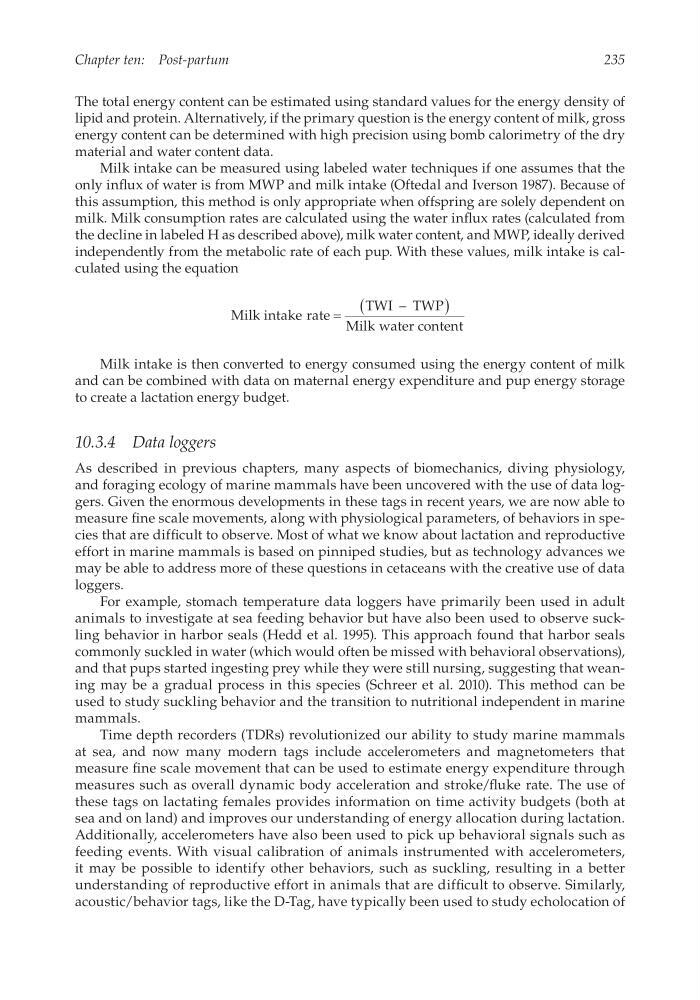
independently from the metabolic rate of each pup. With these values, milk intake is calculated using the equation
Milk intake rate
TWI TWP
Milk water content
=
(
)
–
Milk intake is then converted to energy consumed using the energy content of milk
and can be combined with data on maternal energy expenditure and pup energy storage
to create a lactation energy budget.
10.3.4 Data loggers
As described in previous chapters, many aspects of biomechanics, diving physiology,
and foraging ecology of marine mammals have been uncovered with the use of data loggers. Given the enormous developments in these tags in recent years, we are now able to
measure fine scale movements, along with physiological parameters, of behaviors in species that are difficult to observe. Most of what we know about lactation and reproductive
effort in marine mammals is based on pinniped studies, but as technology advances we
may be able to address more of these questions in cetaceans with the creative use of data
loggers.
For example, stomach temperature data loggers have primarily been used in adult
animals to investigate at sea feeding behavior but have also been used to observe suckling behavior in harbor seals (Hedd et al. 1995). This approach found that harbor seals
commonly suckled in water (which would often be missed with behavioral observations),
and that pups started ingesting prey while they were still nursing, suggesting that weaning may be a gradual process in this species (Schreer et al. 2010). This method can be
used to study suckling behavior and the transition to nutritional independent in marine
mammals.
Time depth recorders (TDRs) revolutionized our ability to study marine mammals
at sea, and now many modern tags include accelerometers and magnetometers that
measure fine scale movement that can be used to estimate energy expenditure through
measures such as overall dynamic body acceleration and stroke/fluke rate. The use of
these tags on lactating females provides information on time activity budgets (both at
sea and on land) and improves our understanding of energy allocation during lactation.
Additionally, accelerometers have also been used to pick up behavioral signals such as
feeding events. With visual calibration of animals instrumented with accelerometers,
it may be possible to identify other behaviors, such as suckling, resulting in a better
understanding of reproductive effort in animals that are difficult to observe. Similarly,
acoustic/behavior tags, like the D-Tag, have typically been used to study echolocation of
Chapter ten: Post-partum
The total energy content can be estimated using standard values for the energy density of
lipid and protein. Alternatively, if the primary question is the energy content of milk, gross
energy content can be determined with high precision using bomb calorimetry of the dry
material and water content data.
Milk intake can be measured using labeled water techniques if one assumes that the
only influx of water is from MWP and milk intake (Oftedal and Iverson 1987). Because of
this assumption, this method is only appropriate when offspring are solely dependent on
milk. Milk consumption rates are calculated using the water influx rates (calculated from
the decline in labeled H as described above), milk water content, and MWP, ideally derived
independently from the metabolic rate of each pup. With these values, milk intake is calculated using the equation
Milk intake rate
TWI TWP
Milk water content
=
(
)
–
Milk intake is then converted to energy consumed using the energy content of milk
and can be combined with data on maternal energy expenditure and pup energy storage
to create a lactation energy budget.
10.3.4 Data loggers
As described in previous chapters, many aspects of biomechanics, diving physiology,
and foraging ecology of marine mammals have been uncovered with the use of data loggers. Given the enormous developments in these tags in recent years, we are now able to
measure fine scale movements, along with physiological parameters, of behaviors in species that are difficult to observe. Most of what we know about lactation and reproductive
effort in marine mammals is based on pinniped studies, but as technology advances we
may be able to address more of these questions in cetaceans with the creative use of data
loggers.
For example, stomach temperature data loggers have primarily been used in adult
animals to investigate at sea feeding behavior but have also been used to observe suckling behavior in harbor seals (Hedd et al. 1995). This approach found that harbor seals
commonly suckled in water (which would often be missed with behavioral observations),
and that pups started ingesting prey while they were still nursing, suggesting that weaning may be a gradual process in this species (Schreer et al. 2010). This method can be
used to study suckling behavior and the transition to nutritional independent in marine
mammals.
Time depth recorders (TDRs) revolutionized our ability to study marine mammals
at sea, and now many modern tags include accelerometers and magnetometers that
measure fine scale movement that can be used to estimate energy expenditure through
measures such as overall dynamic body acceleration and stroke/fluke rate. The use of
these tags on lactating females provides information on time activity budgets (both at
sea and on land) and improves our understanding of energy allocation during lactation.
Additionally, accelerometers have also been used to pick up behavioral signals such as
feeding events. With visual calibration of animals instrumented with accelerometers,
it may be possible to identify other behaviors, such as suckling, resulting in a better
understanding of reproductive effort in animals that are difficult to observe. Similarly,
acoustic/behavior tags, like the D-Tag, have typically been used to study echolocation of