

230
Marine Mammal Physiology: Requisites for Ocean Living
may also reflect a mammary gland that is highly adapted for pinniped lactation systems.
Lactose is an important determinant of milk water content as it is unable to diffuse through
the mammary cell membrane and draws water into the mammary alveoli by osmosis. Low
lactose levels are associated with the ability to concentrate milk solids, facilitating the high
lipid and protein content of the milk. Thus, low lactose levels may help promote the high
fat and protein contents in pinniped milk.
The low lactose levels may also be a result of a mutation in the alpha-lactalbumin gene
(LALBA) that normally encodes a protein that plays an important role in lactose synthesis.
Mutations in the LALBA gene may help preserve mammary gland functionality during
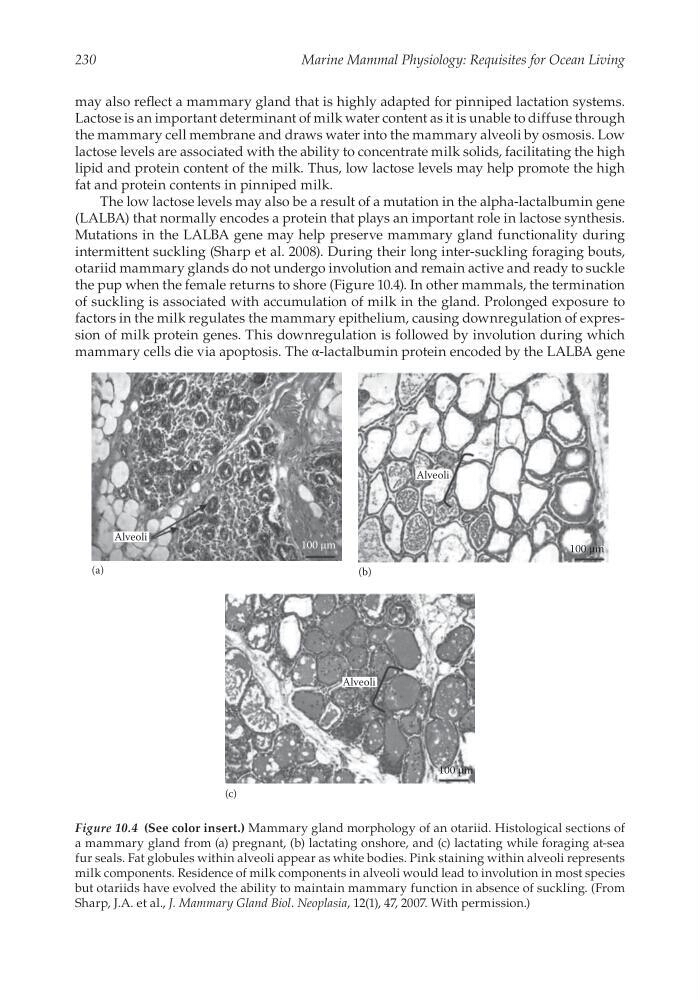
intermittent suckling (Sharp et al. 2008). During their long inter-suckling foraging bouts,
otariid mammary glands do not undergo involution and remain active and ready to suckle
the pup when the female returns to shore (Figure 10.4). In other mammals, the termination
of suckling is associated with accumulation of milk in the gland. Prolonged exposure to
factors in the milk regulates the mammary epithelium, causing downregulation of expression of milk protein genes. This downregulation is followed by involution during which
mammary cells die via apoptosis. The α-lactalbumin protein encoded by the LALBA gene
(a)
Alveoli
100 µm
100 µm
(b)
Alveoli
100 µm
(c)
Alveoli
Figure 10.4 (See color insert.) Mammary gland morphology of an otariid. Histological sections of
a mammary gland from (a) pregnant, (b) lactating onshore, and (c) lactating while foraging at-sea
fur seals. Fat globules within alveoli appear as white bodies. Pink staining within alveoli represents
milk components. Residence of milk components in alveoli would lead to involution in most species
but otariids have evolved the ability to maintain mammary function in absence of suckling. (From
Sharp, J.A. et al., J. Mammary Gland Biol. Neoplasia, 12(1), 47, 2007. With permission.)
Marine Mammal Physiology: Requisites for Ocean Living
may also reflect a mammary gland that is highly adapted for pinniped lactation systems.
Lactose is an important determinant of milk water content as it is unable to diffuse through
the mammary cell membrane and draws water into the mammary alveoli by osmosis. Low
lactose levels are associated with the ability to concentrate milk solids, facilitating the high
lipid and protein content of the milk. Thus, low lactose levels may help promote the high
fat and protein contents in pinniped milk.
The low lactose levels may also be a result of a mutation in the alpha-lactalbumin gene
(LALBA) that normally encodes a protein that plays an important role in lactose synthesis.
Mutations in the LALBA gene may help preserve mammary gland functionality during
intermittent suckling (Sharp et al. 2008). During their long inter-suckling foraging bouts,
otariid mammary glands do not undergo involution and remain active and ready to suckle
the pup when the female returns to shore (Figure 10.4). In other mammals, the termination
of suckling is associated with accumulation of milk in the gland. Prolonged exposure to
factors in the milk regulates the mammary epithelium, causing downregulation of expression of milk protein genes. This downregulation is followed by involution during which
mammary cells die via apoptosis. The α-lactalbumin protein encoded by the LALBA gene
(a)
Alveoli
100 µm
100 µm
(b)
Alveoli
100 µm
(c)
Alveoli
Figure 10.4 (See color insert.) Mammary gland morphology of an otariid. Histological sections of
a mammary gland from (a) pregnant, (b) lactating onshore, and (c) lactating while foraging at-sea
fur seals. Fat globules within alveoli appear as white bodies. Pink staining within alveoli represents
milk components. Residence of milk components in alveoli would lead to involution in most species
but otariids have evolved the ability to maintain mammary function in absence of suckling. (From
Sharp, J.A. et al., J. Mammary Gland Biol. Neoplasia, 12(1), 47, 2007. With permission.)