

220
Marine Mammal Physiology: Requisites for Ocean Living
demanding component of reproduction and can buffer the transition to independence by providing the offspring with energy stores, or extending the duration of the developmental period.
Marine mammals exhibit a diverse range of lactation strategies that are influenced by size and
environment. Periods of parental investment range widely in marine mammals from 4 days
to several years (Figure 10.2). Cetaceans have evolved a suite of behavioral and anatomical
10
5
10
4
10
3
10 2
10
1
10
0
10
1
10
2
10
3
10
4
10
5
10
6
Maternal mass (kg)
Polar bears
Walrus
Sea otters
Otariids
Phocids
Mysticetes
Odontocetes
Birth mass (kg)
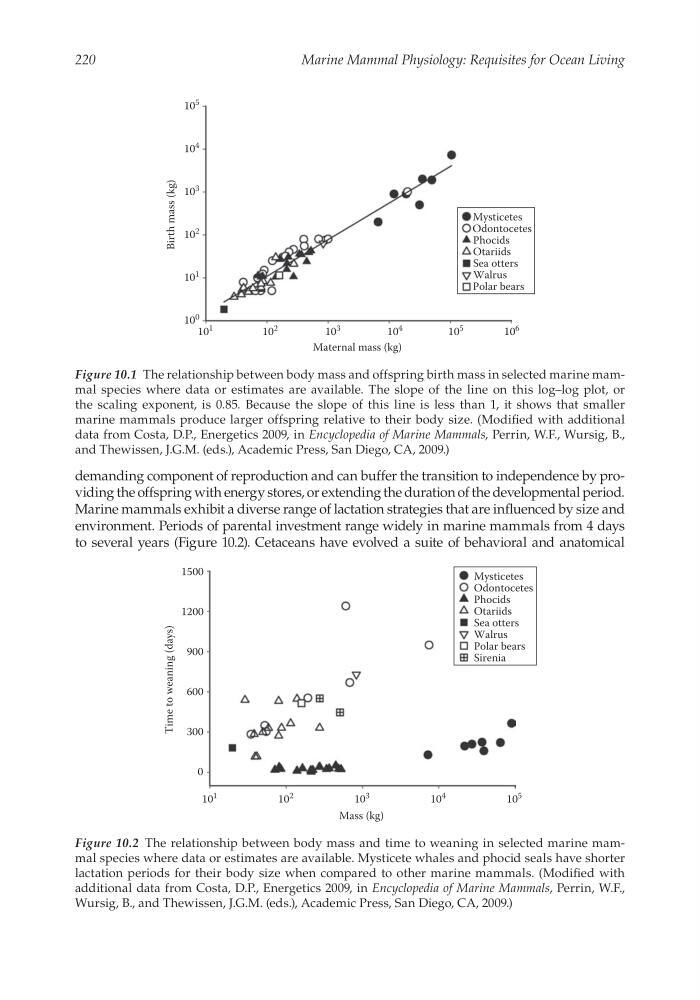
Figure 10.1 The relationship between body mass and offspring birth mass in selected marine mammal species where data or estimates are available. The slope of the line on this log–log plot, or
the scaling exponent, is 0.85. Because the slope of this line is less than 1, it shows that smaller
marine mammals produce larger offspring relative to their body size. (Modified with additional
data from Costa, D.P., Energetics 2009, in Encyclopedia of Marine Mammals, Perrin, W.F., Wursig, B.,
and Thewissen, J.G.M. (eds.), Academic Press, San Diego, CA, 2009.)
1500
1200
900
600
300
0
Time to weaning (days)
Mass (kg)
10
1
10
2
10
3
10
4
10
5
Mysticetes
Sirenia
Odontocetes
Polar bears
Walrus
Sea otters
Otariids
Phocids
Figure 10.2 The relationship between body mass and time to weaning in selected marine mammal species where data or estimates are available. Mysticete whales and phocid seals have shorter
lactation periods for their body size when compared to other marine mammals. (Modified with
additional data from Costa, D.P., Energetics 2009, in Encyclopedia of Marine Mammals, Perrin, W.F.,
Wursig, B., and Thewissen, J.G.M. (eds.), Academic Press, San Diego, CA, 2009.)
Marine Mammal Physiology: Requisites for Ocean Living
demanding component of reproduction and can buffer the transition to independence by providing the offspring with energy stores, or extending the duration of the developmental period.
Marine mammals exhibit a diverse range of lactation strategies that are influenced by size and
environment. Periods of parental investment range widely in marine mammals from 4 days
to several years (Figure 10.2). Cetaceans have evolved a suite of behavioral and anatomical
10
5
10
4
10
3
10 2
10
1
10
0
10
1
10
2
10
3
10
4
10
5
10
6
Maternal mass (kg)
Polar bears
Walrus
Sea otters
Otariids
Phocids
Mysticetes
Odontocetes
Birth mass (kg)
Figure 10.1 The relationship between body mass and offspring birth mass in selected marine mammal species where data or estimates are available. The slope of the line on this log–log plot, or
the scaling exponent, is 0.85. Because the slope of this line is less than 1, it shows that smaller
marine mammals produce larger offspring relative to their body size. (Modified with additional
data from Costa, D.P., Energetics 2009, in Encyclopedia of Marine Mammals, Perrin, W.F., Wursig, B.,
and Thewissen, J.G.M. (eds.), Academic Press, San Diego, CA, 2009.)
1500
1200
900
600
300
0
Time to weaning (days)
Mass (kg)
10
1
10
2
10
3
10
4
10
5
Mysticetes
Sirenia
Odontocetes
Polar bears
Walrus
Sea otters
Otariids
Phocids
Figure 10.2 The relationship between body mass and time to weaning in selected marine mammal species where data or estimates are available. Mysticete whales and phocid seals have shorter
lactation periods for their body size when compared to other marine mammals. (Modified with
additional data from Costa, D.P., Energetics 2009, in Encyclopedia of Marine Mammals, Perrin, W.F.,
Wursig, B., and Thewissen, J.G.M. (eds.), Academic Press, San Diego, CA, 2009.)