

200
Marine Mammal Physiology: Requisites for Ocean Living
Koopman et al. 2002). A seasonality effect leads to thicker blubber tending to be present in
winter months for phocids (Rosen and Renouf 1997; Nilssen et al. 2001), but this effect does
not come into play until adulthood (Pitcher 1986).
Given all of these caveats that can influence blubber content and structure, we can
turn now to its thermal characteristics. As seen in Table 9.1, lipid has a high thermal insulation (low conductivity) capacity and forms an effective insulator against the cold for
marine mammals. Therefore, the entire Fick thermal gradient occurs through the blubber
of the marine mammal, from the warm muscle to the cold skin. The thicker the blubber,
the greater insulation for the cetacean or the pinniped. Blubber can vary from a few mm
in some body regions of the fur seals and seal lions, to over 35 cm in the bowhead. Cold
water pinnipeds in the polar regions, such as the Weddell seal, can carry blubber of 8 cm
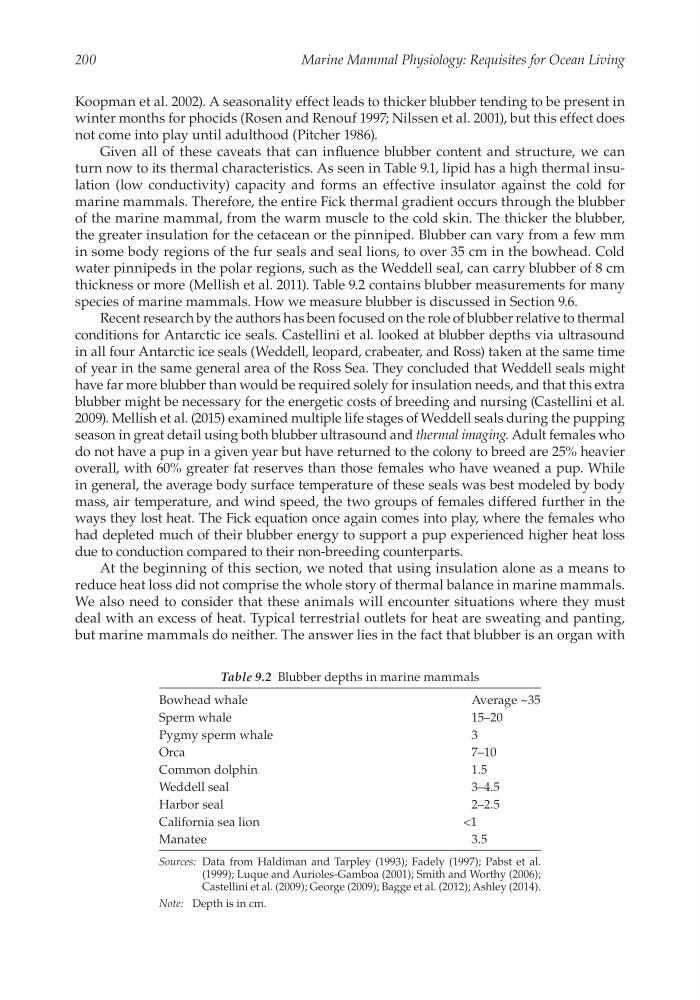
thickness or more (Mellish et al. 2011). Table 9.2 contains blubber measurements for many
species of marine mammals. How we measure blubber is discussed in Section 9.6.
Recent research by the authors has been focused on the role of blubber relative to thermal
conditions for Antarctic ice seals. Castellini et al. looked at blubber depths via ultrasound
in all four Antarctic ice seals (Weddell, leopard, crabeater, and Ross) taken at the same time
of year in the same general area of the Ross Sea. They concluded that Weddell seals might
have far more blubber than would be required solely for insulation needs, and that this extra
blubber might be necessary for the energetic costs of breeding and nursing (Castellini et al.
2009). Mellish et al. (2015) examined multiple life stages of Weddell seals during the pupping
season in great detail using both blubber ultrasound and thermal imaging. Adult females who
do not have a pup in a given year but have returned to the colony to breed are 25% heavier
overall, with 60% greater fat reserves than those females who have weaned a pup. While
in general, the average body surface temperature of these seals was best modeled by body
mass, air temperature, and wind speed, the two groups of females differed further in the
ways they lost heat. The Fick equation once again comes into play, where the females who
had depleted much of their blubber energy to support a pup experienced higher heat loss
due to conduction compared to their non-breeding counterparts.
At the beginning of this section, we noted that using insulation alone as a means to
reduce heat loss did not comprise the whole story of thermal balance in marine mammals.
We also need to consider that these animals will encounter situations where they must
deal with an excess of heat. Typical terrestrial outlets for heat are sweating and panting,
but marine mammals do neither. The answer lies in the fact that blubber is an organ with
Table 9.2 Blubber depths in marine mammals
Bowhead whale
Average ~35
Sperm whale
15–20
Pygmy sperm whale
3
Orca
7–10
Common dolphin
1.5
Weddell seal
3–4.5
Harbor seal
2–2.5
California sea lion
<1
Manatee
3.5
Sources: Data from Haldiman and Tarpley (1993); Fadely (1997); Pabst et al.
(1999); Luque and Aurioles-Gamboa (2001); Smith and Worthy (2006);
Castellini et al. (2009); George (2009); Bagge et al. (2012); Ashley (2014).
Note: Depth is in cm.
Marine Mammal Physiology: Requisites for Ocean Living
Koopman et al. 2002). A seasonality effect leads to thicker blubber tending to be present in
winter months for phocids (Rosen and Renouf 1997; Nilssen et al. 2001), but this effect does
not come into play until adulthood (Pitcher 1986).
Given all of these caveats that can influence blubber content and structure, we can
turn now to its thermal characteristics. As seen in Table 9.1, lipid has a high thermal insulation (low conductivity) capacity and forms an effective insulator against the cold for
marine mammals. Therefore, the entire Fick thermal gradient occurs through the blubber
of the marine mammal, from the warm muscle to the cold skin. The thicker the blubber,
the greater insulation for the cetacean or the pinniped. Blubber can vary from a few mm
in some body regions of the fur seals and seal lions, to over 35 cm in the bowhead. Cold
water pinnipeds in the polar regions, such as the Weddell seal, can carry blubber of 8 cm
thickness or more (Mellish et al. 2011). Table 9.2 contains blubber measurements for many
species of marine mammals. How we measure blubber is discussed in Section 9.6.
Recent research by the authors has been focused on the role of blubber relative to thermal
conditions for Antarctic ice seals. Castellini et al. looked at blubber depths via ultrasound
in all four Antarctic ice seals (Weddell, leopard, crabeater, and Ross) taken at the same time
of year in the same general area of the Ross Sea. They concluded that Weddell seals might
have far more blubber than would be required solely for insulation needs, and that this extra
blubber might be necessary for the energetic costs of breeding and nursing (Castellini et al.
2009). Mellish et al. (2015) examined multiple life stages of Weddell seals during the pupping
season in great detail using both blubber ultrasound and thermal imaging. Adult females who
do not have a pup in a given year but have returned to the colony to breed are 25% heavier
overall, with 60% greater fat reserves than those females who have weaned a pup. While
in general, the average body surface temperature of these seals was best modeled by body
mass, air temperature, and wind speed, the two groups of females differed further in the
ways they lost heat. The Fick equation once again comes into play, where the females who
had depleted much of their blubber energy to support a pup experienced higher heat loss
due to conduction compared to their non-breeding counterparts.
At the beginning of this section, we noted that using insulation alone as a means to
reduce heat loss did not comprise the whole story of thermal balance in marine mammals.
We also need to consider that these animals will encounter situations where they must
deal with an excess of heat. Typical terrestrial outlets for heat are sweating and panting,
but marine mammals do neither. The answer lies in the fact that blubber is an organ with
Table 9.2 Blubber depths in marine mammals
Bowhead whale
Average ~35
Sperm whale
15–20
Pygmy sperm whale
3
Orca
7–10
Common dolphin
1.5
Weddell seal
3–4.5
Harbor seal
2–2.5
California sea lion
<1
Manatee
3.5
Sources: Data from Haldiman and Tarpley (1993); Fadely (1997); Pabst et al.
(1999); Luque and Aurioles-Gamboa (2001); Smith and Worthy (2006);
Castellini et al. (2009); George (2009); Bagge et al. (2012); Ashley (2014).
Note: Depth is in cm.