

175
Chapter eight: Fasting
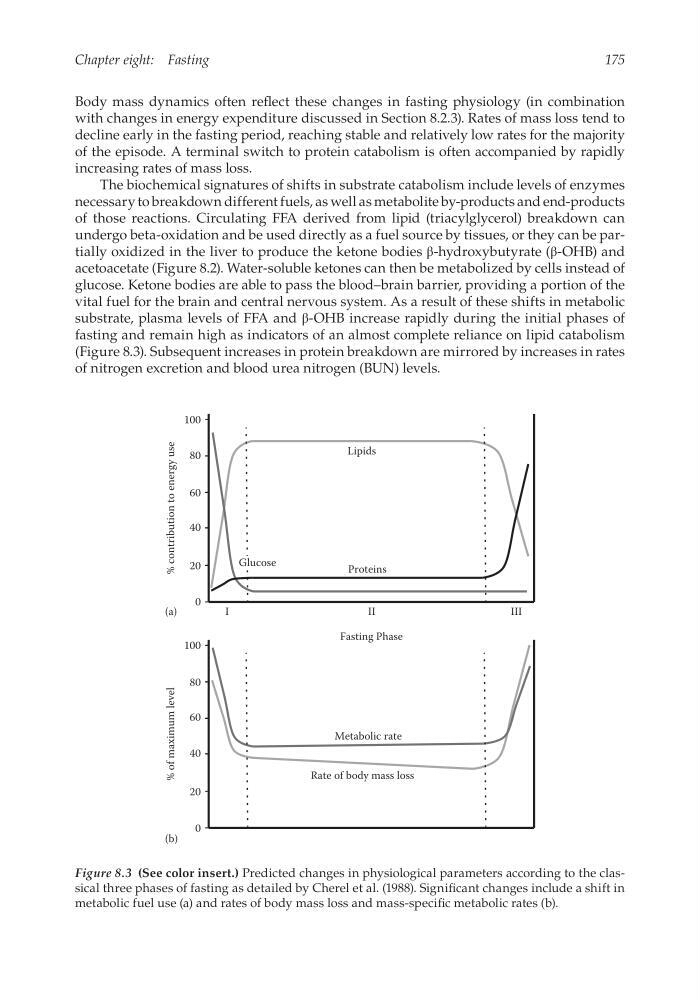
Body mass dynamics often reflect these changes in fasting physiology (in combination
with changes in energy expenditure discussed in Section 8.2.3). Rates of mass loss tend to
decline early in the fasting period, reaching stable and relatively low rates for the majority
of the episode. A terminal switch to protein catabolism is often accompanied by rapidly
increasing rates of mass loss.
The biochemical signatures of shifts in substrate catabolism include levels of enzymes
necessary to breakdown different fuels, as well as metabolite by-products and end- products
of those reactions. Circulating FFA derived from lipid (triacylglycerol) breakdown can
undergo beta-oxidation and be used directly as a fuel source by tissues, or they can be partially oxidized in the liver to produce the ketone bodies β-hydroxybutyrate (β-OHB) and
acetoacetate (Figure 8.2). Water-soluble ketones can then be metabolized by cells instead of
glucose. Ketone bodies are able to pass the blood–brain barrier, providing a portion of the
vital fuel for the brain and central nervous system. As a result of these shifts in metabolic
substrate, plasma levels of FFA and β-OHB increase rapidly during the initial phases of
fasting and remain high as indicators of an almost complete reliance on lipid catabolism
(Figure 8.3). Subsequent increases in protein breakdown are mirrored by increases in rates
of nitrogen excretion and blood urea nitrogen (BUN) levels.
100
0
(a)
(b)
20
40
60
80
100
80
60
40
20
0
Fasting Phase
Metabolic rate
Rate of body mass loss
I
I I
III
Proteins
Lipids
Glucose
% of maximum level
% contribution to energy use
Figure 8.3 (See color insert.) Predicted changes in physiological parameters according to the classical three phases of fasting as detailed by Cherel et al. (1988). Significant changes include a shift in
metabolic fuel use (a) and rates of body mass loss and mass-specific metabolic rates (b).
Chapter eight: Fasting
Body mass dynamics often reflect these changes in fasting physiology (in combination
with changes in energy expenditure discussed in Section 8.2.3). Rates of mass loss tend to
decline early in the fasting period, reaching stable and relatively low rates for the majority
of the episode. A terminal switch to protein catabolism is often accompanied by rapidly
increasing rates of mass loss.
The biochemical signatures of shifts in substrate catabolism include levels of enzymes
necessary to breakdown different fuels, as well as metabolite by-products and end- products
of those reactions. Circulating FFA derived from lipid (triacylglycerol) breakdown can
undergo beta-oxidation and be used directly as a fuel source by tissues, or they can be partially oxidized in the liver to produce the ketone bodies β-hydroxybutyrate (β-OHB) and
acetoacetate (Figure 8.2). Water-soluble ketones can then be metabolized by cells instead of
glucose. Ketone bodies are able to pass the blood–brain barrier, providing a portion of the
vital fuel for the brain and central nervous system. As a result of these shifts in metabolic
substrate, plasma levels of FFA and β-OHB increase rapidly during the initial phases of
fasting and remain high as indicators of an almost complete reliance on lipid catabolism
(Figure 8.3). Subsequent increases in protein breakdown are mirrored by increases in rates
of nitrogen excretion and blood urea nitrogen (BUN) levels.
100
0
(a)
(b)
20
40
60
80
100
80
60
40
20
0
Fasting Phase
Metabolic rate
Rate of body mass loss
I
I I
III
Proteins
Lipids
Glucose
% of maximum level
% contribution to energy use
Figure 8.3 (See color insert.) Predicted changes in physiological parameters according to the classical three phases of fasting as detailed by Cherel et al. (1988). Significant changes include a shift in
metabolic fuel use (a) and rates of body mass loss and mass-specific metabolic rates (b).