

154
Marine Mammal Physiology: Requisites for Ocean Living
(aquaporins) into the apical side of the cell. The aquaporins facilitate the absorption of
water down its concentration gradient that is achieved primarily by the concentrations of
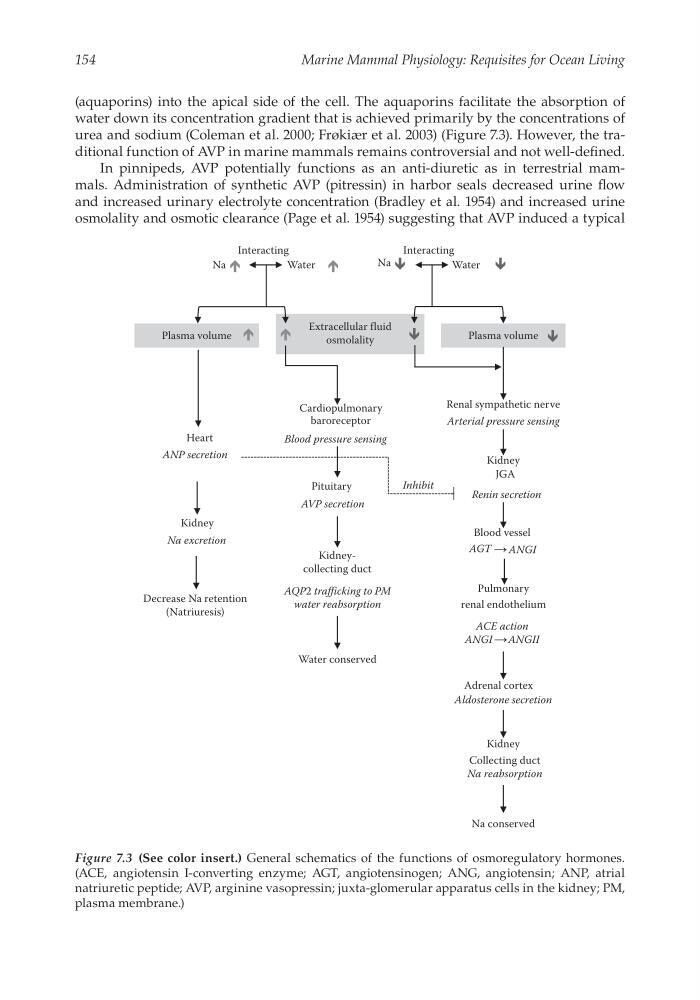
urea and sodium (Coleman et al. 2000; Frøkiær et al. 2003) (Figure 7.3). However, the traditional function of AVP in marine mammals remains controversial and not well-defined.
In pinnipeds, AVP potentially functions as an anti-diuretic as in terrestrial mammals. Administration of synthetic AVP (pitressin) in harbor seals decreased urine flow
and increased urinary electrolyte concentration (Bradley et al. 1954) and increased urine
osmolality and osmotic clearance (Page et al. 1954) suggesting that AVP induced a typical
Plasma volume
Na
Na
Plasma volume
Renal sympathetic nerve
Arterial pressure sensing
Blood pressure sensing
Renin secretion
Extracellular fluid
osmolality
Cardiopulmonary
baroreceptor
Pituitary
Water conserved
Kidneycollecting duct
Decrease Na retention
(Natriuresis)
Kidney
Kidney
Blood vessel
Pulmonary
renal endothelium
Adrenal cortex
Kidney
Collecting duct
Na reabsorption
Aldosterone secretion
ACE action
ANGI ANGII
AQP2 trafficking to PM
water reabsorption
ANGI
AGT
Inhibit
AVP secretion
JGA
Heart
Na excretion
ANP secretion
Na conserved
Water
W ater
Interacting
Interacting
Figure 7.3 (See color insert.) General schematics of the functions of osmoregulatory hormones.
(ACE, angiotensin I-converting enzyme; AGT, angiotensinogen; ANG, angiotensin; ANP, atrial
natriuretic peptide; AVP, arginine vasopressin; juxta-glomerular apparatus cells in the kidney; PM,
plasma membrane.)
Marine Mammal Physiology: Requisites for Ocean Living
(aquaporins) into the apical side of the cell. The aquaporins facilitate the absorption of
water down its concentration gradient that is achieved primarily by the concentrations of
urea and sodium (Coleman et al. 2000; Frøkiær et al. 2003) (Figure 7.3). However, the traditional function of AVP in marine mammals remains controversial and not well-defined.
In pinnipeds, AVP potentially functions as an anti-diuretic as in terrestrial mammals. Administration of synthetic AVP (pitressin) in harbor seals decreased urine flow
and increased urinary electrolyte concentration (Bradley et al. 1954) and increased urine
osmolality and osmotic clearance (Page et al. 1954) suggesting that AVP induced a typical
Plasma volume
Na
Na
Plasma volume
Renal sympathetic nerve
Arterial pressure sensing
Blood pressure sensing
Renin secretion
Extracellular fluid
osmolality
Cardiopulmonary
baroreceptor
Pituitary
Water conserved
Kidneycollecting duct
Decrease Na retention
(Natriuresis)
Kidney
Kidney
Blood vessel
Pulmonary
renal endothelium
Adrenal cortex
Kidney
Collecting duct
Na reabsorption
Aldosterone secretion
ACE action
ANGI ANGII
AQP2 trafficking to PM
water reabsorption
ANGI
AGT
Inhibit
AVP secretion
JGA
Heart
Na excretion
ANP secretion
Na conserved
Water
W ater
Interacting
Interacting
Figure 7.3 (See color insert.) General schematics of the functions of osmoregulatory hormones.
(ACE, angiotensin I-converting enzyme; AGT, angiotensinogen; ANG, angiotensin; ANP, atrial
natriuretic peptide; AVP, arginine vasopressin; juxta-glomerular apparatus cells in the kidney; PM,
plasma membrane.)