

148
Marine Mammal Physiology: Requisites for Ocean Living
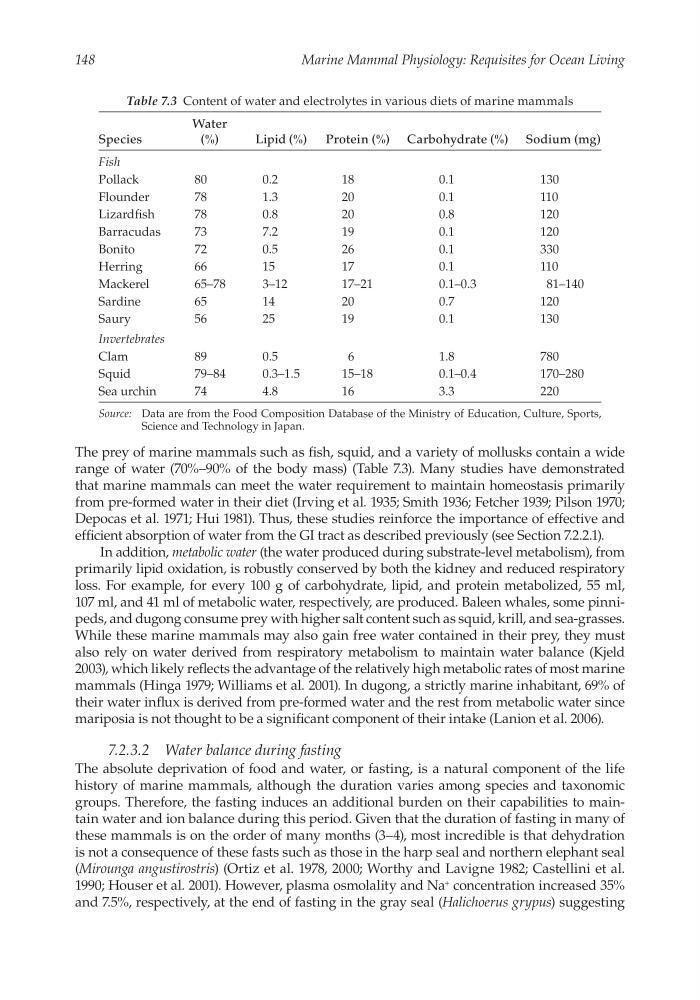
The prey of marine mammals such as fish, squid, and a variety of mollusks contain a wide
range of water (70%–90% of the body mass) (Table 7.3). Many studies have demonstrated
that marine mammals can meet the water requirement to maintain homeostasis primarily
from pre-formed water in their diet (Irving et al. 1935; Smith 1936; Fetcher 1939; Pilson 1970;
Depocas et al. 1971; Hui 1981). Thus, these studies reinforce the importance of effective and
efficient absorption of water from the GI tract as described previously (see Section 7.2.2.1).
In addition, metabolic water (the water produced during substrate-level metabolism), from
primarily lipid oxidation, is robustly conserved by both the kidney and reduced respiratory
loss. For example, for every 100 g of carbohydrate, lipid, and protein metabolized, 55 ml,
107 ml, and 41 ml of metabolic water, respectively, are produced. Baleen whales, some pinnipeds, and dugong consume prey with higher salt content such as squid, krill, and sea-grasses.
While these marine mammals may also gain free water contained in their prey, they must
also rely on water derived from respiratory metabolism to maintain water balance (Kjeld
2003), which likely reflects the advantage of the relatively high metabolic rates of most marine
mammals (Hinga 1979; Williams et al. 2001). In dugong, a strictly marine inhabitant, 69% of
their water influx is derived from pre-formed water and the rest from metabolic water since
mariposia is not thought to be a significant component of their intake (Lanion et al. 2006).
7.2.3.2 Water balance during fasting
The absolute deprivation of food and water, or fasting, is a natural component of the life
history of marine mammals, although the duration varies among species and taxonomic
groups. Therefore, the fasting induces an additional burden on their capabilities to maintain water and ion balance during this period. Given that the duration of fasting in many of
these mammals is on the order of many months (3–4), most incredible is that dehydration
is not a consequence of these fasts such as those in the harp seal and northern elephant seal
(Mirounga angustirostris) (Ortiz et al. 1978, 2000; Worthy and Lavigne 1982; Castellini et al.
1990; Houser et al. 2001). However, plasma osmolality and Na + concentration increased 35%
and 7.5%, respectively, at the end of fasting in the gray seal (Halichoerus grypus) suggesting
Table 7.3 Content of water and electrolytes in various diets of marine mammals
Species
Water
(%)
Lipid (%) Protein (%) Carbohydrate (%) Sodium (mg)
Fish
Pollack
80
0.2
18
0.1
130
Flounder
78
1.3
20
0.1
110
Lizardfish
78
0.8
20
0.8
120
Barracudas
73
7.2
19
0.1
120
Bonito
72
0.5
26
0.1
330
Herring
66
15
17
0.1
110
Mackerel
65–78
3–12
17–21
0.1–0.3
81–140
Sardine
65
14
20
0.7
120
Saury
56
25
19
0.1
130
Invertebrates
Clam
89
0.5
6
1.8
780
Squid
79–84
0.3–1.5
15–18
0.1–0.4
170–280
Sea urchin
74
4.8
16
3.3
220
Source: Data are from the Food Composition Database of the Ministry of Education, Culture, Sports,
Science and Technology in Japan.
Marine Mammal Physiology: Requisites for Ocean Living
The prey of marine mammals such as fish, squid, and a variety of mollusks contain a wide
range of water (70%–90% of the body mass) (Table 7.3). Many studies have demonstrated
that marine mammals can meet the water requirement to maintain homeostasis primarily
from pre-formed water in their diet (Irving et al. 1935; Smith 1936; Fetcher 1939; Pilson 1970;
Depocas et al. 1971; Hui 1981). Thus, these studies reinforce the importance of effective and
efficient absorption of water from the GI tract as described previously (see Section 7.2.2.1).
In addition, metabolic water (the water produced during substrate-level metabolism), from
primarily lipid oxidation, is robustly conserved by both the kidney and reduced respiratory
loss. For example, for every 100 g of carbohydrate, lipid, and protein metabolized, 55 ml,
107 ml, and 41 ml of metabolic water, respectively, are produced. Baleen whales, some pinnipeds, and dugong consume prey with higher salt content such as squid, krill, and sea-grasses.
While these marine mammals may also gain free water contained in their prey, they must
also rely on water derived from respiratory metabolism to maintain water balance (Kjeld
2003), which likely reflects the advantage of the relatively high metabolic rates of most marine
mammals (Hinga 1979; Williams et al. 2001). In dugong, a strictly marine inhabitant, 69% of
their water influx is derived from pre-formed water and the rest from metabolic water since
mariposia is not thought to be a significant component of their intake (Lanion et al. 2006).
7.2.3.2 Water balance during fasting
The absolute deprivation of food and water, or fasting, is a natural component of the life
history of marine mammals, although the duration varies among species and taxonomic
groups. Therefore, the fasting induces an additional burden on their capabilities to maintain water and ion balance during this period. Given that the duration of fasting in many of
these mammals is on the order of many months (3–4), most incredible is that dehydration
is not a consequence of these fasts such as those in the harp seal and northern elephant seal
(Mirounga angustirostris) (Ortiz et al. 1978, 2000; Worthy and Lavigne 1982; Castellini et al.
1990; Houser et al. 2001). However, plasma osmolality and Na + concentration increased 35%
and 7.5%, respectively, at the end of fasting in the gray seal (Halichoerus grypus) suggesting
Table 7.3 Content of water and electrolytes in various diets of marine mammals
Species
Water
(%)
Lipid (%) Protein (%) Carbohydrate (%) Sodium (mg)
Fish
Pollack
80
0.2
18
0.1
130
Flounder
78
1.3
20
0.1
110
Lizardfish
78
0.8
20
0.8
120
Barracudas
73
7.2
19
0.1
120
Bonito
72
0.5
26
0.1
330
Herring
66
15
17
0.1
110
Mackerel
65–78
3–12
17–21
0.1–0.3
81–140
Sardine
65
14
20
0.7
120
Saury
56
25
19
0.1
130
Invertebrates
Clam
89
0.5
6
1.8
780
Squid
79–84
0.3–1.5
15–18
0.1–0.4
170–280
Sea urchin
74
4.8
16
3.3
220
Source: Data are from the Food Composition Database of the Ministry of Education, Culture, Sports,
Science and Technology in Japan.