

145
Chapter seven: Water balance
and urine flows from the duct to the bladder to be excreted (Figure 7.2). The renal medulla
contains the loop of Henle and the collecting duct that contribute to urine concentrating
ability. The relative medullary thickness (RMT: the thickness of the medulla relative to the
size of the kidney) increases in proportion with urine concentrating ability (Beuchat 1990a)
and is quite variable in marine mammals. In cetaceans, the RMT is comparatively high
(bottlenose dolphin = 6.0, Baird’s beaked whale [Berardius bairdii] = 4.9) (Suzuki et al. 2008),
whereas in pinnipeds that is much more variable (1.1 in the cape fur seal [Arctocephalus
pusillus] and bearded seal [Erignathus barbatus]) (Sperber 1944; Bester 1975) to 7.5 in the
Weddell seal (Leptonychotes weddellii) (Vardy and Bryden 1981), indicating the relationship
between the RMT and urine concentrating ability may vary among species. The fact that
the medulla of the kidney is six times thicker than the cortex in the West Indian manatee
(Trichechus m anatus) suggests that this species possesses an enhanced ability to concentrate
urine (Hill and Reynolds 1989; Maluf 1989).
Urea is the end-product of proteins, and simultaneously it is a key molecule for the
production of concentrated urine. Accumulation of urea in the renal medulla is a significant contributing factor to urinary concentration. Urea is reabsorbed from urine across the
epithelium of the inner-medullary collecting duct and recycled among circulation and the
Urine
1. Glomerulus
2. Proximal convoluted tubule
3. Proximal straight tubule
4. Descending thin limb of loop of Henle
5. Ascending thin limb of loop of Henle
6. Thick ascending limb of loop of Henle
7. Distal convoluted tubule
8. Connecting tubule
9. Collecting duct
Na
+ , K
+
Water
urea
Na + , K +
Ca
2+
Na + , Ca 2+
Water
Higher urea
concentration
in the interstitium
Inner medulla Outer medulla Cortex
Water
Outer
stripe
Blood flow
Filtered
plasma
5
6
2
1
9
8
7
4
3
A histological section of the renicule
of a bottlenose dolphin
Cortex
Renicule
Kidney
Renal
papilla
Medulla
Glucose
urea
water
Na
+ , Cl –
K
+ , Ca
2+
Inner
stripe
(a)
(b)
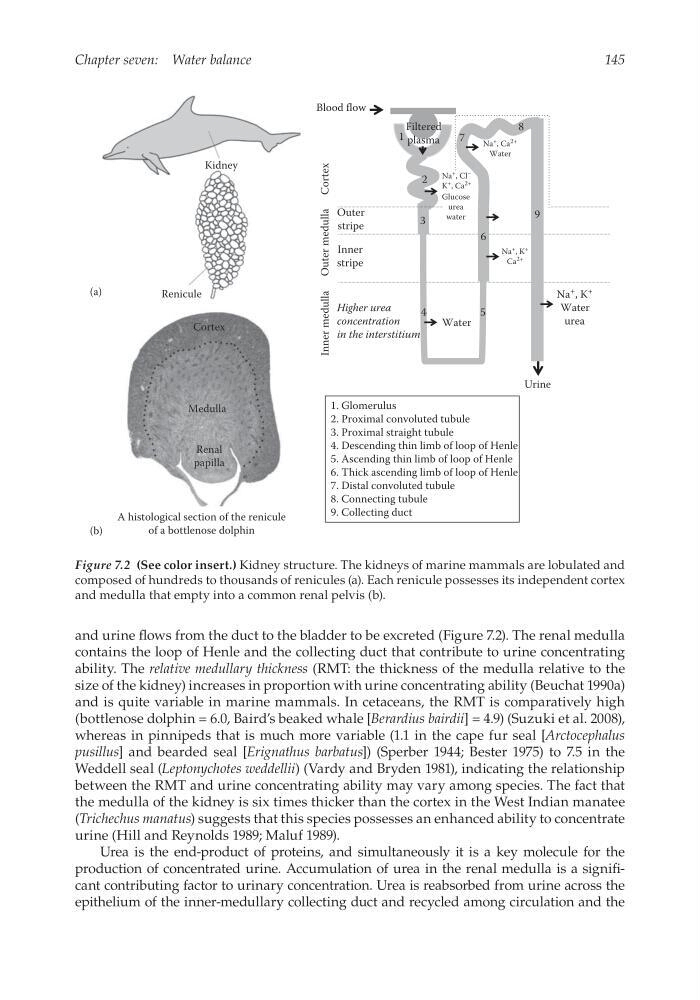
Figure 7.2 (See color insert.) Kidney structure. The kidneys of marine mammals are lobulated and
composed of hundreds to thousands of renicules (a). Each renicule possesses its independent cortex
and medulla that empty into a common renal pelvis (b).
Chapter seven: Water balance
and urine flows from the duct to the bladder to be excreted (Figure 7.2). The renal medulla
contains the loop of Henle and the collecting duct that contribute to urine concentrating
ability. The relative medullary thickness (RMT: the thickness of the medulla relative to the
size of the kidney) increases in proportion with urine concentrating ability (Beuchat 1990a)
and is quite variable in marine mammals. In cetaceans, the RMT is comparatively high
(bottlenose dolphin = 6.0, Baird’s beaked whale [Berardius bairdii] = 4.9) (Suzuki et al. 2008),
whereas in pinnipeds that is much more variable (1.1 in the cape fur seal [Arctocephalus
pusillus] and bearded seal [Erignathus barbatus]) (Sperber 1944; Bester 1975) to 7.5 in the
Weddell seal (Leptonychotes weddellii) (Vardy and Bryden 1981), indicating the relationship
between the RMT and urine concentrating ability may vary among species. The fact that
the medulla of the kidney is six times thicker than the cortex in the West Indian manatee
(Trichechus m anatus) suggests that this species possesses an enhanced ability to concentrate
urine (Hill and Reynolds 1989; Maluf 1989).
Urea is the end-product of proteins, and simultaneously it is a key molecule for the
production of concentrated urine. Accumulation of urea in the renal medulla is a significant contributing factor to urinary concentration. Urea is reabsorbed from urine across the
epithelium of the inner-medullary collecting duct and recycled among circulation and the
Urine
1. Glomerulus
2. Proximal convoluted tubule
3. Proximal straight tubule
4. Descending thin limb of loop of Henle
5. Ascending thin limb of loop of Henle
6. Thick ascending limb of loop of Henle
7. Distal convoluted tubule
8. Connecting tubule
9. Collecting duct
Na
+ , K
+
Water
urea
Na + , K +
Ca
2+
Na + , Ca 2+
Water
Higher urea
concentration
in the interstitium
Inner medulla Outer medulla Cortex
Water
Outer
stripe
Blood flow
Filtered
plasma
5
6
2
1
9
8
7
4
3
A histological section of the renicule
of a bottlenose dolphin
Cortex
Renicule
Kidney
Renal
papilla
Medulla
Glucose
urea
water
Na
+ , Cl –
K
+ , Ca
2+
Inner
stripe
(a)
(b)
Figure 7.2 (See color insert.) Kidney structure. The kidneys of marine mammals are lobulated and
composed of hundreds to thousands of renicules (a). Each renicule possesses its independent cortex
and medulla that empty into a common renal pelvis (b).