

127
Chapter six: Diet and nutrition
in these species limits their distribution to shallow sea-grass habitats, which in turn often
brings them into close contact with several conservation threats such as coastal pollution
and boat strikes.
6.4 Methods for studying diet in marine mammals
Obtaining direct information on diet in often wide ranging and deep-diving marine species remains a major challenge (Biuw et al. 2007). The development of animal telemetry
has greatly improved our understanding of how animals use the marine environment
(Burns et al. 2004; Costa et al. 2010; Cotté et al. 2011; Arthur et al. 2015), but spatially
explicit information on diet remains largely unavailable. By virtue of marine existence,
the study of marine mammal diet is extremely difficult as many species live most of
their lives submerged in open water, making them cryptic organisms when foraging.
Assessing the diet of animals that have large foraging ranges is a particular problem
(Field et al. 2007).
6.4.1 Direct observation of feeding
Direct observation of feeding relies on what can be observed from on or near the surface.
Observations can be made from the air, a vessel, or from a vantage point on land. Much
has been learned from these observations, especially when conducted in a systematic way.
Direct observations of sub-surface feeding, however, are rare (Similä and Ugarte 1993) and
hence, sub-surface feeding on bottom-dwelling (benthic) prey, such as flatfish, flounder,
crabs and other invertebrates, and mid-water prey, such as myctophids and squid, are
greatly underestimated in this method, as it requires the predator to bring its prey to the
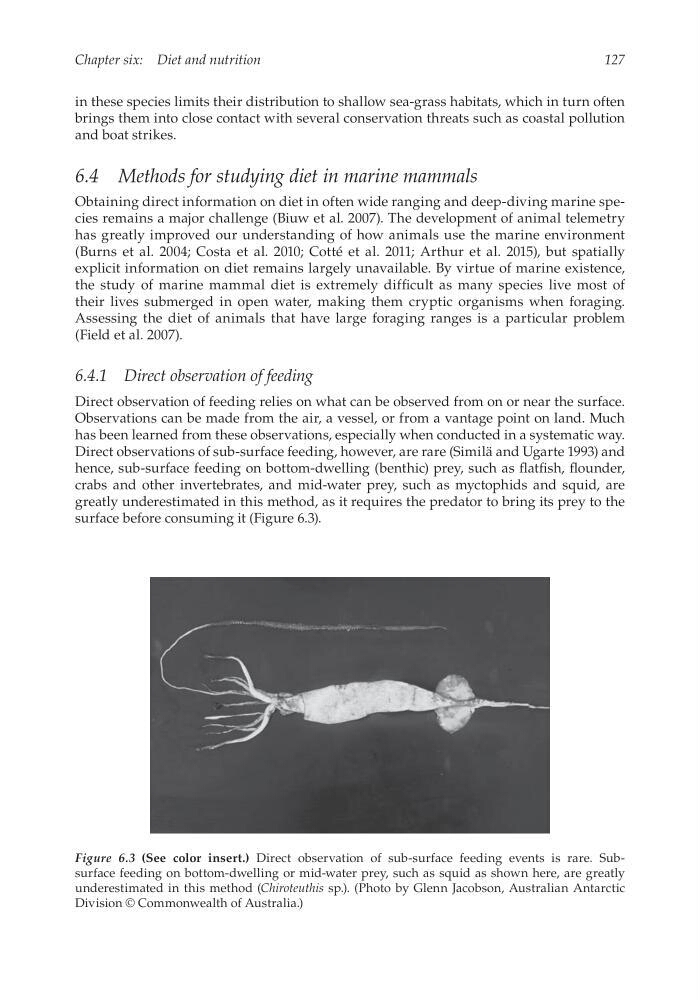
surface before consuming it (Figure 6.3).
Figure 6.3 (See color insert.) Direct observation of sub-surface feeding events is rare. Subsurface feeding on bottom-dwelling or mid-water prey, such as squid as shown here, are greatly
u nderestimated in this method (Chiroteuthis sp.). (Photo by Glenn Jacobson, Australian Antarctic
Division © Commonwealth of Australia.)
Chapter six: Diet and nutrition
in these species limits their distribution to shallow sea-grass habitats, which in turn often
brings them into close contact with several conservation threats such as coastal pollution
and boat strikes.
6.4 Methods for studying diet in marine mammals
Obtaining direct information on diet in often wide ranging and deep-diving marine species remains a major challenge (Biuw et al. 2007). The development of animal telemetry
has greatly improved our understanding of how animals use the marine environment
(Burns et al. 2004; Costa et al. 2010; Cotté et al. 2011; Arthur et al. 2015), but spatially
explicit information on diet remains largely unavailable. By virtue of marine existence,
the study of marine mammal diet is extremely difficult as many species live most of
their lives submerged in open water, making them cryptic organisms when foraging.
Assessing the diet of animals that have large foraging ranges is a particular problem
(Field et al. 2007).
6.4.1 Direct observation of feeding
Direct observation of feeding relies on what can be observed from on or near the surface.
Observations can be made from the air, a vessel, or from a vantage point on land. Much
has been learned from these observations, especially when conducted in a systematic way.
Direct observations of sub-surface feeding, however, are rare (Similä and Ugarte 1993) and
hence, sub-surface feeding on bottom-dwelling (benthic) prey, such as flatfish, flounder,
crabs and other invertebrates, and mid-water prey, such as myctophids and squid, are
greatly underestimated in this method, as it requires the predator to bring its prey to the
surface before consuming it (Figure 6.3).
Figure 6.3 (See color insert.) Direct observation of sub-surface feeding events is rare. Subsurface feeding on bottom-dwelling or mid-water prey, such as squid as shown here, are greatly
u nderestimated in this method (Chiroteuthis sp.). (Photo by Glenn Jacobson, Australian Antarctic
Division © Commonwealth of Australia.)