

xiii
Editors
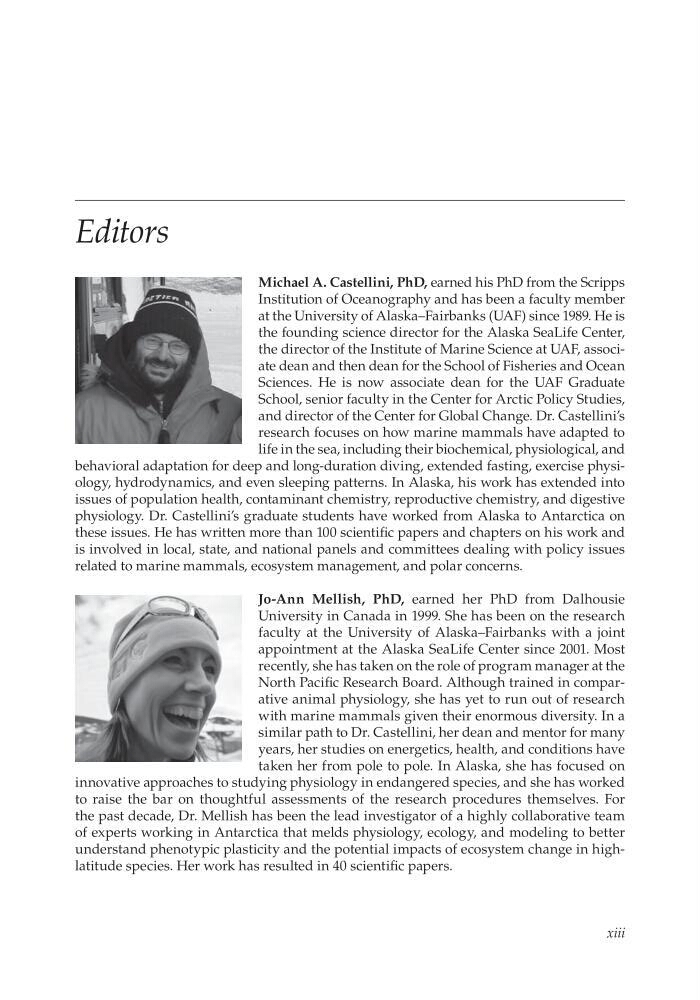
Michael A. Castellini, PhD, earned his PhD from the Scripps
Institution of Oceanography and has been a faculty member
at the University of Alaska–Fairbanks (UAF) since 1989. He is
the founding science director for the Alaska SeaLife Center,
the director of the Institute of Marine Science at UAF, associate dean and then dean for the School of Fisheries and Ocean
Sciences. He is now associate dean for the UAF Graduate
School, senior faculty in the Center for Arctic Policy Studies,
and director of the Center for Global Change. Dr. Castellini’s
research focuses on how marine mammals have adapted to
life in the sea, including their biochemical, physiological, and
behavioral adaptation for deep and long-duration diving, extended fasting, exercise physiology, hydrodynamics, and even sleeping patterns. In Alaska, his work has extended into
issues of population health, contaminant chemistry, reproductive chemistry, and digestive
physiology. Dr. Castellini’s graduate students have worked from Alaska to Antarctica on
these issues. He has written more than 100 scientific papers and chapters on his work and
is involved in local, state, and national panels and committees dealing with policy issues
related to marine mammals, ecosystem management, and polar concerns.
Jo-Ann Mellish, PhD, earned her PhD from Dalhousie
University in Canada in 1999. She has been on the research
faculty at the University of Alaska–Fairbanks with a joint
appointment at the Alaska SeaLife Center since 2001. Most
recently, she has taken on the role of program manager at the
North Pacific Research Board. Although trained in comparative animal physiology, she has yet to run out of research
with marine mammals given their enormous diversity. In a
similar path to Dr. Castellini, her dean and mentor for many
years, her studies on energetics, health, and conditions have
taken her from pole to pole. In Alaska, she has focused on
innovative approaches to studying physiology in endangered species, and she has worked
to raise the bar on thoughtful assessments of the research procedures themselves. For
the past decade, Dr. Mellish has been the lead investigator of a highly collaborative team
of experts working in Antarctica that melds physiology, ecology, and modeling to better
understand phenotypic plasticity and the potential impacts of ecosystem change in highlatitude species. Her work has resulted in 40 scientific papers.
Editors
Michael A. Castellini, PhD, earned his PhD from the Scripps
Institution of Oceanography and has been a faculty member
at the University of Alaska–Fairbanks (UAF) since 1989. He is
the founding science director for the Alaska SeaLife Center,
the director of the Institute of Marine Science at UAF, associate dean and then dean for the School of Fisheries and Ocean
Sciences. He is now associate dean for the UAF Graduate
School, senior faculty in the Center for Arctic Policy Studies,
and director of the Center for Global Change. Dr. Castellini’s
research focuses on how marine mammals have adapted to
life in the sea, including their biochemical, physiological, and
behavioral adaptation for deep and long-duration diving, extended fasting, exercise physiology, hydrodynamics, and even sleeping patterns. In Alaska, his work has extended into
issues of population health, contaminant chemistry, reproductive chemistry, and digestive
physiology. Dr. Castellini’s graduate students have worked from Alaska to Antarctica on
these issues. He has written more than 100 scientific papers and chapters on his work and
is involved in local, state, and national panels and committees dealing with policy issues
related to marine mammals, ecosystem management, and polar concerns.
Jo-Ann Mellish, PhD, earned her PhD from Dalhousie
University in Canada in 1999. She has been on the research
faculty at the University of Alaska–Fairbanks with a joint
appointment at the Alaska SeaLife Center since 2001. Most
recently, she has taken on the role of program manager at the
North Pacific Research Board. Although trained in comparative animal physiology, she has yet to run out of research
with marine mammals given their enormous diversity. In a
similar path to Dr. Castellini, her dean and mentor for many
years, her studies on energetics, health, and conditions have
taken her from pole to pole. In Alaska, she has focused on
innovative approaches to studying physiology in endangered species, and she has worked
to raise the bar on thoughtful assessments of the research procedures themselves. For
the past decade, Dr. Mellish has been the lead investigator of a highly collaborative team
of experts working in Antarctica that melds physiology, ecology, and modeling to better
understand phenotypic plasticity and the potential impacts of ecosystem change in highlatitude species. Her work has resulted in 40 scientific papers.