

103
Chapter five: Feeding mechanisms
simplified dentition, and (3) importance of suction (Fay 1982; King 1983; Kastelein et al.
1994; Werth 2006b; Marshall et al. 2008, 2014). Based on craniodental morphology and some
functional studies, pinniped feeding has been generally characterized as raptorial biting,
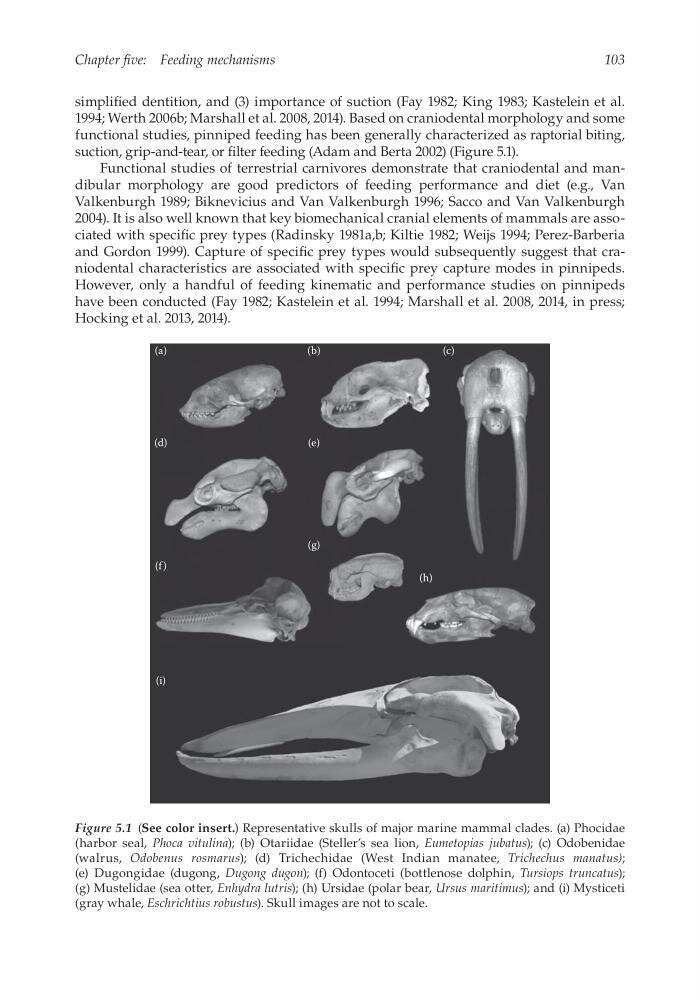
suction, grip-and-tear, or filter feeding (Adam and Berta 2002) (Figure 5.1).
Functional studies of terrestrial carnivores demonstrate that craniodental and mandibular morphology are good predictors of feeding performance and diet (e.g., Van
Valkenburgh 1989; Biknevicius and Van Valkenburgh 1996; Sacco and Van Valkenburgh
2004). It is also well known that key biomechanical cranial elements of mammals are associated with specific prey types (Radinsky 1981a,b; Kiltie 1982; Weijs 1994; Perez-Barberia
and Gordon 1999). Capture of specific prey types would subsequently suggest that craniodental characteristics are associated with specific prey capture modes in pinnipeds.
However, only a handful of feeding kinematic and performance studies on pinnipeds
have been conducted (Fay 1982; Kastelein et al. 1994; Marshall et al. 2008, 2014, in press;
Hocking et al. 2013, 2014).
(a)
(b)
(d)
(f )
(g)
(h)
(i)
(e)
(c)
Figure 5.1 (See color insert.) Representative skulls of major marine mammal clades. (a) Phocidae
(harbor seal, Phoca vitulina); (b) Otariidae (Steller’s sea lion, Eumetopias jubatus); (c) Odobenidae
( walrus, Odobenus rosmarus); (d) Trichechidae (West Indian manatee, Trichechus manatus);
(e) Dugongidae (dugong, Dugong dugon); (f) Odontoceti (bottlenose dolphin, Tursiops truncatus);
(g) Mustelidae (sea otter, Enhydra lutris); (h) Ursidae (polar bear, Ursus maritimus); and (i) Mysticeti
(gray whale, Eschrichtius robustus). Skull images are not to scale.
Chapter five: Feeding mechanisms
simplified dentition, and (3) importance of suction (Fay 1982; King 1983; Kastelein et al.
1994; Werth 2006b; Marshall et al. 2008, 2014). Based on craniodental morphology and some
functional studies, pinniped feeding has been generally characterized as raptorial biting,
suction, grip-and-tear, or filter feeding (Adam and Berta 2002) (Figure 5.1).
Functional studies of terrestrial carnivores demonstrate that craniodental and mandibular morphology are good predictors of feeding performance and diet (e.g., Van
Valkenburgh 1989; Biknevicius and Van Valkenburgh 1996; Sacco and Van Valkenburgh
2004). It is also well known that key biomechanical cranial elements of mammals are associated with specific prey types (Radinsky 1981a,b; Kiltie 1982; Weijs 1994; Perez-Barberia
and Gordon 1999). Capture of specific prey types would subsequently suggest that craniodental characteristics are associated with specific prey capture modes in pinnipeds.
However, only a handful of feeding kinematic and performance studies on pinnipeds
have been conducted (Fay 1982; Kastelein et al. 1994; Marshall et al. 2008, 2014, in press;
Hocking et al. 2013, 2014).
(a)
(b)
(d)
(f )
(g)
(h)
(i)
(e)
(c)
Figure 5.1 (See color insert.) Representative skulls of major marine mammal clades. (a) Phocidae
(harbor seal, Phoca vitulina); (b) Otariidae (Steller’s sea lion, Eumetopias jubatus); (c) Odobenidae
( walrus, Odobenus rosmarus); (d) Trichechidae (West Indian manatee, Trichechus manatus);
(e) Dugongidae (dugong, Dugong dugon); (f) Odontoceti (bottlenose dolphin, Tursiops truncatus);
(g) Mustelidae (sea otter, Enhydra lutris); (h) Ursidae (polar bear, Ursus maritimus); and (i) Mysticeti
(gray whale, Eschrichtius robustus). Skull images are not to scale.