

40
2. Basic Finite-DifferenceMethods
norm. I It might appear that the maximum norm is the most natural one to compute
when working with grid-point values; however, the 12 norm is also useful, because
it is more closely related to conserved physical quantities, such as the total energy.
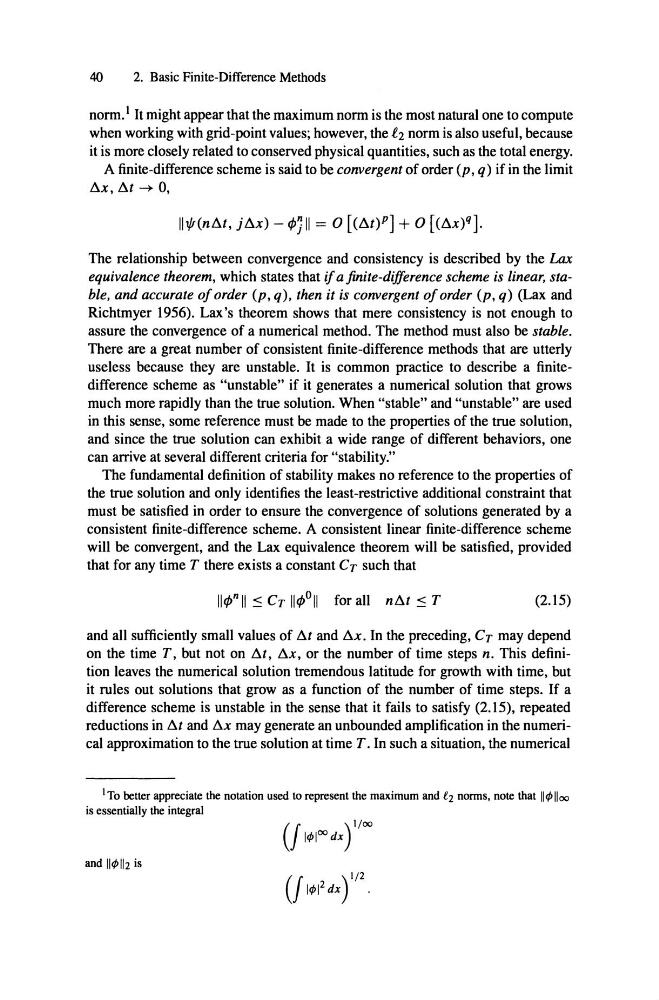
A finite-difference scheme is said to be convergent of order (p , q) if in the limit
ßX , 6t
0,
The relationship between convergence and consistency is described by the Lax
equivalence theorem, which states that if a finite-difference scheme is linear, stable, and accurate 0/ order (p , q), then it is convergent 0/ order (p, q) (Lax and
Richtmyer 1956). Lax's theorem shows that mere consistency is not enough to
assure the convergence of a numerical method. The method must also be stable.
There are a great number of consistent finite-difference methods that are utter1y
useless because they are unstable. It is common practice to describe a finitedifference scheme as "unstable" if it generates a numerical solution that grows
much more rapidly than the true solution. When "stable" and "unstable" are used
in this sense, some reference must be made to the properties of the true solution,
and since the true solution can exhibit a wide range of different behaviors, one
can arrive at several different criteria for "stability,'
The fundamental definition of stability makes no reference to the properties of
the true solution and only identifies the least-restrictive additional constraint that
must be satisfied in order to ensure the convergence of solutions generated by a
consistent finite-difference scheme. A consistent linear finite-difference scheme
will be convergent, and the Lax equivalence theorem will be satisfied, provided
that for any time T there exists a constant CT such that
(2.15)
and all sufficiently small values of ßt and 6x. In the preceding, CT may depend
on the time T, but not on ßt , Sx, or the number of time steps n. This definition leaves the numerical solution tremendous latitude for growth with time, but
it rules out solutions that grow as a function of the number of time steps . If a
difference scheme is unstable in the sense that it fails to satisfy (2.15), repeated
reductions in ßt and ßx may generate an unbounded amplification in the numerical approximation to the true solution at time T. In such a situation, the numerical
ITo better appreciate the notation used to represent the maxirnurn and (.2 norms, note that 114>1100
is essentially the integral
(f1 4>1 00 dX) 1/00
and 114> 112 is
2. Basic Finite-DifferenceMethods
norm. I It might appear that the maximum norm is the most natural one to compute
when working with grid-point values; however, the 12 norm is also useful, because
it is more closely related to conserved physical quantities, such as the total energy.
A finite-difference scheme is said to be convergent of order (p , q) if in the limit
ßX , 6t
0,
The relationship between convergence and consistency is described by the Lax
equivalence theorem, which states that if a finite-difference scheme is linear, stable, and accurate 0/ order (p , q), then it is convergent 0/ order (p, q) (Lax and
Richtmyer 1956). Lax's theorem shows that mere consistency is not enough to
assure the convergence of a numerical method. The method must also be stable.
There are a great number of consistent finite-difference methods that are utter1y
useless because they are unstable. It is common practice to describe a finitedifference scheme as "unstable" if it generates a numerical solution that grows
much more rapidly than the true solution. When "stable" and "unstable" are used
in this sense, some reference must be made to the properties of the true solution,
and since the true solution can exhibit a wide range of different behaviors, one
can arrive at several different criteria for "stability,'
The fundamental definition of stability makes no reference to the properties of
the true solution and only identifies the least-restrictive additional constraint that
must be satisfied in order to ensure the convergence of solutions generated by a
consistent finite-difference scheme. A consistent linear finite-difference scheme
will be convergent, and the Lax equivalence theorem will be satisfied, provided
that for any time T there exists a constant CT such that
(2.15)
and all sufficiently small values of ßt and 6x. In the preceding, CT may depend
on the time T, but not on ßt , Sx, or the number of time steps n. This definition leaves the numerical solution tremendous latitude for growth with time, but
it rules out solutions that grow as a function of the number of time steps . If a
difference scheme is unstable in the sense that it fails to satisfy (2.15), repeated
reductions in ßt and ßx may generate an unbounded amplification in the numerical approximation to the true solution at time T. In such a situation, the numerical
ITo better appreciate the notation used to represent the maxirnurn and (.2 norms, note that 114>1100
is essentially the integral
(f1 4>1 00 dX) 1/00
and 114> 112 is