

8.3 Two-Dimensional StratifiedFlow
427
present at the upper boundary. Letting the subscripts 1 and 2 denote the incident
and reflected waves, respectively , (8.55) becomes
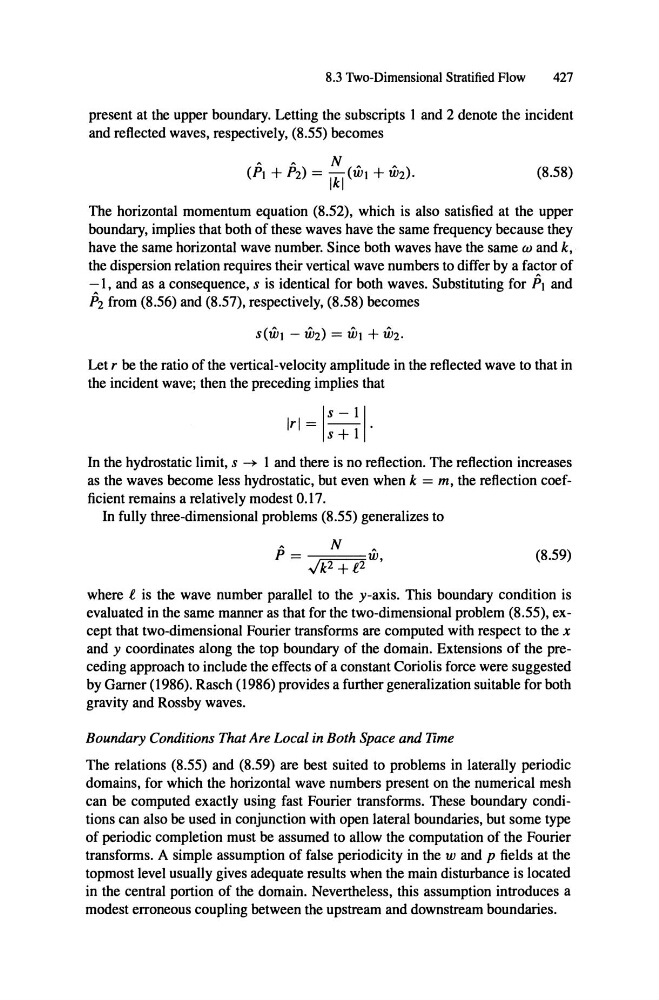
(8.58)
The horizontal momentum equation (8.52), which is also satisfied at the upper
boundary, implies that both of these waves have the same frequency because they
have the same horizontal wave number. Since both waves have the same ta and k,
the dispersion relation requires their vertical wave numbers to differ by a factor of
-1 , and as a consequence, s is identical for both waves. Substituting for PI and
P2 from (8.56) and (8.57), respectively, (8.58) becomes
Let r be the ratio of the vertical-velocity amplitude in the reflected wave to that in
the incident wave; then the preceding implies that
Irl= s
- - .
- 11
I s+1
In the hydrostatic limit, s -+ 1 and there is no reflection . The reflection increases
as the waves become less hydrostatic, but even when k = m, the reflection coefficient remains a relatively modest 0.17.
In fully three-dirnensional problems (8.55) generalizes to
(8.59)
where .e is the wave number parallel to the y-axis. This boundary condition is
evaluated in the same manner as that for the two-dimensional problem (8.55), except that two-dimensional Fourier transforms are computed with respect to the x
and y coordinates along the top boundary of the domain. Extensions of the preceding approach to include the effects of a constant Coriolis force were suggested
by Gamer (1986). Rasch (1986) provides a further generalization suitable for both
gravity and Rossby waves.
Boundary Conditions That Are Local in Both Space and TIme
The relations (8.55) and (8.59) are best suited to problems in laterally periodic
domains, for which the horizontal wave numbers present on the numerical mesh
can be computed exactly using fast Fourier transforms. These boundary conditions can also be used in conjunction with open lateral boundaries, but some type
of periodic completion must be assumed to allow the computation of the Fourier
transforms. A simple assumption of false periodicity in the w and p fields at the
topmost level usually gives adequate results when the main disturbance is located
in the central portion of the domain. Nevertheless, this assumption introduces a
modest erroneous coupling between the upstream and downstream boundaries.
427
present at the upper boundary. Letting the subscripts 1 and 2 denote the incident
and reflected waves, respectively , (8.55) becomes
(8.58)
The horizontal momentum equation (8.52), which is also satisfied at the upper
boundary, implies that both of these waves have the same frequency because they
have the same horizontal wave number. Since both waves have the same ta and k,
the dispersion relation requires their vertical wave numbers to differ by a factor of
-1 , and as a consequence, s is identical for both waves. Substituting for PI and
P2 from (8.56) and (8.57), respectively, (8.58) becomes
Let r be the ratio of the vertical-velocity amplitude in the reflected wave to that in
the incident wave; then the preceding implies that
Irl= s
- - .
- 11
I s+1
In the hydrostatic limit, s -+ 1 and there is no reflection . The reflection increases
as the waves become less hydrostatic, but even when k = m, the reflection coefficient remains a relatively modest 0.17.
In fully three-dirnensional problems (8.55) generalizes to
(8.59)
where .e is the wave number parallel to the y-axis. This boundary condition is
evaluated in the same manner as that for the two-dimensional problem (8.55), except that two-dimensional Fourier transforms are computed with respect to the x
and y coordinates along the top boundary of the domain. Extensions of the preceding approach to include the effects of a constant Coriolis force were suggested
by Gamer (1986). Rasch (1986) provides a further generalization suitable for both
gravity and Rossby waves.
Boundary Conditions That Are Local in Both Space and TIme
The relations (8.55) and (8.59) are best suited to problems in laterally periodic
domains, for which the horizontal wave numbers present on the numerical mesh
can be computed exactly using fast Fourier transforms. These boundary conditions can also be used in conjunction with open lateral boundaries, but some type
of periodic completion must be assumed to allow the computation of the Fourier
transforms. A simple assumption of false periodicity in the w and p fields at the
topmost level usually gives adequate results when the main disturbance is located
in the central portion of the domain. Nevertheless, this assumption introduces a
modest erroneous coupling between the upstream and downstream boundaries.