

8.1 One-Dimensional Flow
405
such circumstances, a shallow-water wave arriving at a boundary may simultaneously reflect into two inward-moving waves. If c > luI, one reflected wave will
be a physical mode and the other a nonphysical mode .
As discussed in Section 2.4.1, solutions of the form
r/J(x, t) = e i (kj 6.x - wt )
satisfy the differential-difference equation (8.14), provided that
sin kt:.x
w=u--- t:.x
(8.16)
The group velocities of these waves are given by
aw
-
ak
= U coskt:.x .
For each w there are two different wave numbers that satisfy the dispersion relation (8.16): kl and ka = Jr / t:.x - kl oSince the group velocities of these two
waves are equal in magnitude but opposite in sign, it is useful to divide the waves
resolvable on the discrete grid into two categories: physical modes, for which
o :s k t:.x < Jr /2, and computational modes , for which n /2 :s k t:.x :s tt , According to this division of the modes, a group (or wave packet) of physical modes
propagates in the same direction as the true physical solution, whereas a group of
computational modes propagates backwards (4t:.x waves have zero group velocity). For each to except U / Sx one of the roots of (8.16) is a physical mode and
one is a computational mode.
In order to determine the strength of the reflection introduced by the extrapolation boundary condition (8.15), suppose that a disturbance oscillating at the
frequency ia is present at the left boundary. This disturbance, being a solution of
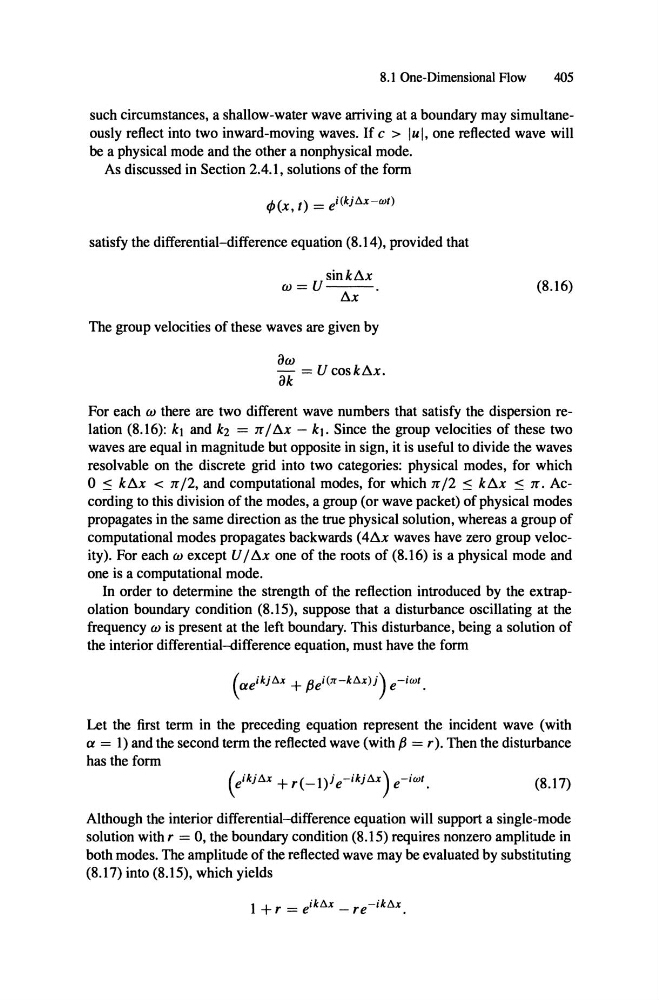
the interior differential-difference equation, must have the form
Let the first term in the preceding equation represent the incident wave (with
a = 1) and the second term the reflected wave (with ß = r). Then the disturbance
has the form
(8.17)
Although the interior differential-difference equation will support a single-mode
solution with r = 0, the boundary condition (8.15) requires nonzero amplitude in
both modes . The amplitude of the reflected wave may be evaluated by substituting
(8.17) into (8.15), which yields
1 +r = e i k6.x _ re- i k6.x.
405
such circumstances, a shallow-water wave arriving at a boundary may simultaneously reflect into two inward-moving waves. If c > luI, one reflected wave will
be a physical mode and the other a nonphysical mode .
As discussed in Section 2.4.1, solutions of the form
r/J(x, t) = e i (kj 6.x - wt )
satisfy the differential-difference equation (8.14), provided that
sin kt:.x
w=u--- t:.x
(8.16)
The group velocities of these waves are given by
aw
-
ak
= U coskt:.x .
For each w there are two different wave numbers that satisfy the dispersion relation (8.16): kl and ka = Jr / t:.x - kl oSince the group velocities of these two
waves are equal in magnitude but opposite in sign, it is useful to divide the waves
resolvable on the discrete grid into two categories: physical modes, for which
o :s k t:.x < Jr /2, and computational modes , for which n /2 :s k t:.x :s tt , According to this division of the modes, a group (or wave packet) of physical modes
propagates in the same direction as the true physical solution, whereas a group of
computational modes propagates backwards (4t:.x waves have zero group velocity). For each to except U / Sx one of the roots of (8.16) is a physical mode and
one is a computational mode.
In order to determine the strength of the reflection introduced by the extrapolation boundary condition (8.15), suppose that a disturbance oscillating at the
frequency ia is present at the left boundary. This disturbance, being a solution of
the interior differential-difference equation, must have the form
Let the first term in the preceding equation represent the incident wave (with
a = 1) and the second term the reflected wave (with ß = r). Then the disturbance
has the form
(8.17)
Although the interior differential-difference equation will support a single-mode
solution with r = 0, the boundary condition (8.15) requires nonzero amplitude in
both modes . The amplitude of the reflected wave may be evaluated by substituting
(8.17) into (8.15), which yields
1 +r = e i k6.x _ re- i k6.x.