

8.1 One-Dirnensional Flow
403
The first term in the preeeding represents the unit-amplitude wave propagating toward the boundary at x = 0, and the seeond term represents an arbitrary refleeted
wave propagating away from that boundary. The amplitude, wave number, and
phase of this refleeted wave are determined by the boundary eondition at x = O.
If the zero gradient eondition au/ax = 0 is enforeed at x = 0, then
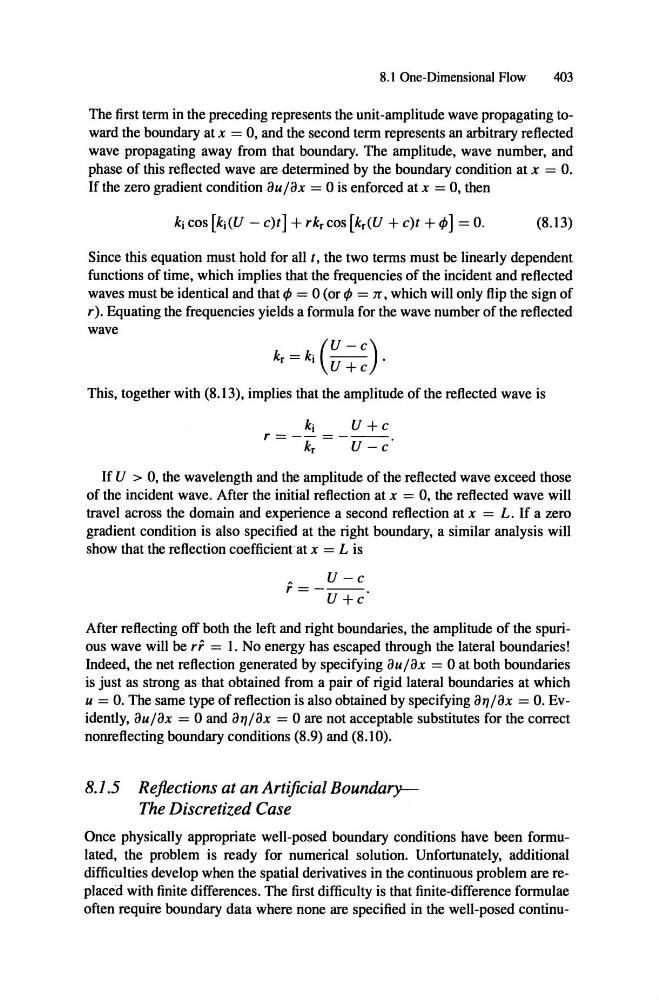
kj eos [kj(U - c)t] + rk, eos [kr(U + c)t + r/J] = O.
(8.13)
Sinee this equation must hold for all t, the two terms must be linearly dependent
funetions of time, which implies that the frequeneies of the incident and refleeted
waves must be identical and that r/J = 0 (or r/J = n , whieh will only flip the sign of
r). Equating the frequeneies yields a forrnula for the wave number of the refleeted
wave
k r = kj
.
This, together with (8.13), implies that the amplitude of the refleeted wave is
kj
U +c
r = - - = - - - .
k r
U-c
If U > 0, the wavelength and the amplitude of the refleeted wave exeeed those
of the incident wave. After the initial refleetion at x = 0, the refleeted wave will
travel aeross the domain and experienee a seeond refleetion at x = L. If a zero
gradient eondition is also specified at the right boundary, a similar analysis will
show that the refleetion coefficientat x = L is
A
U-c
r = - - - .
U+c
After refleeting off both the left and right boundaries, the amplitude of the spuri -
ous wave will be rr = I. No energy has eseaped through the lateral boundaries!
Indeed, the net refleetion generated by specifying au/ax = 0 at both boundaries
is just as strong as that obtained from a pair of rigid lateral boundaries at whieh
u = O. The same type ofrefleetion is also obtained byspecifying aT/lax = O. Evidently, au/ax = 0 and aT/lax = 0 are not aeeeptable substitutes for the eorreet
nonreflecting boundary eonditions (8.9) and (8.10).
8.1.5 Reflections at an Artificial BoundaryThe Discretized Case
Onee physically appropriate well-posed boundary eonditions have been formulated, the problem is ready for numerieal solution. Unfortunately, additional
diffieulties develop when the spatial derivatives in the eontinuous problem are replaeed with finite differenees. The first diffieulty is that finite-difference forrnulae
often require boundary data where none are speeified in the well-posed continu -
403
The first term in the preeeding represents the unit-amplitude wave propagating toward the boundary at x = 0, and the seeond term represents an arbitrary refleeted
wave propagating away from that boundary. The amplitude, wave number, and
phase of this refleeted wave are determined by the boundary eondition at x = O.
If the zero gradient eondition au/ax = 0 is enforeed at x = 0, then
kj eos [kj(U - c)t] + rk, eos [kr(U + c)t + r/J] = O.
(8.13)
Sinee this equation must hold for all t, the two terms must be linearly dependent
funetions of time, which implies that the frequeneies of the incident and refleeted
waves must be identical and that r/J = 0 (or r/J = n , whieh will only flip the sign of
r). Equating the frequeneies yields a forrnula for the wave number of the refleeted
wave
k r = kj
.
This, together with (8.13), implies that the amplitude of the refleeted wave is
kj
U +c
r = - - = - - - .
k r
U-c
If U > 0, the wavelength and the amplitude of the refleeted wave exeeed those
of the incident wave. After the initial refleetion at x = 0, the refleeted wave will
travel aeross the domain and experienee a seeond refleetion at x = L. If a zero
gradient eondition is also specified at the right boundary, a similar analysis will
show that the refleetion coefficientat x = L is
A
U-c
r = - - - .
U+c
After refleeting off both the left and right boundaries, the amplitude of the spuri -
ous wave will be rr = I. No energy has eseaped through the lateral boundaries!
Indeed, the net refleetion generated by specifying au/ax = 0 at both boundaries
is just as strong as that obtained from a pair of rigid lateral boundaries at whieh
u = O. The same type ofrefleetion is also obtained byspecifying aT/lax = O. Evidently, au/ax = 0 and aT/lax = 0 are not aeeeptable substitutes for the eorreet
nonreflecting boundary eonditions (8.9) and (8.10).
8.1.5 Reflections at an Artificial BoundaryThe Discretized Case
Onee physically appropriate well-posed boundary eonditions have been formulated, the problem is ready for numerieal solution. Unfortunately, additional
diffieulties develop when the spatial derivatives in the eontinuous problem are replaeed with finite differenees. The first diffieulty is that finite-difference forrnulae
often require boundary data where none are speeified in the well-posed continu -