

374
7. Physically Insignificant FastWaves
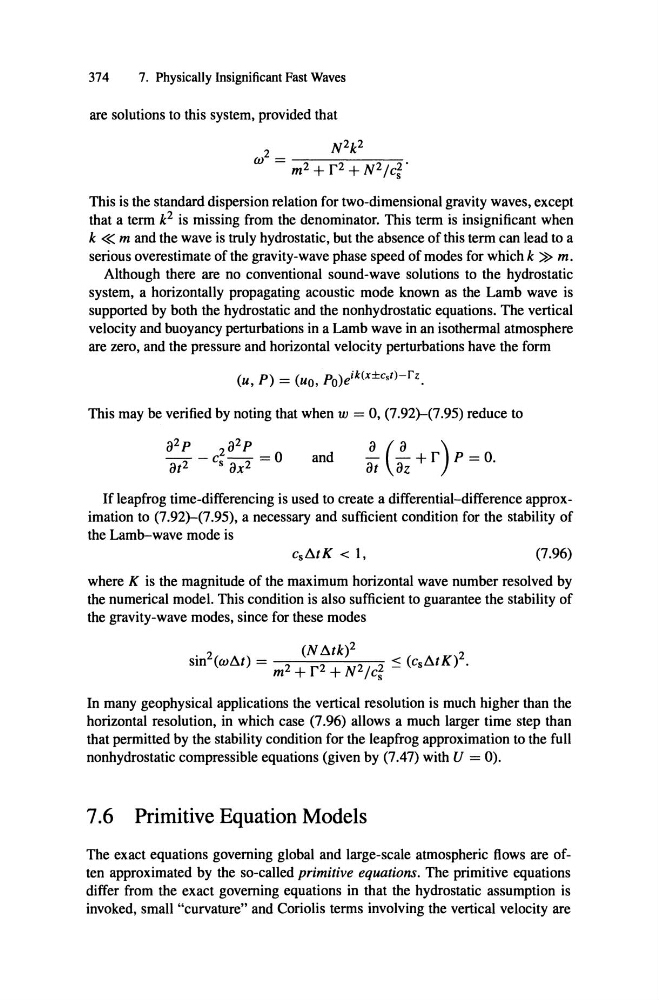
are solutions to this system, provided that
This is the standard dispersion relation for two-dimensional gravity waves, except
that a term k
2
is missing from the denominator. This term is insignificant when
k « m and the wave is truly hydrostatic, but the absence of this term can lead to a
serious overestimate of the gravity-wave phase speed of modes for which k » m.
Although there are no conventional sound-wave solutions to the hydrostatic
system, a horizontally propagating acoustic mode known as the Lamb wave is
supported by both the hydrostatic and the nonhydrostatic equations. The vertical
velocity and buoyancy perturbations in a Lamb wave in an isothermal atmosphere
are zero, and the pressure and horizontal velocity perturbations have the form
(u , P) = (uo , Po)eik(x±cst)-r z.
This may be verified by noting that when w = 0, (7.92)-(7.95) reduce to
and
at az
=0.
If leapfrog time-differencing is used to create a differential-difference approximation to (7.92)-(7.95), a necessary and sufficient condit ion for the stability of
the Lamb-wave mode is
csli.tK < I ,
(7.96)
where K is the magnitude of the maximum horizontal wave number resolved by
the numerical model. This condition is also sufficient to guarantee the stability of
the gravity-wave modes, since for these modes
. 2
(N li.tk)2
2
(csli.tK) .
sm (wli.t) = 2
2
2 2
m + r + N fc s
In many geophysical applications the vertical resolution is much higher than the
horizontal resolution, in which case (7.96) allows a much larger time step than
that permitted by the stability condition for the leapfrog approximation to the full
nonhydrostatic compressible equations (given by (7.47) with U = 0).
7.6 Primitive Equation Models
The exact equations goveming global and large-scale atmospheric ftows are often approximated by the so-called primitive equations. The primitive equations
differ from the exact goveming equations in that the hydrostatic assumption is
invoked, small "curvature" and Coriolis terms involving the vertical velocity are
7. Physically Insignificant FastWaves
are solutions to this system, provided that
This is the standard dispersion relation for two-dimensional gravity waves, except
that a term k
2
is missing from the denominator. This term is insignificant when
k « m and the wave is truly hydrostatic, but the absence of this term can lead to a
serious overestimate of the gravity-wave phase speed of modes for which k » m.
Although there are no conventional sound-wave solutions to the hydrostatic
system, a horizontally propagating acoustic mode known as the Lamb wave is
supported by both the hydrostatic and the nonhydrostatic equations. The vertical
velocity and buoyancy perturbations in a Lamb wave in an isothermal atmosphere
are zero, and the pressure and horizontal velocity perturbations have the form
(u , P) = (uo , Po)eik(x±cst)-r z.
This may be verified by noting that when w = 0, (7.92)-(7.95) reduce to
and
at az
=0.
If leapfrog time-differencing is used to create a differential-difference approximation to (7.92)-(7.95), a necessary and sufficient condit ion for the stability of
the Lamb-wave mode is
csli.tK < I ,
(7.96)
where K is the magnitude of the maximum horizontal wave number resolved by
the numerical model. This condition is also sufficient to guarantee the stability of
the gravity-wave modes, since for these modes
. 2
(N li.tk)2
2
(csli.tK) .
sm (wli.t) = 2
2
2 2
m + r + N fc s
In many geophysical applications the vertical resolution is much higher than the
horizontal resolution, in which case (7.96) allows a much larger time step than
that permitted by the stability condition for the leapfrog approximation to the full
nonhydrostatic compressible equations (given by (7.47) with U = 0).
7.6 Primitive Equation Models
The exact equations goveming global and large-scale atmospheric ftows are often approximated by the so-called primitive equations. The primitive equations
differ from the exact goveming equations in that the hydrostatic assumption is
invoked, small "curvature" and Coriolis terms involving the vertical velocity are