

360
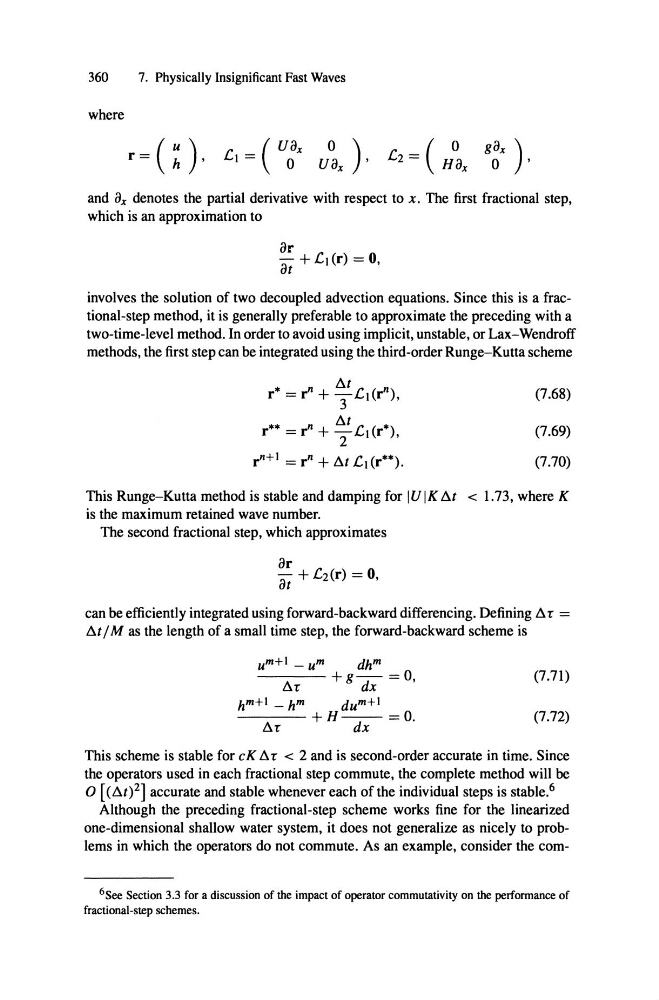
where
7. Physically Insignificant Fast Waves
) , L2 = (
and a x denotes the partial derivative with respeet to x . The first fraetional step,
which is an approximation to
ar
-
at
+LI(r) = 0,
involves the solution of two deeoupled adveetion equations. Sinee this is a fraetional-step method, it is generally preferable to approximate the preeeding with a
two-time-level method . In order to avoid using implieit, unstable , or Lax-Wendroff
methods, the first step ean be integrated using the third-order Runge-Kutta seheme
t:.t
r" =r" + 3"LI(r
t:.t
(7.68)
(7.69)
n ) ,
r** = r" + -LI (r"),
2
r
n
+
1 = r" + t:.t LI (r'").
(7.70)
This Runge-Kutta method is stable and damping for IUIK t:.t < 1.73, where K
is the maximum retained wave number.
The seeond fraetional step, whieh approximates
ar
- at + L2(r) = 0,
ean be efficiently integrated using forward -baekward differencing. Defining t:.r =
t:.t / M as the length of a small time step, the forward -backward seheme is
(7.71)
(7.72)
This seheme is stable for cK t:.r < 2 and is second-order accurate in time. Sinee
the operators used in eaeh fraetional step eommute, the eomplete method will be
o [(t:.t)2] accurate and stable whenever eaeh of the individual steps is stable ,?
Although the preeeding fraetional-step seheme works fine for the linearized
one-dimensional shallow water system, it does not generalize as nicely to problems in which the operators do not eommute. As an example, eonsider the com6See Section 3.3 for a discussion of the impact of operator commutativity on the performance of
fractional-step schemes .
where
7. Physically Insignificant Fast Waves
) , L2 = (
and a x denotes the partial derivative with respeet to x . The first fraetional step,
which is an approximation to
ar
-
at
+LI(r) = 0,
involves the solution of two deeoupled adveetion equations. Sinee this is a fraetional-step method, it is generally preferable to approximate the preeeding with a
two-time-level method . In order to avoid using implieit, unstable , or Lax-Wendroff
methods, the first step ean be integrated using the third-order Runge-Kutta seheme
t:.t
r" =r" + 3"LI(r
t:.t
(7.68)
(7.69)
n ) ,
r** = r" + -LI (r"),
2
r
n
+
1 = r" + t:.t LI (r'").
(7.70)
This Runge-Kutta method is stable and damping for IUIK t:.t < 1.73, where K
is the maximum retained wave number.
The seeond fraetional step, whieh approximates
ar
- at + L2(r) = 0,
ean be efficiently integrated using forward -baekward differencing. Defining t:.r =
t:.t / M as the length of a small time step, the forward -backward seheme is
(7.71)
(7.72)
This seheme is stable for cK t:.r < 2 and is second-order accurate in time. Sinee
the operators used in eaeh fraetional step eommute, the eomplete method will be
o [(t:.t)2] accurate and stable whenever eaeh of the individual steps is stable ,?
Although the preeeding fraetional-step seheme works fine for the linearized
one-dimensional shallow water system, it does not generalize as nicely to problems in which the operators do not eommute. As an example, eonsider the com6See Section 3.3 for a discussion of the impact of operator commutativity on the performance of
fractional-step schemes .