

22
1. Introduction
In order for an approximate set of governing equations to provide a physically
acceptable approximation to the dynamics of the unapproximated system, the approximate equations should conserve energy in the sense that the domain integral
of the total energy should be equal to the divergence of an energy flux through the
boundaries of the domain. The energy equation for the full compressible system
is
aE
-
at
(1.55)
+ V . [(E + p)v] = 0,
where
V , v
E=p ( T+gz+cvT
)
dp = °
dt
(1.56)
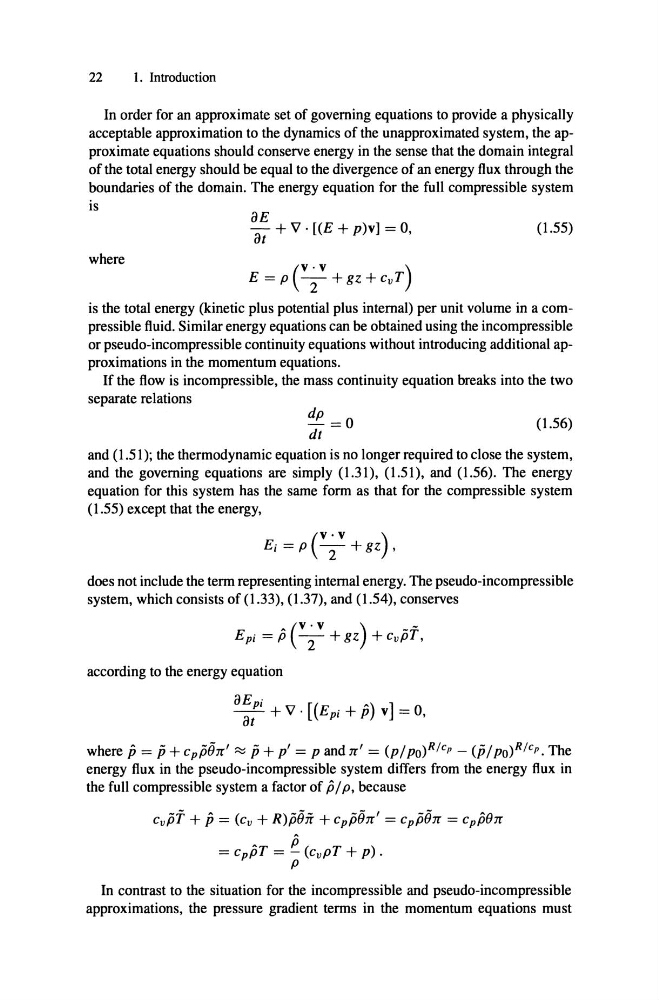
is the total energy (kinetic plus potential plus internal) per unit volume in a compressible fluid. Similar energy equations can be obtained using the incompressible
or pseudo-incompressible continuity equations without introducing additional approximations in the momentum equations .
If the flow is incompressible, the mass continuity equation breaks into the two
separate relations
and (1.51); the thermodynamic equation is no longer required to close the system,
and the governing equations are simply (1.31), (1.51), and (1.56). The energy
equation for this system has the same form as that for the compressible system
(1.55) except that the energy,
V ' V
T+gZ
E; =p (
) ,
does not include the term representing internal energy. The pseudo-incompressible
system, which consists of (1.33), (1.37), and (1.54), conservcs
V , v
)
-
E p; =p ( T+gZ +cvpT,
according to the energy equation
aE
p ; + V· [(E p ; + ß) vJ = 0,
at
where ß= P+ cppOrc' P+ p' = p and tt' = (pi PO)R /c p - (pi PO)R /cp. The
energy flux in the pseudo-incompressible system differs from the energy flux in
the full compressible system a factor of pip , because
cvpT + ß= (c v + R)pOir + cppOrc' = cppOrc = cpp()rc
= cppT =
p (cvpT + p) .
In contrast to the situation for the incompressible and pseudo-incompressible
approximations, the pressure gradient terms in the momentum equations must
1. Introduction
In order for an approximate set of governing equations to provide a physically
acceptable approximation to the dynamics of the unapproximated system, the approximate equations should conserve energy in the sense that the domain integral
of the total energy should be equal to the divergence of an energy flux through the
boundaries of the domain. The energy equation for the full compressible system
is
aE
-
at
(1.55)
+ V . [(E + p)v] = 0,
where
V , v
E=p ( T+gz+cvT
)
dp = °
dt
(1.56)
is the total energy (kinetic plus potential plus internal) per unit volume in a compressible fluid. Similar energy equations can be obtained using the incompressible
or pseudo-incompressible continuity equations without introducing additional approximations in the momentum equations .
If the flow is incompressible, the mass continuity equation breaks into the two
separate relations
and (1.51); the thermodynamic equation is no longer required to close the system,
and the governing equations are simply (1.31), (1.51), and (1.56). The energy
equation for this system has the same form as that for the compressible system
(1.55) except that the energy,
V ' V
T+gZ
E; =p (
) ,
does not include the term representing internal energy. The pseudo-incompressible
system, which consists of (1.33), (1.37), and (1.54), conservcs
V , v
)
-
E p; =p ( T+gZ +cvpT,
according to the energy equation
aE
p ; + V· [(E p ; + ß) vJ = 0,
at
where ß= P+ cppOrc' P+ p' = p and tt' = (pi PO)R /c p - (pi PO)R /cp. The
energy flux in the pseudo-incompressible system differs from the energy flux in
the full compressible system a factor of pip , because
cvpT + ß= (c v + R)pOir + cppOrc' = cppOrc = cpp()rc
= cppT =
p (cvpT + p) .
In contrast to the situation for the incompressible and pseudo-incompressible
approximations, the pressure gradient terms in the momentum equations must