

6.4 Alternative Trajectories
329
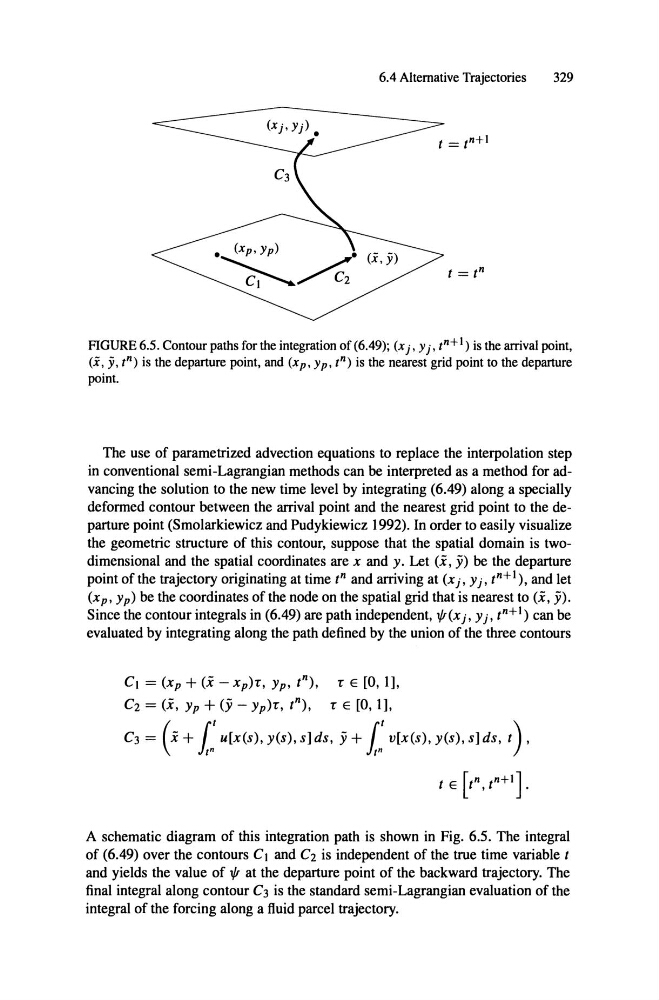
RGURE 6.5. Contour paths for the integration of (6.49); (x i- Yi - t n +I) is the arrival point,
(x , y, r") is the departure point, and (x p, Yp, r") is the nearest grid point to the departure
point.
The use of parametrized advection equations to replace the interpolation step
in conventional semi-Lagrangian methods can be interpreted as a method for advancing the solution to the new time level by integrating (6.49) along a specially
deformed contour between the arrival point and the nearest grid point to the departure point (Smolarkiewicz and Pudykiewicz 1992) . In order to easily visualize
the geometric structure of this contour, suppose that the spatial domain is twodimensional and the spatial coordinates are x and y. Let (i, y) be the departure
point of the trajectory originating at time t" and arriving at (x i- yi- t n +I), and let
(x p , Yp) be the coordinates ofthe node on the spatial grid that is nearest to (i, y).
Since the contour integrals in (6.49) are path independent, 1/J(x i- Yi- t n +I) can be
evaluated by integrating along the path defined by the union of the three contours
CI = (x p + (i - xp)r, Yp» t
n ) ,
rE [0, 1],
C2 = (i , Yp + (y - Yph , r"), r E [0, 1],
C3 = (i + /: u[x(s), y(s), s] ds, Y+ /: v[x(s) , y(s) , s] ds, t) ,
tE [tn, tn+IJ .
A schematic diagram of this integration path is shown in Fig. 6.5. The integral
of (6.49) over the contours CI and C2 is independent of the true time variable t
and yields the value of 1/J at the departure point of the backward trajectory. The
final integral along contour C3 is the standard serni-Lagrangian evaluation of the
integral of the forcing along a fluid parcel trajectory.
329
RGURE 6.5. Contour paths for the integration of (6.49); (x i- Yi - t n +I) is the arrival point,
(x , y, r") is the departure point, and (x p, Yp, r") is the nearest grid point to the departure
point.
The use of parametrized advection equations to replace the interpolation step
in conventional semi-Lagrangian methods can be interpreted as a method for advancing the solution to the new time level by integrating (6.49) along a specially
deformed contour between the arrival point and the nearest grid point to the departure point (Smolarkiewicz and Pudykiewicz 1992) . In order to easily visualize
the geometric structure of this contour, suppose that the spatial domain is twodimensional and the spatial coordinates are x and y. Let (i, y) be the departure
point of the trajectory originating at time t" and arriving at (x i- yi- t n +I), and let
(x p , Yp) be the coordinates ofthe node on the spatial grid that is nearest to (i, y).
Since the contour integrals in (6.49) are path independent, 1/J(x i- Yi- t n +I) can be
evaluated by integrating along the path defined by the union of the three contours
CI = (x p + (i - xp)r, Yp» t
n ) ,
rE [0, 1],
C2 = (i , Yp + (y - Yph , r"), r E [0, 1],
C3 = (i + /: u[x(s), y(s), s] ds, Y+ /: v[x(s) , y(s) , s] ds, t) ,
tE [tn, tn+IJ .
A schematic diagram of this integration path is shown in Fig. 6.5. The integral
of (6.49) over the contours CI and C2 is independent of the true time variable t
and yields the value of 1/J at the departure point of the backward trajectory. The
final integral along contour C3 is the standard serni-Lagrangian evaluation of the
integral of the forcing along a fluid parcel trajectory.