

6.4 Alternative Trajectories
327
the deviation of u; frorn the average velocity along the back trajectory is sufficiently small. Let u = (Xj - it
l )/ (2ßt ) be the average velocity required to
arrive at the true departure point and define the deviation of the velocity at the
midpoint as v = u* - u.Then
p Sx
_
p Sx
u: = u* - 2/),.t = u - 2/),.t + v,
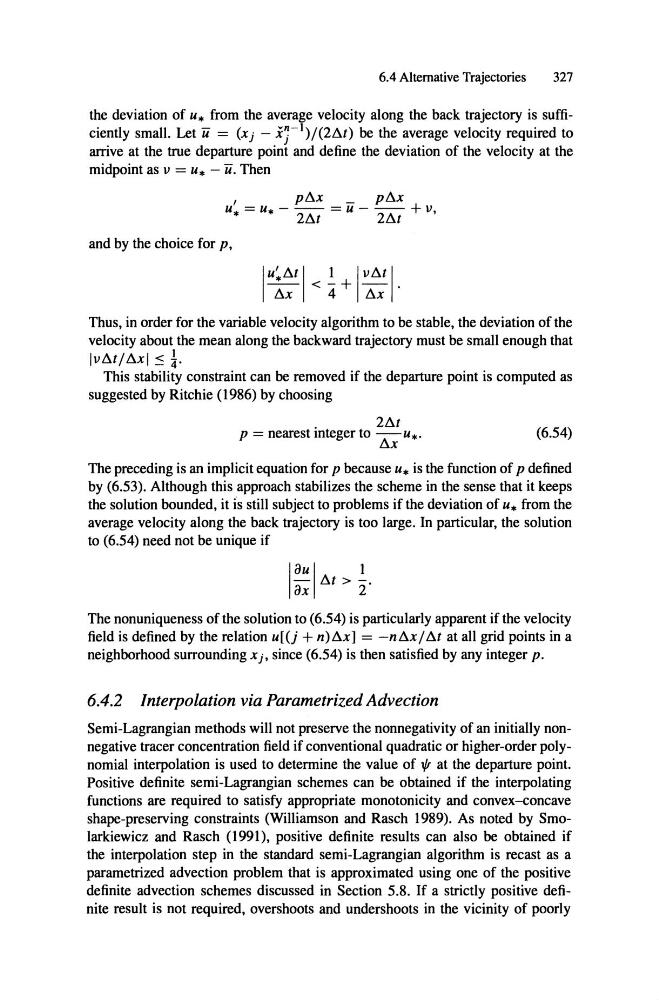
and by the choice for p ,
Thus, in order for the variable velocity algorithm to be stable, the deviation of the
velocity about the mean along the backward trajectory must be small enough that
Iv/),.t/ /),.X I :::
This stability constraint can be removed if the departure point is computed as
suggested by Ritchie (1986) by choosing
.
2/),.t
p = nearest Integer to --u*.
(6.54)
/),.X
The preceding is an implicit equation for p because u; is the function of p defined
by (6.53). Although this approach stabilizes the scheme in the sense that it keeps
the solution bounded, it IS still subject to problems if the deviation of u* from the
average velocity along the back trajectory is too large. In particular, the solution
to (6.54) need not be unique if
auI
1
ax si » 2°
l
The nonuniqueness of the solution to (6.54) is particularly apparent if the velocity
field is defined by the relation u [(j + n) /),.x] = -n /),.x/ /),.t at all grid points in a
neighborhood surrounding Xj, since (6.54) is then satisfied by any integer p.
6.4.2 Interpolation via Parametrized Advection
Semi-Lagrangian methods will not preserve the nonnegativity of an initially nonnegative tracer concentration field if conventional quadratic or higher-order polynomial interpolation is used to deterrnine the value of 1/1 at the departure point.
Positive definite semi-Lagrangian schemes can be obtained if the interpolating
functions are required to satisfy appropriate monotonicity and convex-concave
shape-preserving constraints (Williamson and Rasch 1989). As noted by Smolarkiewicz and Rasch (1991), positive definite results can also be obtained if
the interpolation step in the standard semi-Lagrangian algorithm is recast as a
parametrized advection problem that is approximated using one of the positive
definite advection schemes discussed in Section 5.8. If a strictly positive definite result is not required , overshoots and undershoots in the vicinity of poorly
327
the deviation of u; frorn the average velocity along the back trajectory is sufficiently small. Let u = (Xj - it
l )/ (2ßt ) be the average velocity required to
arrive at the true departure point and define the deviation of the velocity at the
midpoint as v = u* - u.Then
p Sx
_
p Sx
u: = u* - 2/),.t = u - 2/),.t + v,
and by the choice for p ,
Thus, in order for the variable velocity algorithm to be stable, the deviation of the
velocity about the mean along the backward trajectory must be small enough that
Iv/),.t/ /),.X I :::
This stability constraint can be removed if the departure point is computed as
suggested by Ritchie (1986) by choosing
.
2/),.t
p = nearest Integer to --u*.
(6.54)
/),.X
The preceding is an implicit equation for p because u; is the function of p defined
by (6.53). Although this approach stabilizes the scheme in the sense that it keeps
the solution bounded, it IS still subject to problems if the deviation of u* from the
average velocity along the back trajectory is too large. In particular, the solution
to (6.54) need not be unique if
auI
1
ax si » 2°
l
The nonuniqueness of the solution to (6.54) is particularly apparent if the velocity
field is defined by the relation u [(j + n) /),.x] = -n /),.x/ /),.t at all grid points in a
neighborhood surrounding Xj, since (6.54) is then satisfied by any integer p.
6.4.2 Interpolation via Parametrized Advection
Semi-Lagrangian methods will not preserve the nonnegativity of an initially nonnegative tracer concentration field if conventional quadratic or higher-order polynomial interpolation is used to deterrnine the value of 1/1 at the departure point.
Positive definite semi-Lagrangian schemes can be obtained if the interpolating
functions are required to satisfy appropriate monotonicity and convex-concave
shape-preserving constraints (Williamson and Rasch 1989). As noted by Smolarkiewicz and Rasch (1991), positive definite results can also be obtained if
the interpolation step in the standard semi-Lagrangian algorithm is recast as a
parametrized advection problem that is approximated using one of the positive
definite advection schemes discussed in Section 5.8. If a strictly positive definite result is not required , overshoots and undershoots in the vicinity of poorly