

308
6. Semi-Lagrangian Methods
coincides with a grid point. This may be compared with Eulerian upstream differencing, which is exact for a Courant number of unity (see Sections 2.5.1 and
2.5.2) . In practical applications the wind speed and therefore the Courant number
are functions of space and time . Stability constraints require the Eulerian upstream
method to be integrated using a time step that ensures that the maximum Courant
number will be less than one at every point within the computational domain. As a
consequence of this restriction on 6.1, the domain-averaged Courant number is often substantially less than the optimal value ofunity. In contrast, the unconditional
stability of the semi-Lagrangian scheme allows the time step to be chosen such
that the average value of the Courant number is unity-or any integer-thereby
reducing the average truncation error throughout the computational domain.
Higher-Order Interpolation
Upstream differencing generates too much numerical diffusion to be useful in
practical computations involving Eulerian problems with smooth solutions. A
similar situation holds in the Lagrangian framework, where linearly interpolating
the tracer field also generates too much diffusion. Higher-order interpolation is
therefore used in most semi-Lagrangian approximations to equations with smooth
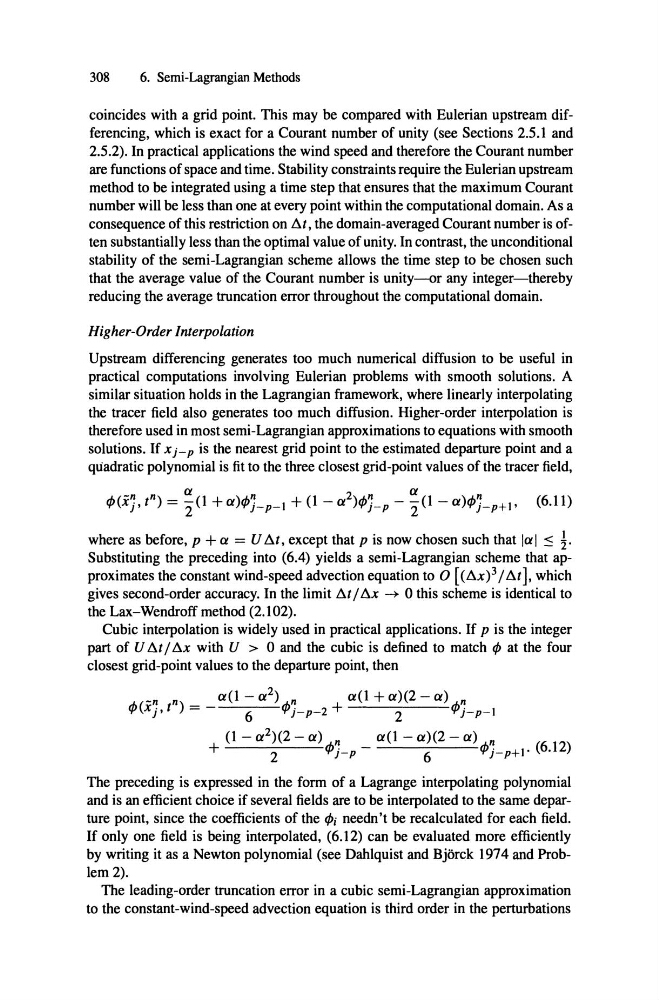
solutions . If x j _ p is the nearest grid point to the estimated departure point and a
quadratic polynomial is fit to the three closest grid-point values of the tracer field,
where as before, p + a = U 6.t, except that p is now chosen such that Ja I :::: 1.
Substituting the preceding into (6.4) yields a semi-Lagrangian scheme that approximates the constant wind-speed advection equation to 0 [(6.x)3 / 6.t l- which
gives second -order accuracy. In the limit 6.1/ 6.x
the Lax-Wendroff method (2.102).
0 this scheme is identical to
Cubic interpolation is widely used in practical applications. If p is the integer
part of U 6.// 6.x with U > 0 and the cubic is defined to match r/J at the four
closest grid-point values to the departure point, then
A..(i'! In) = _ a(l - (
2 ) A..' !
+ a(l + a)(2 - a) A..' !
Y'
J'
6
Y'J-p-2
2
Y'J-p-l
+ (l - (
2 ) (2 - a) r/J' !
a(l - a)(2 - a) r/J' !
(612)
2
J-P
6
J-P+)"
The preceding is expressed in the form of a Lagrange interpolating polynomial
and is an efficient choice if several fields are to be interpolated to the same departure point, since the coefficients of the r/Ji needn 't be recalculated for each field.
If only one field is being interpolated, (6.12) can be evaluated more efficiendy
by writing it as a Newton polynomial (see Dahlquist and Björck 1974 and Problem 2).
The leading-order truncation error in a cubic semi-Lagrangian approximation
to the constant-wind -speed advection equation is third order in the perturbations
6. Semi-Lagrangian Methods
coincides with a grid point. This may be compared with Eulerian upstream differencing, which is exact for a Courant number of unity (see Sections 2.5.1 and
2.5.2) . In practical applications the wind speed and therefore the Courant number
are functions of space and time . Stability constraints require the Eulerian upstream
method to be integrated using a time step that ensures that the maximum Courant
number will be less than one at every point within the computational domain. As a
consequence of this restriction on 6.1, the domain-averaged Courant number is often substantially less than the optimal value ofunity. In contrast, the unconditional
stability of the semi-Lagrangian scheme allows the time step to be chosen such
that the average value of the Courant number is unity-or any integer-thereby
reducing the average truncation error throughout the computational domain.
Higher-Order Interpolation
Upstream differencing generates too much numerical diffusion to be useful in
practical computations involving Eulerian problems with smooth solutions. A
similar situation holds in the Lagrangian framework, where linearly interpolating
the tracer field also generates too much diffusion. Higher-order interpolation is
therefore used in most semi-Lagrangian approximations to equations with smooth
solutions . If x j _ p is the nearest grid point to the estimated departure point and a
quadratic polynomial is fit to the three closest grid-point values of the tracer field,
where as before, p + a = U 6.t, except that p is now chosen such that Ja I :::: 1.
Substituting the preceding into (6.4) yields a semi-Lagrangian scheme that approximates the constant wind-speed advection equation to 0 [(6.x)3 / 6.t l- which
gives second -order accuracy. In the limit 6.1/ 6.x
the Lax-Wendroff method (2.102).
0 this scheme is identical to
Cubic interpolation is widely used in practical applications. If p is the integer
part of U 6.// 6.x with U > 0 and the cubic is defined to match r/J at the four
closest grid-point values to the departure point, then
A..(i'! In) = _ a(l - (
2 ) A..' !
+ a(l + a)(2 - a) A..' !
Y'
J'
6
Y'J-p-2
2
Y'J-p-l
+ (l - (
2 ) (2 - a) r/J' !
a(l - a)(2 - a) r/J' !
(612)
2
J-P
6
J-P+)"
The preceding is expressed in the form of a Lagrange interpolating polynomial
and is an efficient choice if several fields are to be interpolated to the same departure point, since the coefficients of the r/Ji needn 't be recalculated for each field.
If only one field is being interpolated, (6.12) can be evaluated more efficiendy
by writing it as a Newton polynomial (see Dahlquist and Björck 1974 and Problem 2).
The leading-order truncation error in a cubic semi-Lagrangian approximation
to the constant-wind -speed advection equation is third order in the perturbations