

276
5. Finite-Volume Methods
.
•
.
.
·
·
•
.
. .
:
.
: / :
· ·
. .
· ·
.
.
. .
. .
· ·
.
0
. :
.
·
. :
:
x
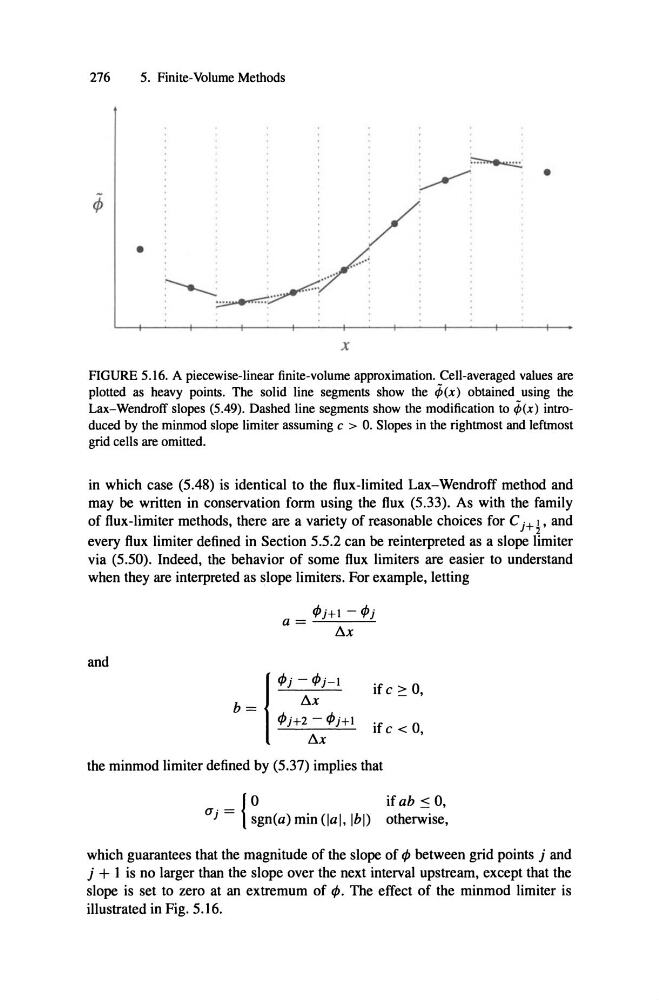
FIGURE 5.16. A piecewise-linear finite-volume approximation. Cell-averaged values are
plotted as heavy points. The solid line segments show the (i> (x ) obtained using the
Lax-Wendroff slopes (5.49). Dashed line segments show the modification to (i>(x) introduced by the minmod slope limiter assuming c > O. Slopes in the rightmost and leftmost
grid cells are omitted.
in which case (5.48) is identical to the flux-limited Lax-Wendroff method and
may be written in conservation form using the flux (5.33). As with the family
of flux-limiter methods, there are a variety of reasonable choices for C j+!' and
every flux limiter defined in Section 5.5 .2 can be reinterpreted as a slope limiter
via (5.50) . Indeed, the behavior of some flux limiters are easier to understand
when they are interpreted as slope limitcrs. For exampIe, letting
a = r/J '+l-r/J '
J
J
l:i.x
and
r/Jj - r/Jj-l
b _
l:i.x
- { r/Jj+2 - r/Jj+l
if e 0,
ife < 0,
the minmod limiter defined by (5.37) implies that
0
if ab 0,
Gj = { sgn(a) min (lai, Ibl) otherwise,
which guarantees that the magnitude of the slope of r/J between grid points j and
j + I is no larger than the slope over the next interval upstream, except that the
slope is set to zero at an extremum of r/J. The effect of the minmod limiter is
illustrated in Fig. 5.16.
5. Finite-Volume Methods
.
•
.
.
·
·
•
.
. .
:
.
: / :
· ·
. .
· ·
.
.
. .
. .
· ·
.
0
. :
.
·
. :
:
x
FIGURE 5.16. A piecewise-linear finite-volume approximation. Cell-averaged values are
plotted as heavy points. The solid line segments show the (i> (x ) obtained using the
Lax-Wendroff slopes (5.49). Dashed line segments show the modification to (i>(x) introduced by the minmod slope limiter assuming c > O. Slopes in the rightmost and leftmost
grid cells are omitted.
in which case (5.48) is identical to the flux-limited Lax-Wendroff method and
may be written in conservation form using the flux (5.33). As with the family
of flux-limiter methods, there are a variety of reasonable choices for C j+!' and
every flux limiter defined in Section 5.5 .2 can be reinterpreted as a slope limiter
via (5.50) . Indeed, the behavior of some flux limiters are easier to understand
when they are interpreted as slope limitcrs. For exampIe, letting
a = r/J '+l-r/J '
J
J
l:i.x
and
r/Jj - r/Jj-l
b _
l:i.x
- { r/Jj+2 - r/Jj+l
if e 0,
ife < 0,
the minmod limiter defined by (5.37) implies that
0
if ab 0,
Gj = { sgn(a) min (lai, Ibl) otherwise,
which guarantees that the magnitude of the slope of r/J between grid points j and
j + I is no larger than the slope over the next interval upstream, except that the
slope is set to zero at an extremum of r/J. The effect of the minmod limiter is
illustrated in Fig. 5.16.