

270
5. Finite-Volume Methods
Scheme
Upstream
Minmod Flux-Limiter
Superbee Flux-Limiter
ZaiesakFCT
MC Flux-Limiter
Lax-Wendroff
Estimated Order 0/Accuracy
0.9
1.6
1.6
1.7
1.9
2.0
TABLE 5.1. Empirically determined order of accuracy for constant-wind-speed advection
of a sine wave
x
3
x
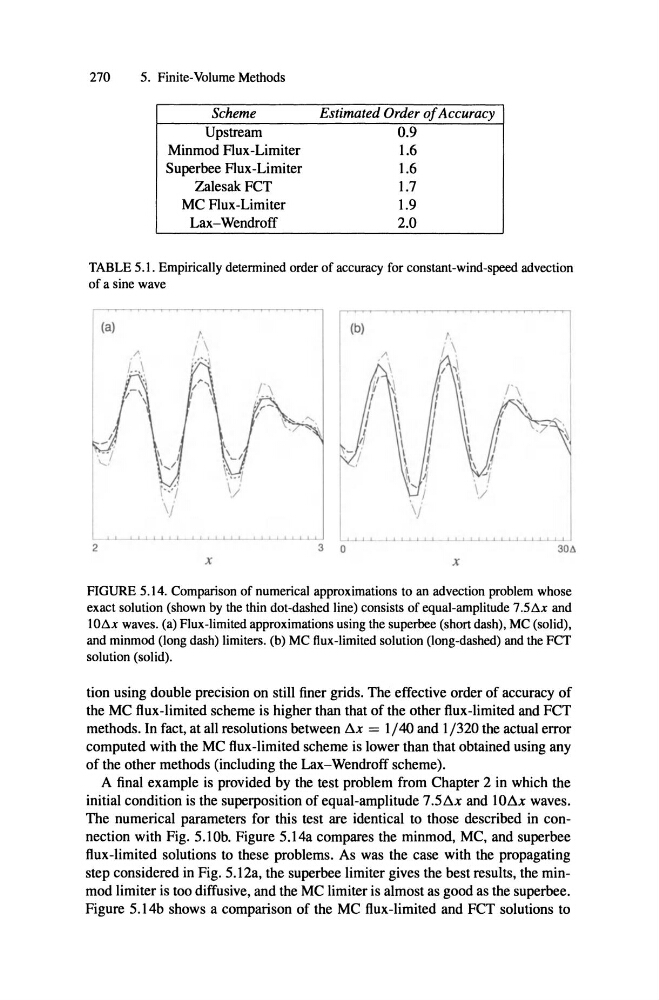
FlGURE 5.14 . Comparison of numerical approximations to an advection problem whose
exact solution (shown by the thin dot-dashed line) consists of equal-amplitude 7.5tH and
10ßx waves. (a) Flux-limited approximations using the superbee (short dash), MC (solid).
and minmod (Iong dash) limiters. (b) MC flux-limited solution (long-dashed) and the FCT
solution (solid).
tion using double precision on still finer grids . The effective order of accuracy of
the MC flux-limited scheme is higher than that of the other flux-limited and FCT
methods. Infact, at all resolutions between l:i.x = 1/40 and 1/320 the actual error
computed with the MC flux-limited scheme is lower than that obtained using any
of the other methods (including the Lax-Wendroff scheme).
A final example is provided by the test problem from Chapter 2 in which the
initial condition is the superposition of equal -amplitude 7.51:i.x and IOl:i.x waves.
The numerical parameters for this test are identical to those described in connection with Fig. 5.10b. Figure 5.14a compares the minmod, MC, and superbee
flux-limited solutions to these problems. As was the case with the propagating
step considered in Fig. 5.12a, the superbee limiter gives the best results, the minmod limiter is too diffusive, and the MC limiter is almost as good as the superbee.
Figure 5.14b shows a comparison of the MC flux-limited and FCT solutions to
5. Finite-Volume Methods
Scheme
Upstream
Minmod Flux-Limiter
Superbee Flux-Limiter
ZaiesakFCT
MC Flux-Limiter
Lax-Wendroff
Estimated Order 0/Accuracy
0.9
1.6
1.6
1.7
1.9
2.0
TABLE 5.1. Empirically determined order of accuracy for constant-wind-speed advection
of a sine wave
x
3
x
FlGURE 5.14 . Comparison of numerical approximations to an advection problem whose
exact solution (shown by the thin dot-dashed line) consists of equal-amplitude 7.5tH and
10ßx waves. (a) Flux-limited approximations using the superbee (short dash), MC (solid).
and minmod (Iong dash) limiters. (b) MC flux-limited solution (long-dashed) and the FCT
solution (solid).
tion using double precision on still finer grids . The effective order of accuracy of
the MC flux-limited scheme is higher than that of the other flux-limited and FCT
methods. Infact, at all resolutions between l:i.x = 1/40 and 1/320 the actual error
computed with the MC flux-limited scheme is lower than that obtained using any
of the other methods (including the Lax-Wendroff scheme).
A final example is provided by the test problem from Chapter 2 in which the
initial condition is the superposition of equal -amplitude 7.51:i.x and IOl:i.x waves.
The numerical parameters for this test are identical to those described in connection with Fig. 5.10b. Figure 5.14a compares the minmod, MC, and superbee
flux-limited solutions to these problems. As was the case with the propagating
step considered in Fig. 5.12a, the superbee limiter gives the best results, the minmod limiter is too diffusive, and the MC limiter is almost as good as the superbee.
Figure 5.14b shows a comparison of the MC flux-limited and FCT solutions to