

268
5. Finite-Volume Methods
(a)
3
2
I (b)
I1/
. . . .
/ .
I
:
I
I " "
0
I
....x. ,
,
. ....
, , ,
"
\
\ \ \ ,
\
\
\ ,
,
/
I
I
I
I
I
I
I
I
I
I
I
" .... _. :-. ."::.:....
.. .
/
"I :
x
, I
30t.
x
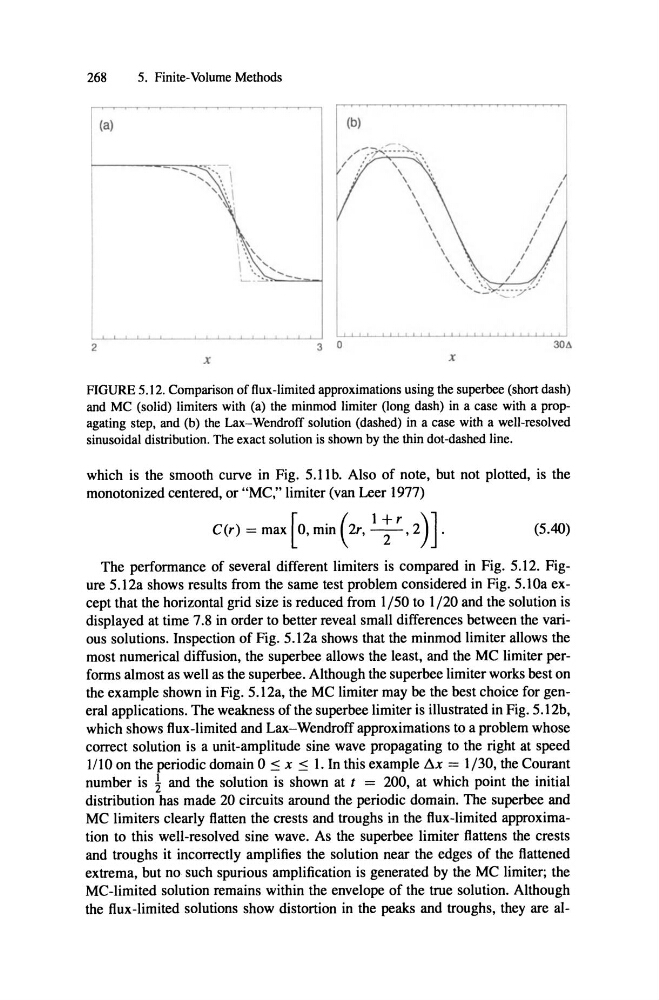
FIGURE 5.12. Comparison of ftux-Iimited approximations using the superbee (short dash)
and MC (solid) Iimiters with (a) the minmod Iimiter (Iong dash) in a case with a propagating step, and (b) the Lax-Wendroff solution (dashed) in a case with a well-resolved
sinusoidal distribution. The exact solution is shown by the thin dot-dashed line.
which is the smooth curve in Fig. 5.11b. Also of note, but not plotted, is the
monotonized centered, or "MC," limiter (van Leer 1977)
C(r) = max [0, min (2r, I ; r , 2) ] .
(5.40)
The performance of several different limiters is compared in Fig. 5.12. Figure 5.12a shows results from the same test problem considered in Fig. 5.lOa except that the horizontal grid size is reduced from I/50 to 1/20 and the solution is
displayed at time 7.8 in order to better reveal small differences between the various solutions. Inspection of Fig. 5.12a shows that the minmod limiter allows the
most numerical diffusion, the superbee allows the least, and the MC limiter performs almost as weil as the superbee. Although the superbee limiter works best on
the example shown in Fig. 5.12a, the MC limiter may be the best choice for general applications. The weakness of the superbee limiter is illustrated in Fig. 5.12b,
which shows flux-limited and Lax-Wendroff approximations to a problem whose
correct solution is a unit-amplitude sine wave propagating to the right at speed
1/10 on the periodic domain 0 x
I. In this example 8x = 1/30, the Courant
number is and the solution is shown at t = 200, at which point the initial
distribution has made 20 circuits around the periodic domain. The superbee and
MC limiters clearly flatten the crests and troughs in the flux-limited approximation to this well-resolved sine wave. As the superbee limiter flattens the crests
and troughs it incorrectly amplifies the solution near the edges of the flattened
extrema, but no such spurious amplification is generated by the MC limiter; the
MC-limited solution remains within the envelope of the true solution. Although
the flux-Iimited solutions show distortion in the peaks and troughs, they are al-
5. Finite-Volume Methods
(a)
3
2
I (b)
I1/
. . . .
/ .
I
:
I
I " "
0
I
....x. ,
,
. ....
, , ,
"
\
\ \ \ ,
\
\
\ ,
,
/
I
I
I
I
I
I
I
I
I
I
I
" .... _. :-. ."::.:....
.. .
/
"I :
x
, I
30t.
x
FIGURE 5.12. Comparison of ftux-Iimited approximations using the superbee (short dash)
and MC (solid) Iimiters with (a) the minmod Iimiter (Iong dash) in a case with a propagating step, and (b) the Lax-Wendroff solution (dashed) in a case with a well-resolved
sinusoidal distribution. The exact solution is shown by the thin dot-dashed line.
which is the smooth curve in Fig. 5.11b. Also of note, but not plotted, is the
monotonized centered, or "MC," limiter (van Leer 1977)
C(r) = max [0, min (2r, I ; r , 2) ] .
(5.40)
The performance of several different limiters is compared in Fig. 5.12. Figure 5.12a shows results from the same test problem considered in Fig. 5.lOa except that the horizontal grid size is reduced from I/50 to 1/20 and the solution is
displayed at time 7.8 in order to better reveal small differences between the various solutions. Inspection of Fig. 5.12a shows that the minmod limiter allows the
most numerical diffusion, the superbee allows the least, and the MC limiter performs almost as weil as the superbee. Although the superbee limiter works best on
the example shown in Fig. 5.12a, the MC limiter may be the best choice for general applications. The weakness of the superbee limiter is illustrated in Fig. 5.12b,
which shows flux-limited and Lax-Wendroff approximations to a problem whose
correct solution is a unit-amplitude sine wave propagating to the right at speed
1/10 on the periodic domain 0 x
I. In this example 8x = 1/30, the Courant
number is and the solution is shown at t = 200, at which point the initial
distribution has made 20 circuits around the periodic domain. The superbee and
MC limiters clearly flatten the crests and troughs in the flux-limited approximation to this well-resolved sine wave. As the superbee limiter flattens the crests
and troughs it incorrectly amplifies the solution near the edges of the flattened
extrema, but no such spurious amplification is generated by the MC limiter; the
MC-limited solution remains within the envelope of the true solution. Although
the flux-Iimited solutions show distortion in the peaks and troughs, they are al-