

262
5. Finite-Volume Methods
(a)
o
1
x
(b)
306
0
x
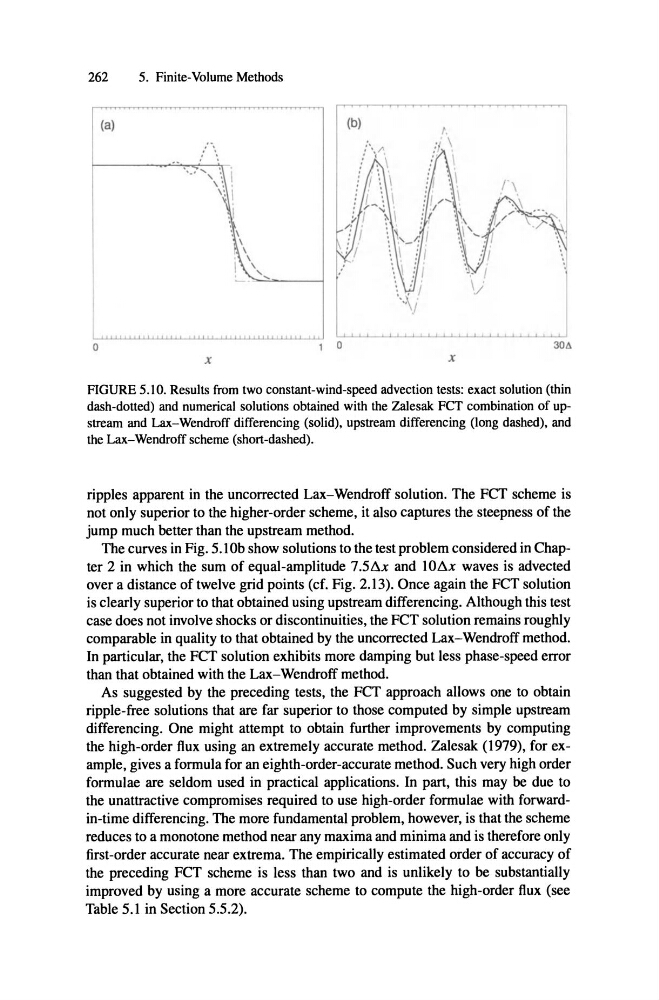
FIGURE 5.10. Results from two constant-wind-speed advection tests: exact solution (thin
dash-dotted) and numerical solutions obtained with the Zalesak FeT combination of upstrearn and Lax-Wendroff differencing (solid), upstream differencing (long dashed), and
the Lax-Wendroff scheme (short-dashed).
ripplcs apparent in the uncorrected Lax-Wendroff solution. The FCT scheme is
not only superior to the higher-order scheme, it also captures the steepness of the
jump much better than the upstream method.
The curves in Fig. 5.IOb show solutions to the test problem considered in Chapter 2 in which the sum of equal-amplitude 7.5!':l.x and IO!':l.x waves is advected
over a distance of twelve grid points (cf. Fig. 2.13). Once again the FCT solution
is cIearly superior to that obtained using upstream differencing. Although this test
case does not involve shocks or discontinuities, the FCT solution remains roughly
comparable in quality to that obtained by the uncorrected Lax-Wendroff method.
In particular, the FCT solution exhibits more damping but less phase-speed error
than that obtained with the Lax-Wendroff method.
As suggested by the preceding tests, the FCT approach allows one to obtain
ripple-free solutions that are far superior to those computed by simple upstream
differencing. One might attempt to obtain further improvements by computing
the high-order flux using an extremely accurate method. Zalesak (1979), for example, gives a formula for an eighth -order-accurate method. Such very high order
formulae are seidom used in practical applications. In part, this may be due to
the unattractive compromises required to use high-order formulae with forwardin-time differencing. The more fundamental problem, however, is that the scheme
reduces to a monotone method near any maxima and minima and is therefore only
first-order accurate near extrema . The empirically estimated order of accuracy of
the preceding FCT scheme is less than two and is unlikely to be substantially
improved by using a more accurate scheme to compute the high-order flux (see
Table 5.I in Section 5.5.2).
5. Finite-Volume Methods
(a)
o
1
x
(b)
306
0
x
FIGURE 5.10. Results from two constant-wind-speed advection tests: exact solution (thin
dash-dotted) and numerical solutions obtained with the Zalesak FeT combination of upstrearn and Lax-Wendroff differencing (solid), upstream differencing (long dashed), and
the Lax-Wendroff scheme (short-dashed).
ripplcs apparent in the uncorrected Lax-Wendroff solution. The FCT scheme is
not only superior to the higher-order scheme, it also captures the steepness of the
jump much better than the upstream method.
The curves in Fig. 5.IOb show solutions to the test problem considered in Chapter 2 in which the sum of equal-amplitude 7.5!':l.x and IO!':l.x waves is advected
over a distance of twelve grid points (cf. Fig. 2.13). Once again the FCT solution
is cIearly superior to that obtained using upstream differencing. Although this test
case does not involve shocks or discontinuities, the FCT solution remains roughly
comparable in quality to that obtained by the uncorrected Lax-Wendroff method.
In particular, the FCT solution exhibits more damping but less phase-speed error
than that obtained with the Lax-Wendroff method.
As suggested by the preceding tests, the FCT approach allows one to obtain
ripple-free solutions that are far superior to those computed by simple upstream
differencing. One might attempt to obtain further improvements by computing
the high-order flux using an extremely accurate method. Zalesak (1979), for example, gives a formula for an eighth -order-accurate method. Such very high order
formulae are seidom used in practical applications. In part, this may be due to
the unattractive compromises required to use high-order formulae with forwardin-time differencing. The more fundamental problem, however, is that the scheme
reduces to a monotone method near any maxima and minima and is therefore only
first-order accurate near extrema . The empirically estimated order of accuracy of
the preceding FCT scheme is less than two and is unlikely to be substantially
improved by using a more accurate scheme to compute the high-order flux (see
Table 5.I in Section 5.5.2).