

8
I. Introduction
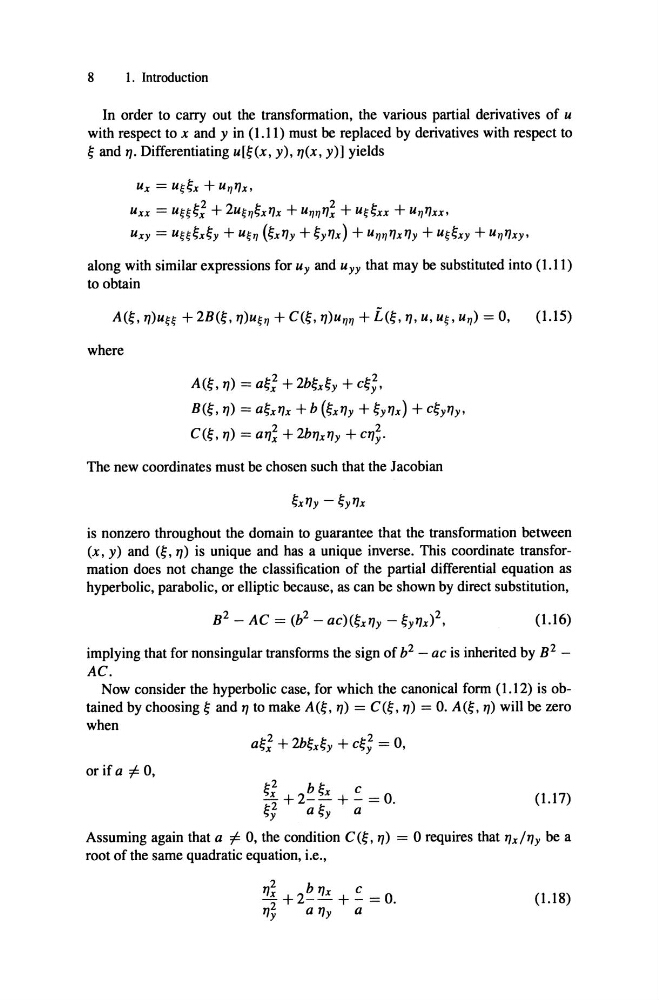
In order to carry out the transfonnation, the various partial derivatives of U
with respect to x and y in (1.11) must be replaced by derivatives with respect to
and 1/. Differentiating
y) , ntx , y)] yields
Ux =
Uxx =
uxy =
+ U,,1/x ,
+
+ ul;"
+ u,,1/xy ,
+ u",,1/; +
+ u,,1/xx,
+
+ u",,1/x1/y +
along with similar expressions for uy and " v» that may be substituted into (1.11)
to obtain
(1.15)
where
1/) =
1/) =
+
+ b
+
+
+
1/) = a1/; + 2b1/x1/y + C1/;'
The new coordinates must be chosen such that the Jacobian
-
is nonzero throughout the domain to guarantee that the transfonnation between
(x, y) and
1/) is unique and has a unique inverse. This coordinate transformation does not change the c1assification of the partial differential equation as
hyperbolic, parabolic, or elliptic because, as can be shown by direct substitution,
(1.16)
implying that for nonsingular transfonns the sign of b 2 - ac is inherited by B 2 -
AC.
Now consider the hyperbolic case, for which the canonical form (1.12) is obtained by choosing
when
and 1/ to make
1/) =
1/) = O.
1/) will be zero
or if a i= 0,
t:2 +
b t:
c
+ - = O.
(1.17)
a
a
Assuming again that a i= 0, the condition
root of the same quadratic equation, i.e.,
1/) = 0 requires that 1/x/1/y be a
n 2
b n
c
+ 2-:!!.. + - = O.
(1.18)
1/ y
a n, a
I. Introduction
In order to carry out the transfonnation, the various partial derivatives of U
with respect to x and y in (1.11) must be replaced by derivatives with respect to
and 1/. Differentiating
y) , ntx , y)] yields
Ux =
Uxx =
uxy =
+ U,,1/x ,
+
+ ul;"
+ u,,1/xy ,
+ u",,1/; +
+ u,,1/xx,
+
+ u",,1/x1/y +
along with similar expressions for uy and " v» that may be substituted into (1.11)
to obtain
(1.15)
where
1/) =
1/) =
+
+ b
+
+
+
1/) = a1/; + 2b1/x1/y + C1/;'
The new coordinates must be chosen such that the Jacobian
-
is nonzero throughout the domain to guarantee that the transfonnation between
(x, y) and
1/) is unique and has a unique inverse. This coordinate transformation does not change the c1assification of the partial differential equation as
hyperbolic, parabolic, or elliptic because, as can be shown by direct substitution,
(1.16)
implying that for nonsingular transfonns the sign of b 2 - ac is inherited by B 2 -
AC.
Now consider the hyperbolic case, for which the canonical form (1.12) is obtained by choosing
when
and 1/ to make
1/) =
1/) = O.
1/) will be zero
or if a i= 0,
t:2 +
b t:
c
+ - = O.
(1.17)
a
a
Assuming again that a i= 0, the condition
root of the same quadratic equation, i.e.,
1/) = 0 requires that 1/x/1/y be a
n 2
b n
c
+ 2-:!!.. + - = O.
(1.18)
1/ y
a n, a