

208
4. Series-Expansion Methods
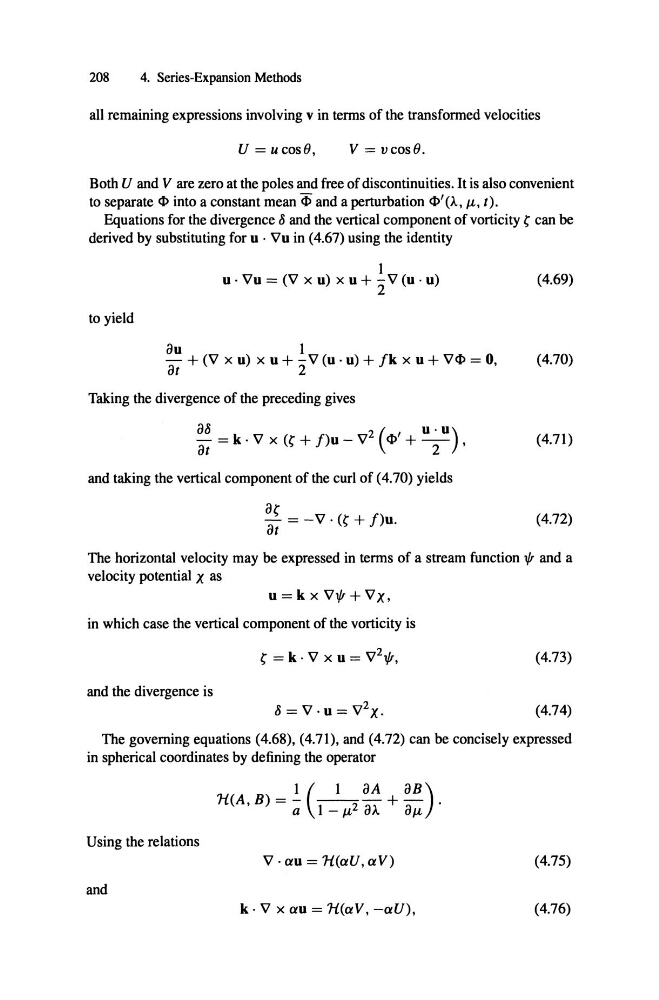
all remaining expressions involving v in terms of the transformed velocities
U = u cost),
v = vcosO.
Both U and V are zero at the poles and free of discontinuities. It is also convenient
to separate cI> into a constant mean cI> and aperturbation cI>,(A, JL, t) .
Equations for the divergence and the vertical component of vorticity can be
derived by substituting for u . Vu in (4.67) using the identity
u . Vu = (V x u) x u + 2
1 V (u . u)
(4.69)
to yield
(4.70)
ou
-
- es
2 ( '
cI>
-
ot
1
ot
+ (V x u) x u + - V (u . u) + fk x u + VcI> = 0,
2
Taking the divergence of the preceding gives
ot
= k . V x
+ f)u - V
+ - u· u) ,
2
(4.71)
and taking the vertical component of the curl of (4.70) yields
= -V · « + f)u.
(4.72)
The horizontal velocity may be expressed in terms of a stream funct ion 1{! and a
velocity potential X as
u=kxV1{!+VX ,
in which case the vertical component of the vorticity is
(4.73)
and the divergence is
(4.74)
The goveming equations (4.68), (4.71), and (4.72) can be concisely expressed
in spherical coordinates by defining the operator
'H(A ,B) = - 1 ( - - - + -
1
oA OB) .
a 1 - JL2 OA
oJL
Using the relations
and
V· au = 'H(aU, aV)
k · V x au = 'H(aV, -aU),
(4.75)
(4.76)
4. Series-Expansion Methods
all remaining expressions involving v in terms of the transformed velocities
U = u cost),
v = vcosO.
Both U and V are zero at the poles and free of discontinuities. It is also convenient
to separate cI> into a constant mean cI> and aperturbation cI>,(A, JL, t) .
Equations for the divergence and the vertical component of vorticity can be
derived by substituting for u . Vu in (4.67) using the identity
u . Vu = (V x u) x u + 2
1 V (u . u)
(4.69)
to yield
(4.70)
ou
-
- es
2 ( '
cI>
-
ot
1
ot
+ (V x u) x u + - V (u . u) + fk x u + VcI> = 0,
2
Taking the divergence of the preceding gives
ot
= k . V x
+ f)u - V
+ - u· u) ,
2
(4.71)
and taking the vertical component of the curl of (4.70) yields
= -V · « + f)u.
(4.72)
The horizontal velocity may be expressed in terms of a stream funct ion 1{! and a
velocity potential X as
u=kxV1{!+VX ,
in which case the vertical component of the vorticity is
(4.73)
and the divergence is
(4.74)
The goveming equations (4.68), (4.71), and (4.72) can be concisely expressed
in spherical coordinates by defining the operator
'H(A ,B) = - 1 ( - - - + -
1
oA OB) .
a 1 - JL2 OA
oJL
Using the relations
and
V· au = 'H(aU, aV)
k · V x au = 'H(aV, -aU),
(4.75)
(4.76)