

6
I. 1ntroduction
exp ik(x - djjt) . Every solution to the original system (1.5) is a linear superposition of these waves.
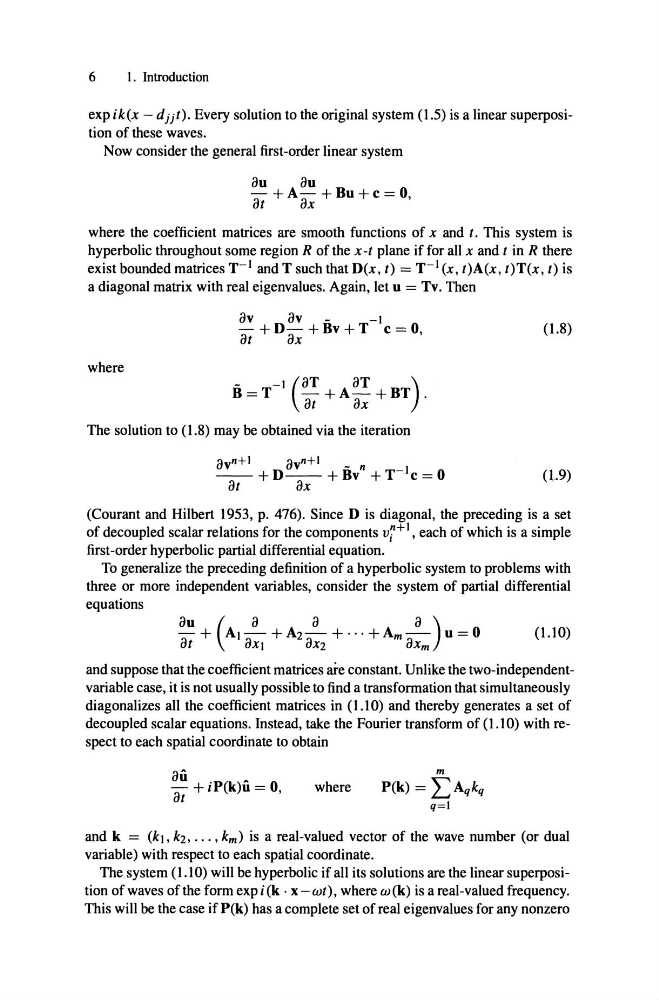
Now consider the general first-order linear system
au
-
at
au
+A- +Bu+c=O,
ax
where the coefficient matrices are smooth functions of x and t. This system is
hyperbolic throughout some region R of the x -t plane if for all x and t in R there
exist bounded matrices T- 1 and T such that O(x, t) = T- 1 (x, t)A(x, t)T(x , t) is
a diagonal matrix with real eigenvalues . Again, let u = Tv. Then
av
av -
-I
- +0- +Bv+T c=O,
at
ax
(1.8)
where
B=T
-
-I (aT -+A-+BT. ar
)
at
ax
The solution to (1.8) may be obtained via the iteration
av n + 1
av n + 1 - n
--+O--+Bv +T-1c=0
(1.9)
at
ax
(Courant and Hilbert 1953, p. 476). Since D is diagonal, the preceding is a set
of decoupled scalar relations for the components
first-order hyperbolic partial differential equation.
each of which is a simple
To generalize the preceding definition of a hyperbolic system to problems with
three or more independent variables, consider the system of partial differential
equations
au +
at
aXI
axz
+ " ' + Am- a- ) u = o
aX m
(1.10)
and suppose that the coefficient matrices are constant. Unlike the two-independentvariable case, it is not usually possible to find a transformation that simultaneously
diagonalizes all the coefficient matrices in (1.10) and thereby generates a set of
decoupled scalar equations. Instead, take the Fourier transform of (1.10) with respect to each spatial coordinate to obtain
-
aii
+ iP(k)u = 0,
at
where
m
P(k) = LAqkq
q=1
and k = (kl, ka. .. . ,km) is a real-valued vector of the wave number (or dual
variable) with respect to each spatial coordinate.
Thesystem (1.10) will be hyperbolic if all its solutions are the linear superposition ofwaves ofthe form exp i(k . x -wt), where w(k) is a real-valued frequency .
This will be the case if P(k) has a complete set of real eigenvalues for any nonzero
I. 1ntroduction
exp ik(x - djjt) . Every solution to the original system (1.5) is a linear superposition of these waves.
Now consider the general first-order linear system
au
-
at
au
+A- +Bu+c=O,
ax
where the coefficient matrices are smooth functions of x and t. This system is
hyperbolic throughout some region R of the x -t plane if for all x and t in R there
exist bounded matrices T- 1 and T such that O(x, t) = T- 1 (x, t)A(x, t)T(x , t) is
a diagonal matrix with real eigenvalues . Again, let u = Tv. Then
av
av -
-I
- +0- +Bv+T c=O,
at
ax
(1.8)
where
B=T
-
-I (aT -+A-+BT. ar
)
at
ax
The solution to (1.8) may be obtained via the iteration
av n + 1
av n + 1 - n
--+O--+Bv +T-1c=0
(1.9)
at
ax
(Courant and Hilbert 1953, p. 476). Since D is diagonal, the preceding is a set
of decoupled scalar relations for the components
first-order hyperbolic partial differential equation.
each of which is a simple
To generalize the preceding definition of a hyperbolic system to problems with
three or more independent variables, consider the system of partial differential
equations
au +
at
aXI
axz
+ " ' + Am- a- ) u = o
aX m
(1.10)
and suppose that the coefficient matrices are constant. Unlike the two-independentvariable case, it is not usually possible to find a transformation that simultaneously
diagonalizes all the coefficient matrices in (1.10) and thereby generates a set of
decoupled scalar equations. Instead, take the Fourier transform of (1.10) with respect to each spatial coordinate to obtain
-
aii
+ iP(k)u = 0,
at
where
m
P(k) = LAqkq
q=1
and k = (kl, ka. .. . ,km) is a real-valued vector of the wave number (or dual
variable) with respect to each spatial coordinate.
Thesystem (1.10) will be hyperbolic if all its solutions are the linear superposition ofwaves ofthe form exp i(k . x -wt), where w(k) is a real-valued frequency .
This will be the case if P(k) has a complete set of real eigenvalues for any nonzero