

4.4 Spherical Hannonics
195
Whatever the exact details of the energy-removal scherne, if it prevents the unphysieal accumulation of energy at the short wavelengths in the spectral solution,
the same energy-removal scheme will often stabilize a pseudospectral solution to
the same problem . In the case shown in Fig. 4.3b, for example, the amount of
viscous dissipation required to stabilize the pseudospectral solution is less than
that required to remove the spurious ripples from the spectral solution. Although
it is not generally necessary to filter the solution this heavily, aliasing error can
be completely eliminated by removing all energy at wavelengths shorter than
or equal to
after each time step, or equivalently, by removing the highest
onethird of the resolved wave numbers. If such a filter is used in combination
with a pseudospectral method truncated at wave number M, the resulting algorithm is identieal to that for a Galerkin spectral method truncated at wave number
2M/3 in which the nonlinear terms are computed via the transform method .
4.4 Spherical Harmonics
The two-dimensional distribution of a scalar variable on the surface of a sphere
ean be efficiently approximated by a truncated series of spherical harmonic functions. Spherical harmonics can also be used to represent three-dimensional fields
defined within a volume bounded by two concentric spheres if grid points or finiteelements are used to approximate the spatial structure along the radial coordinate
and thereby divide the computational domain into aseries of nested spheres. Let
A be the longitude, 0 the latitude, and define JL = sin O. If 1{r is a smooth function
of A and JL, it can be represented by a convergent expansion of spherical harmonie
functions of the form
00
00
1{r(A , JL) = L L am,nYm,n(A, JL),
m=-oon=lml
(4.40)
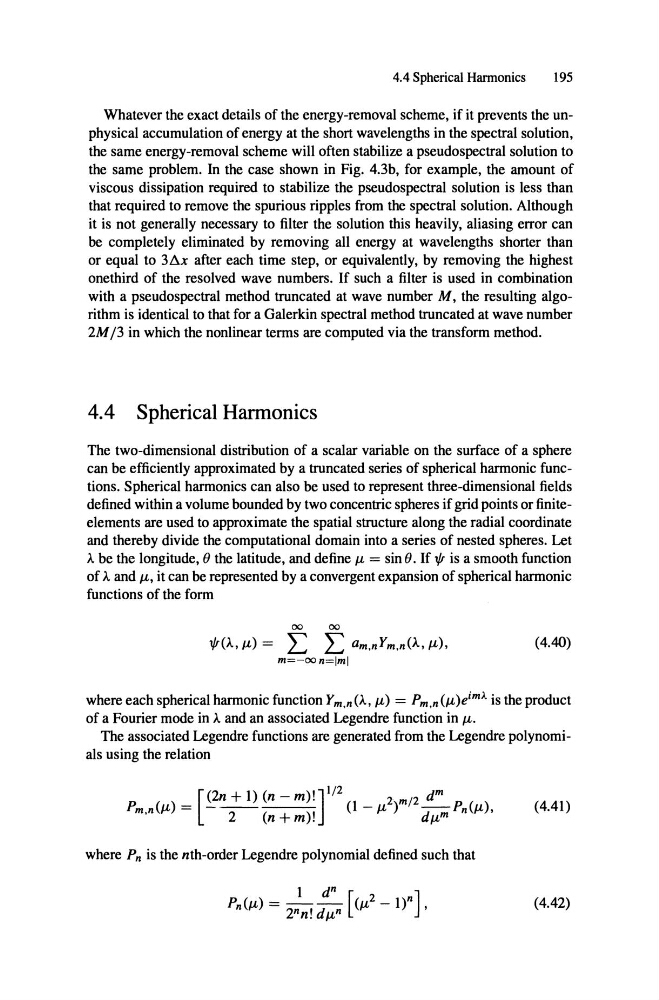
where each spherical harmonie function Ym,n(A, JL) = Pm,n(JL)eimJ.. is the product
of a Fourier mode in A and an associated Legendre function in JL.
The associated Legendre functions are generated from the Legendre polynomials using the relation
p
_
m,n(JL) -
+ 1) (n - m)!JI/2 1 _ 2 m/2 d
(4.41)
2
(n + m)!
(
JL)
du/" n(JL),
where P« is the nth-order Legendre polynomial defined such that
Pn(JL) = 2 n
1 'd d
-1)
n] ,
(4.42)
n. JL
n
n
[2 (JL
m P
195
Whatever the exact details of the energy-removal scherne, if it prevents the unphysieal accumulation of energy at the short wavelengths in the spectral solution,
the same energy-removal scheme will often stabilize a pseudospectral solution to
the same problem . In the case shown in Fig. 4.3b, for example, the amount of
viscous dissipation required to stabilize the pseudospectral solution is less than
that required to remove the spurious ripples from the spectral solution. Although
it is not generally necessary to filter the solution this heavily, aliasing error can
be completely eliminated by removing all energy at wavelengths shorter than
or equal to
after each time step, or equivalently, by removing the highest
onethird of the resolved wave numbers. If such a filter is used in combination
with a pseudospectral method truncated at wave number M, the resulting algorithm is identieal to that for a Galerkin spectral method truncated at wave number
2M/3 in which the nonlinear terms are computed via the transform method .
4.4 Spherical Harmonics
The two-dimensional distribution of a scalar variable on the surface of a sphere
ean be efficiently approximated by a truncated series of spherical harmonic functions. Spherical harmonics can also be used to represent three-dimensional fields
defined within a volume bounded by two concentric spheres if grid points or finiteelements are used to approximate the spatial structure along the radial coordinate
and thereby divide the computational domain into aseries of nested spheres. Let
A be the longitude, 0 the latitude, and define JL = sin O. If 1{r is a smooth function
of A and JL, it can be represented by a convergent expansion of spherical harmonie
functions of the form
00
00
1{r(A , JL) = L L am,nYm,n(A, JL),
m=-oon=lml
(4.40)
where each spherical harmonie function Ym,n(A, JL) = Pm,n(JL)eimJ.. is the product
of a Fourier mode in A and an associated Legendre function in JL.
The associated Legendre functions are generated from the Legendre polynomials using the relation
p
_
m,n(JL) -
+ 1) (n - m)!JI/2 1 _ 2 m/2 d
(4.41)
2
(n + m)!
(
JL)
du/" n(JL),
where P« is the nth-order Legendre polynomial defined such that
Pn(JL) = 2 n
1 'd d
-1)
n] ,
(4.42)
n. JL
n
n
[2 (JL
m P