

4.2 The Spectral Method
183
If 1/r is represcntcd by a spectral approximation, the scries will be truncated at
some wave number N, but the Fourier coefficients for all ikI N will beidentical
to those in the infinite series (4.20). 3 Thus, the error in the spectral representation
of a1/rlax is
E = L ikakeikx.
Ikl>N
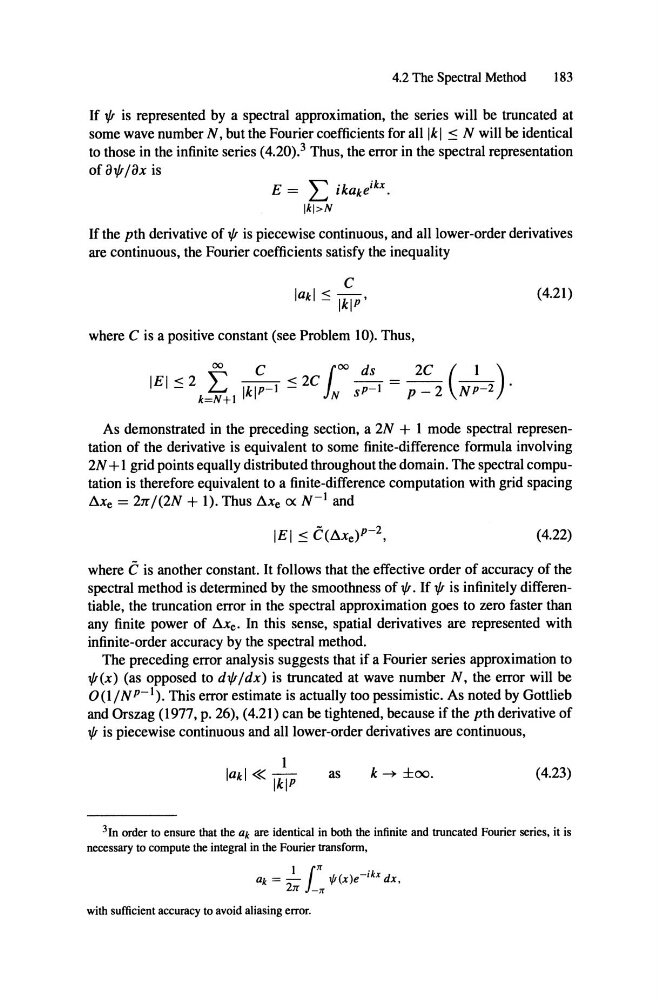
If the pth derivative of 1/r is piecewise continuous, and alliower-order derivatives
are continuous, the Fourier coefficients satisfy the inequality
(4.21)
where C is a positive constant (see Problem 10). Thus,
I E
00
C
1 ds
00
2C ( 1
1_ <2 L - - < 2 C
Iklp-1 -
- - - - - - -
p-I -
_ 2 NP-2
N
k=N+1
S
P
)
.
As demonstrated in the preceding section, a 2N + 1 mode spectral representation of the derivative is equivalent to some finite-difference formula involving
2N +1grid points equally distributed throughout the domain . The spectral computation is therefore equivalent to a finite-difference computation with grid spacing
ßXe = 21TI(2N + 1). Thus ßX e oc N -
1
and
(4.22)
where Cis another constant. It follows that the effective order of accuracy of the
spectral method is determined by the smoothness of 1/r. If 1/r is infinitely differentiable, the truncation error in the spectral approximation goes to zero faster than
any finite power of ßXe. In this sense, spatial derivatives are represented with
infinite-order accuracy by the spectral method.
The preceding error analysis suggests that if a Fourier series approximation to
1/r(x) (as opposed to d1/rldx) is truncated at wave number N, the error will be
0(1 IN p -I) . This error estimate is actually too pessimistic. As noted by Gottlieb
and Orszag (1977, p. 26), (4.21) can be tightened, because ifthe pth derivative of
1/r is piecewise continuous and alliower-order derivatives are continuous,
as
k ---+ ±oo.
(4.23)
3In order to ensure that the ak are identical in both the infinite and truncated Fourier series, it is
necessary to compute the integral in the Fourier transform,
with sufficient accurac y to avoid aliasing error.
183
If 1/r is represcntcd by a spectral approximation, the scries will be truncated at
some wave number N, but the Fourier coefficients for all ikI N will beidentical
to those in the infinite series (4.20). 3 Thus, the error in the spectral representation
of a1/rlax is
E = L ikakeikx.
Ikl>N
If the pth derivative of 1/r is piecewise continuous, and alliower-order derivatives
are continuous, the Fourier coefficients satisfy the inequality
(4.21)
where C is a positive constant (see Problem 10). Thus,
I E
00
C
1 ds
00
2C ( 1
1_ <2 L - - < 2 C
Iklp-1 -
- - - - - - -
p-I -
_ 2 NP-2
N
k=N+1
S
P
)
.
As demonstrated in the preceding section, a 2N + 1 mode spectral representation of the derivative is equivalent to some finite-difference formula involving
2N +1grid points equally distributed throughout the domain . The spectral computation is therefore equivalent to a finite-difference computation with grid spacing
ßXe = 21TI(2N + 1). Thus ßX e oc N -
1
and
(4.22)
where Cis another constant. It follows that the effective order of accuracy of the
spectral method is determined by the smoothness of 1/r. If 1/r is infinitely differentiable, the truncation error in the spectral approximation goes to zero faster than
any finite power of ßXe. In this sense, spatial derivatives are represented with
infinite-order accuracy by the spectral method.
The preceding error analysis suggests that if a Fourier series approximation to
1/r(x) (as opposed to d1/rldx) is truncated at wave number N, the error will be
0(1 IN p -I) . This error estimate is actually too pessimistic. As noted by Gottlieb
and Orszag (1977, p. 26), (4.21) can be tightened, because ifthe pth derivative of
1/r is piecewise continuous and alliower-order derivatives are continuous,
as
k ---+ ±oo.
(4.23)
3In order to ensure that the ak are identical in both the infinite and truncated Fourier series, it is
necessary to compute the integral in the Fourier transform,
with sufficient accurac y to avoid aliasing error.