

166
3. Beyond the One-WayWaveEquation
and the numerical approximation to the Jacobian operator is
Phillips (1959) showed that solutions obtained using the preceding scheme are
subject to an instability in which short-wavelength perturbations suddenly amplify
without bound. This instability cannot be controlled by reducing the time step, and
it occurs using values of l:i.t that are well below the threshold required to maintain
the stability of equivalent numerical approximations to the linearized constantcoefficient problem. Phillips demonstrated that this instability could be controlled
by removing all waves with wavelengths shorter than four grid intervals, thereby
eliminating the possibility of aliasing error.
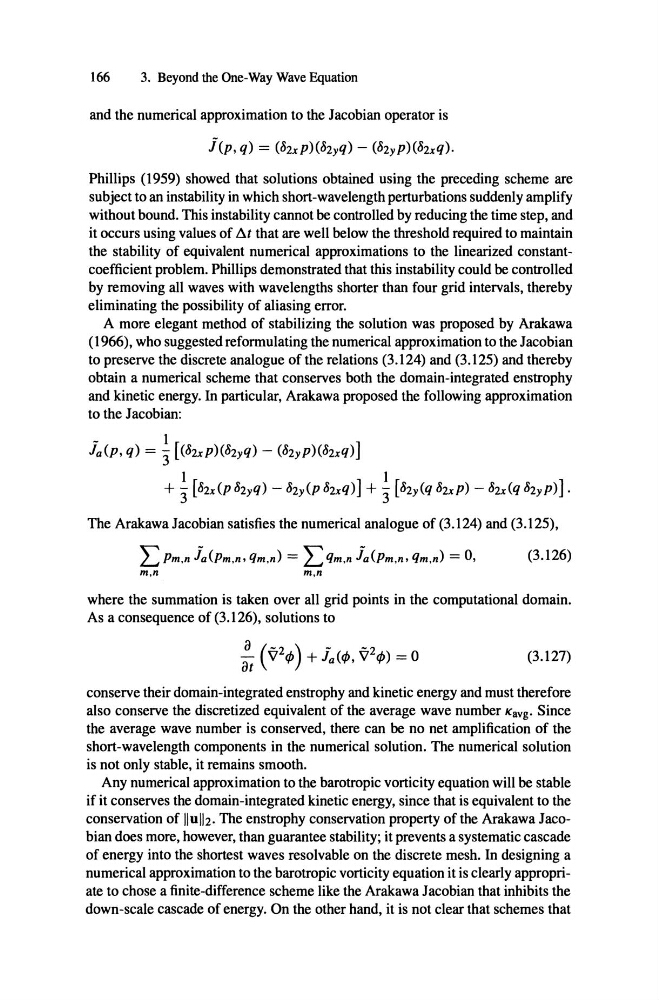
A more elegant method of stabilizing the solution was proposed by Arakawa
(1966), who suggested reforrnulating the numerical approximation to the Jacobian
to preserve the discrete analogue of the relations (3.124) and (3.125) and thereby
obtain a numerical scheme that conserves both the dornain-integrated enstrophy
and kinetic energy. In particular, Arakawa proposed the following approximation
to the Jacobian:
Ja(p,q) =
[(02xP)(02yq) - (02yP)(02xq)]
1
1
+ "3 [02x(P 02yq) - 02y(P o2xq)] + "3 [02y(q 02xp) - 02x(q 02yP)].
The Arakawa Jacobian satisfies the numerical analogue of (3.124) and (3.125),
L Pm,n Ja(Pm,n, qm,n) = Lqm ,n Ja(Pm,n, qm,n) = 0,
(3.126)
m,n
m,n
where the summation is taken over all grid points in the computational domain.
As a consequence of (3.126), solutions to
(3.127)
conserve their domain-integrated enstrophy and kinetic energy and must therefore
also conserve the discretized equivalent of the average wave number K avg • Since
the average wave number is conserved, there can be no net amplification of the
short-wavelength components in the numerical solution. The numerical solution
is not only stable , it remains smooth.
Any numerical approximation to the barotropic vorticity equation will be stable
if it conserves the domain-integrated kinetic energy, since that is equivalent to the
conservation of 11 u 112. The enstrophy conservation property of the Arakawa Jacobian does more, however, than guarantee stability; it prevents a systematic cascade
of energy into the shortest waves resolvable on the diserete mesh . In designing a
numerical approximation to the barotropic vorticity equation it is c1early appropriate to chose a finite-difference seheme like the Arakawa Jaeobian that inhibits the
down-seale easeade of energy. On the other hand, it is not c1ear that sehemes that
3. Beyond the One-WayWaveEquation
and the numerical approximation to the Jacobian operator is
Phillips (1959) showed that solutions obtained using the preceding scheme are
subject to an instability in which short-wavelength perturbations suddenly amplify
without bound. This instability cannot be controlled by reducing the time step, and
it occurs using values of l:i.t that are well below the threshold required to maintain
the stability of equivalent numerical approximations to the linearized constantcoefficient problem. Phillips demonstrated that this instability could be controlled
by removing all waves with wavelengths shorter than four grid intervals, thereby
eliminating the possibility of aliasing error.
A more elegant method of stabilizing the solution was proposed by Arakawa
(1966), who suggested reforrnulating the numerical approximation to the Jacobian
to preserve the discrete analogue of the relations (3.124) and (3.125) and thereby
obtain a numerical scheme that conserves both the dornain-integrated enstrophy
and kinetic energy. In particular, Arakawa proposed the following approximation
to the Jacobian:
Ja(p,q) =
[(02xP)(02yq) - (02yP)(02xq)]
1
1
+ "3 [02x(P 02yq) - 02y(P o2xq)] + "3 [02y(q 02xp) - 02x(q 02yP)].
The Arakawa Jacobian satisfies the numerical analogue of (3.124) and (3.125),
L Pm,n Ja(Pm,n, qm,n) = Lqm ,n Ja(Pm,n, qm,n) = 0,
(3.126)
m,n
m,n
where the summation is taken over all grid points in the computational domain.
As a consequence of (3.126), solutions to
(3.127)
conserve their domain-integrated enstrophy and kinetic energy and must therefore
also conserve the discretized equivalent of the average wave number K avg • Since
the average wave number is conserved, there can be no net amplification of the
short-wavelength components in the numerical solution. The numerical solution
is not only stable , it remains smooth.
Any numerical approximation to the barotropic vorticity equation will be stable
if it conserves the domain-integrated kinetic energy, since that is equivalent to the
conservation of 11 u 112. The enstrophy conservation property of the Arakawa Jacobian does more, however, than guarantee stability; it prevents a systematic cascade
of energy into the shortest waves resolvable on the diserete mesh . In designing a
numerical approximation to the barotropic vorticity equation it is c1early appropriate to chose a finite-difference seheme like the Arakawa Jaeobian that inhibits the
down-seale easeade of energy. On the other hand, it is not c1ear that sehemes that