

1.1 Partial Differential Equations-Some Basics
3
new unknown functions equal to the lower-order time derivatives of the original
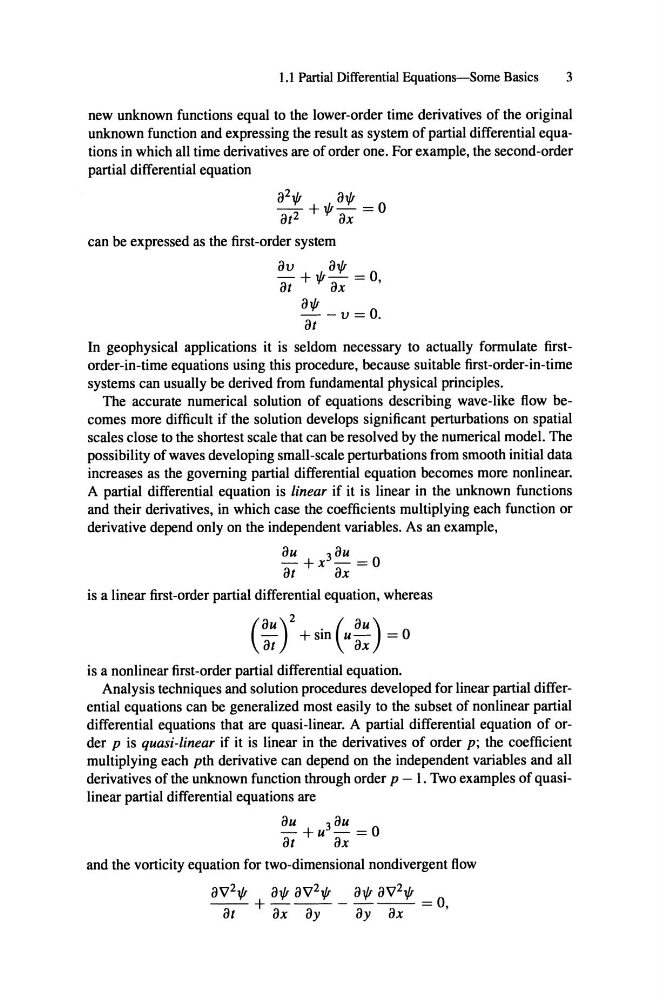
unknown function and expressing the result as system of partial differential equations in which all time derivatives are of order one. For example, the second-order
partial differential equation
8
21/1 + 1/1 81/1 = 0
8t 2
8x
can be expressed as the first-order system
8u
81/1
at + 1/I-a.; = 0,
81/1 _ v = o.
8t
In geophysical applications it is seldom necessary to actually formulate firstorder-in-time equations using this procedure, because suitable first-order-in-time
systems can usually be derived from fundamental physical principles .
The accurate numerical solution of equations describing wave-like flow becomes more difficult if the solution develops significant perturbations on spatial
scales close to the shortest scale that can beresolved by the numerical model. The
possibility of waves developing srnall-scale perturbations from smooth initial data
increases as the goveming partial differential equation becomes more nonlinear.
A partial differential equation is linear if it is linear in the unknown functions
and their derivatives, in which case the coefficients multiplying each function or
derivative depend only on the independent variables. As an example,
8u + x38u = 0
8t
8x
r+s in (u ::)
is a linear first-order partial differential equation, whereas
= 0
is a nonlinear first-order partial differential equation.
Analysis techniques and solution procedures developed for linear partial differential equations can be generalized most easily to the subset of nonlinear partial
differential equations that are quasi -linear. A partial differential equation of order p is quasi-linear if it is linear in the derivatives of order p ; the coefficient
multiplying each pth derivative can depend on the independent variables and all
derivatives of the unknown function through order p - 1. Two examples of quasilinear partial differential equations are
8u + u38u = 0
8t
8x
and the vorticity equation for two-dimensional nondivergent flow
8V 21/1
81/1 8V21/1
81/1 8V
21/1
- - + - - - - - - - = 0,
8t
8x 8y
8y 8x
3
new unknown functions equal to the lower-order time derivatives of the original
unknown function and expressing the result as system of partial differential equations in which all time derivatives are of order one. For example, the second-order
partial differential equation
8
21/1 + 1/1 81/1 = 0
8t 2
8x
can be expressed as the first-order system
8u
81/1
at + 1/I-a.; = 0,
81/1 _ v = o.
8t
In geophysical applications it is seldom necessary to actually formulate firstorder-in-time equations using this procedure, because suitable first-order-in-time
systems can usually be derived from fundamental physical principles .
The accurate numerical solution of equations describing wave-like flow becomes more difficult if the solution develops significant perturbations on spatial
scales close to the shortest scale that can beresolved by the numerical model. The
possibility of waves developing srnall-scale perturbations from smooth initial data
increases as the goveming partial differential equation becomes more nonlinear.
A partial differential equation is linear if it is linear in the unknown functions
and their derivatives, in which case the coefficients multiplying each function or
derivative depend only on the independent variables. As an example,
8u + x38u = 0
8t
8x
r+s in (u ::)
is a linear first-order partial differential equation, whereas
= 0
is a nonlinear first-order partial differential equation.
Analysis techniques and solution procedures developed for linear partial differential equations can be generalized most easily to the subset of nonlinear partial
differential equations that are quasi -linear. A partial differential equation of order p is quasi-linear if it is linear in the derivatives of order p ; the coefficient
multiplying each pth derivative can depend on the independent variables and all
derivatives of the unknown function through order p - 1. Two examples of quasilinear partial differential equations are
8u + u38u = 0
8t
8x
and the vorticity equation for two-dimensional nondivergent flow
8V 21/1
81/1 8V21/1
81/1 8V
21/1
- - + - - - - - - - = 0,
8t
8x 8y
8y 8x