

3.3 Splittinginto Fractional Steps
and then integrate the term involving b using trapezoidal differencing:
135
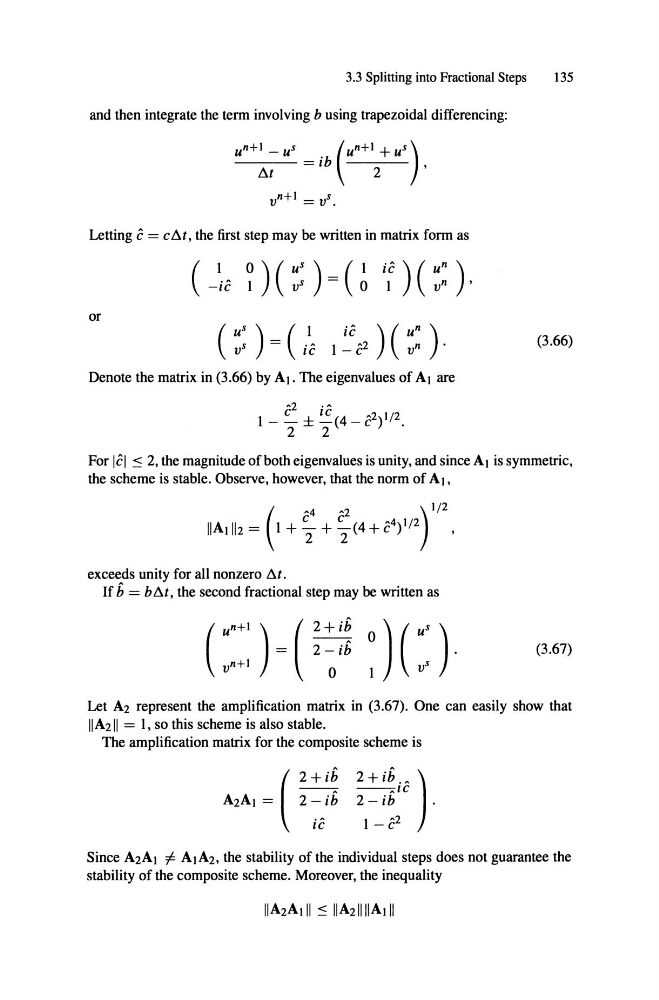
Letting e= cSt ; the first step may be written in matrix form as
or
(3.66)
Denote the matrix in (3.66) by AI. The eigenvalues of AI are
AZ
C
. A
IC
AZ I/Z
1--±-(4-c)
2
2
.
For lei::: 2, the magnitude ofboth eigenvalues is unity, and sinee AI is symmetrie,
the sehe me is stable. Observe, however, that the norm of AI,
exeeeds unity for all nonzero /)"t .
If b = bSt, the seeond fraetional step may be written as
(3.67)
Let Az represent the amplifieation matrix in (3.67). One ean easily show that
11 Azil = 1, so this seheme is also stable.
The amplifieation matrix for the eomposite sehe me is
2+ib
AzAI = (
2
IC
Sinee AzAI =1= AIAZ, the stability ofthe individual steps does not guarantee the
stability of the eomposite seheme. Moreover, the inequality
and then integrate the term involving b using trapezoidal differencing:
135
Letting e= cSt ; the first step may be written in matrix form as
or
(3.66)
Denote the matrix in (3.66) by AI. The eigenvalues of AI are
AZ
C
. A
IC
AZ I/Z
1--±-(4-c)
2
2
.
For lei::: 2, the magnitude ofboth eigenvalues is unity, and sinee AI is symmetrie,
the sehe me is stable. Observe, however, that the norm of AI,
exeeeds unity for all nonzero /)"t .
If b = bSt, the seeond fraetional step may be written as
(3.67)
Let Az represent the amplifieation matrix in (3.67). One ean easily show that
11 Azil = 1, so this seheme is also stable.
The amplifieation matrix for the eomposite sehe me is
2+ib
AzAI = (
2
IC
Sinee AzAI =1= AIAZ, the stability ofthe individual steps does not guarantee the
stability of the eomposite seheme. Moreover, the inequality