

3.2 Three or More Independent Variables
119
T
U y
-L
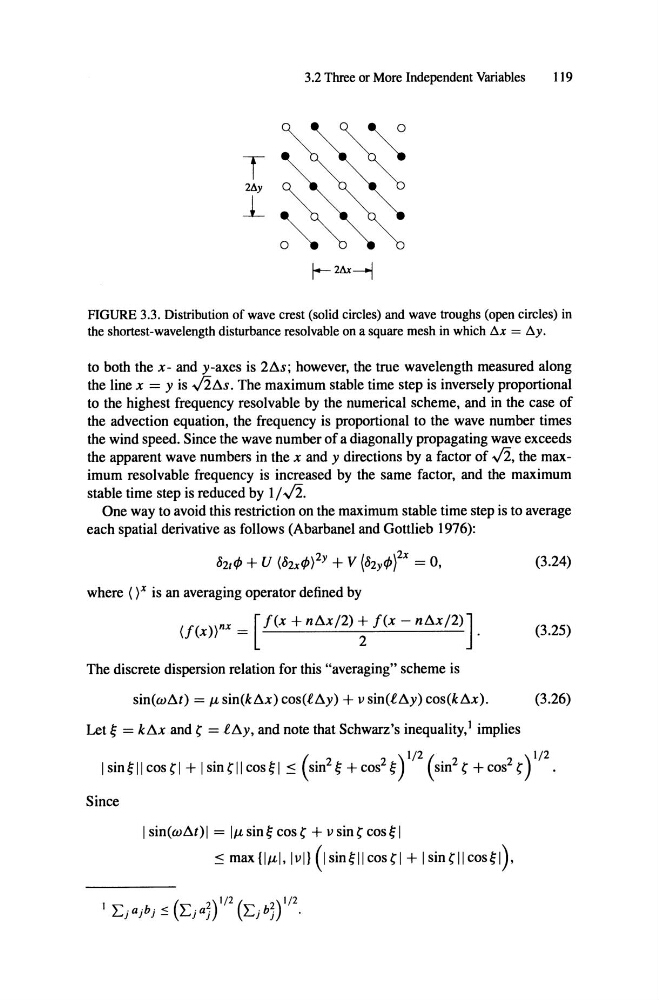
FIGURE 3.3. Distribution of wave crest (solid circles) and wave troughs (open circles) in
the shortest-wavelength disturbance resolvable on a square mesh in which
= t::..y.
to both the x- and y-axes is
however, the true wavelength measured along
the line x = y is
The maximum stable time step is inversely proportional
to the highest frequeney resolvable by the numerieal scherne, and in the ease of
the adveetion equation, the frequeney is proportional to the wave number times
the wind speed. Sinee the wave number of a diagonally propagating wave exeeeds
the apparent wave numbers in the x and y direetions by a faetor of ".fi, the maximum resolvable frequeney is inereased by the same faetor, and the maximum
stable time step is redueed by l/".fi.
One way to avoid this restrietion on the maximum stable time step is to average
eaeh spatial derivative as follows (Abarbanel and Gottlieb 1976):
(3.24)
where ( )X is an averaging operator defined by
(f(x))nx = [f(X +
; f(x -
.
The diserete dispersion relation for this "averaging" sehe me is
sin(wM) = J.l
Let = kt>..x and { =
+ v
and note that Sehwarz's inequality,' implies
(3.25)
(3.26)
Sinee
I
I = 1J.l sin eos { + v sin { eos I
max Ilrz], lvI}
+
119
T
U y
-L
FIGURE 3.3. Distribution of wave crest (solid circles) and wave troughs (open circles) in
the shortest-wavelength disturbance resolvable on a square mesh in which
= t::..y.
to both the x- and y-axes is
however, the true wavelength measured along
the line x = y is
The maximum stable time step is inversely proportional
to the highest frequeney resolvable by the numerieal scherne, and in the ease of
the adveetion equation, the frequeney is proportional to the wave number times
the wind speed. Sinee the wave number of a diagonally propagating wave exeeeds
the apparent wave numbers in the x and y direetions by a faetor of ".fi, the maximum resolvable frequeney is inereased by the same faetor, and the maximum
stable time step is redueed by l/".fi.
One way to avoid this restrietion on the maximum stable time step is to average
eaeh spatial derivative as follows (Abarbanel and Gottlieb 1976):
(3.24)
where ( )X is an averaging operator defined by
(f(x))nx = [f(X +
; f(x -
.
The diserete dispersion relation for this "averaging" sehe me is
sin(wM) = J.l
Let = kt>..x and { =
+ v
and note that Sehwarz's inequality,' implies
(3.25)
(3.26)
Sinee
I
I = 1J.l sin eos { + v sin { eos I
max Ilrz], lvI}
+