

2.5 CombinedTime- and Space-Differencing
91
solutions that nevertheless converge to the correct solution of the oscillation equation as ßt -)- O. The amplification factor arising from a Von Neumann stability
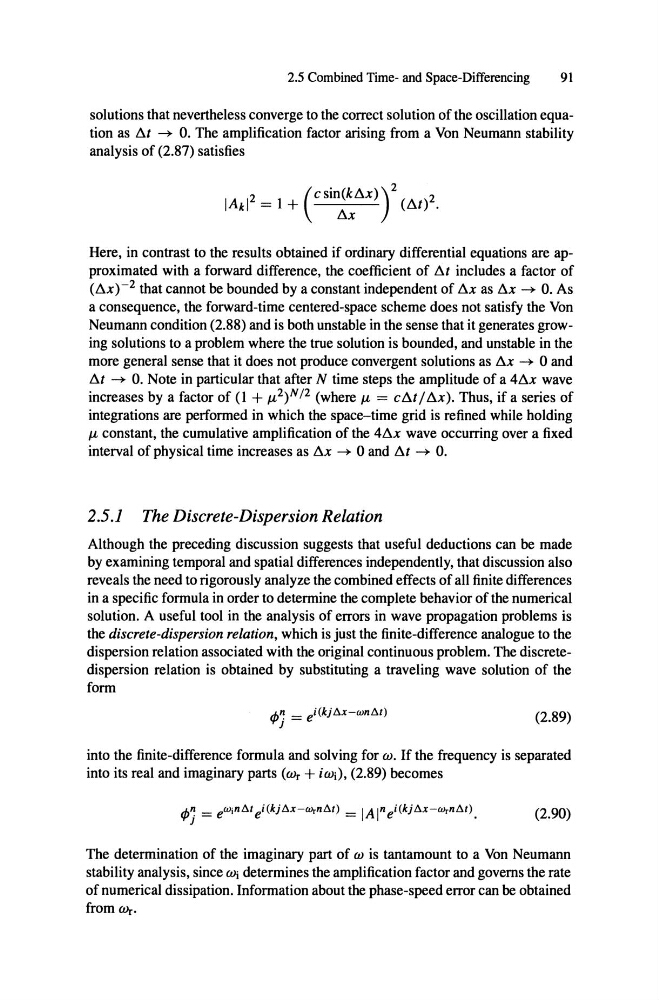
analysis of (2.87) satisfies
Here, in contrast to the results obtained if ordinary differential equations are approximated with a forward difference, the coefficient of ßt includes a factor of
(ßx)-2 that cannot be bounded by a constant independent of ßx as Sx -)- O. As
a consequence, the forward-time centered-space scheme does not satisfy the Von
Neumann condition (2.88) and is both unstable in the sense that it generates growing solutions to a problem where the true solution is bounded, and unstable in the
more general sense that it does not produce convergent solutions as Sx -)- 0 and
ßt -)- O. Note in particular that after N time steps the amplitude of a 4ßx wave
increases by a factor of (1 + p})N/2 (where J1, = eßt / ßx). Thus, if aseries of
integrations are performed in wh ich the space-time grid is refined while holding
J1, constant, the cumulative amplification of the 4ßx wave occurring over a fixed
interval of physical time increases as ßx -)- 0 and ßt -)- O.
2.5.1 The Discrete-Dispersion Relation
Although the preceding discussion suggests that useful deductions can be made
by examining temporal and spatial differences independently, that discussion also
reveals the need to rigorously analyze the combined effects of all finite differences
in a specific formula in order to determine the complete behavior of the numerical
solution. A useful tool in the analysis of errors in wave propagation problems is
the diserete-dispersion relation, which is just the finite-difference analogue to the
dispersion relation associated with the original continuous problem. The discretedispersion relation is obtained by substituting a traveling wave solution of the
form
eil! = ei(kjßx-wnM)
J
(2.89)
into the finite-difference formula and solving for w. If the frequency is separated
into its real and imaginary parts (Wr + iWj), (2.89) becomes
(2.90)
The determination of the imaginary part of w is tantamount to a Von Neumann
stability analysis, since Wj determines the amplification factor and govems the rate
of numerical dissipation. Information about the phase-speed error can be obtained
from Wr.
91
solutions that nevertheless converge to the correct solution of the oscillation equation as ßt -)- O. The amplification factor arising from a Von Neumann stability
analysis of (2.87) satisfies
Here, in contrast to the results obtained if ordinary differential equations are approximated with a forward difference, the coefficient of ßt includes a factor of
(ßx)-2 that cannot be bounded by a constant independent of ßx as Sx -)- O. As
a consequence, the forward-time centered-space scheme does not satisfy the Von
Neumann condition (2.88) and is both unstable in the sense that it generates growing solutions to a problem where the true solution is bounded, and unstable in the
more general sense that it does not produce convergent solutions as Sx -)- 0 and
ßt -)- O. Note in particular that after N time steps the amplitude of a 4ßx wave
increases by a factor of (1 + p})N/2 (where J1, = eßt / ßx). Thus, if aseries of
integrations are performed in wh ich the space-time grid is refined while holding
J1, constant, the cumulative amplification of the 4ßx wave occurring over a fixed
interval of physical time increases as ßx -)- 0 and ßt -)- O.
2.5.1 The Discrete-Dispersion Relation
Although the preceding discussion suggests that useful deductions can be made
by examining temporal and spatial differences independently, that discussion also
reveals the need to rigorously analyze the combined effects of all finite differences
in a specific formula in order to determine the complete behavior of the numerical
solution. A useful tool in the analysis of errors in wave propagation problems is
the diserete-dispersion relation, which is just the finite-difference analogue to the
dispersion relation associated with the original continuous problem. The discretedispersion relation is obtained by substituting a traveling wave solution of the
form
eil! = ei(kjßx-wnM)
J
(2.89)
into the finite-difference formula and solving for w. If the frequency is separated
into its real and imaginary parts (Wr + iWj), (2.89) becomes
(2.90)
The determination of the imaginary part of w is tantamount to a Von Neumann
stability analysis, since Wj determines the amplification factor and govems the rate
of numerical dissipation. Information about the phase-speed error can be obtained
from Wr.