

Sea Turtle Husbandry
417
bleached at the same time the raceways are disinfected. The crates are soaked in
raceways filled with the bleach solution for 24 h. The crates are rinsed with freshwater followed by an additional 24 h soak in seawater. The containers are again
rinsed with freshwater and stored dry until they are ready for use. Just prior to use,
the containers are soaked in seawater for 24 h followed by a freshwater rinse. A
new batch of hog rings (Caillouet, 2000) is applied to the bottom of the cages
annually to replace those that rusted off or became loose during the previous year.
New nylon cable ties (Caillouet, 2000) are used to suspend the cages. Crates and
cages are stored dry until they are ready for use.
16.3 SEAWATER SYSTEM
The NMFS STF relies on a natural seawater system consisting of a beach pump,
sump, and water storage tanks (Caillouet, 2000; Fontaine et al., 1985). Water is
drawn directly from the Gulf of Mexico.
16.3.1 W ATER T REATMENT AND S TORAGE
The NMFS STF uses four 26,000-l and two 38,000-l insulated fiberglass tanks to
store seawater (Caillouet, 2000). Each of the four small tanks contains a quartz
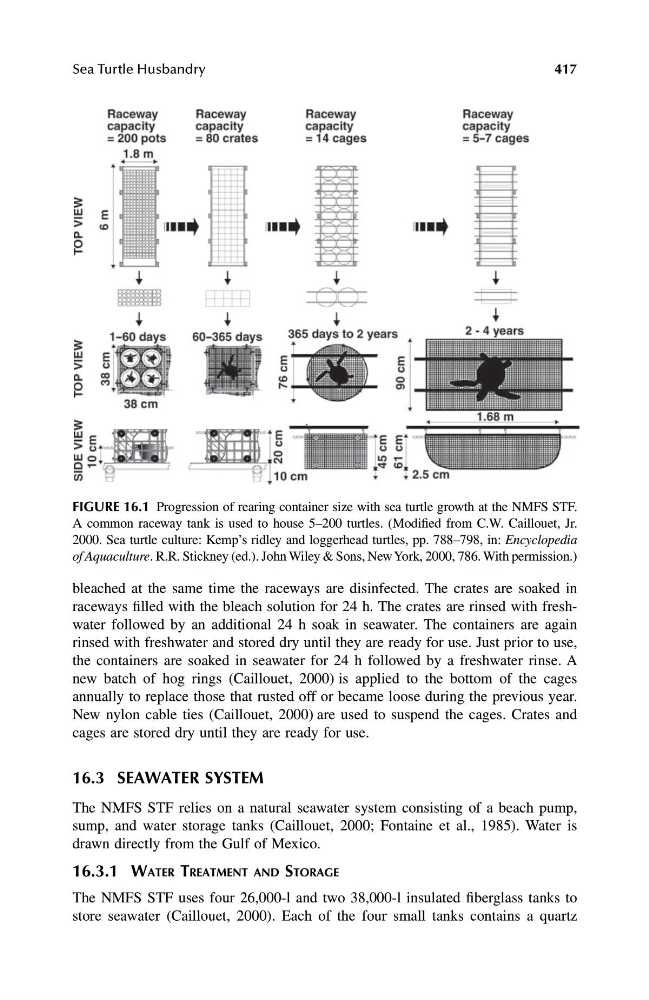
FIGURE 16.1 Progression of rearing container size with sea turtle growth at the NMFS STF.
A common raceway tank is used to house 5–200 turtles. (Modified from C.W. Caillouet, Jr.
2000. Sea turtle culture: Kemp’s ridley and loggerhead turtles, pp. 788–798, in: Encyclopedia
of Aquaculture . R.R. Stickney (ed.). John Wiley & Sons, New York, 2000, 786. With permission.)
1123_C16 Page 417 Tuesday, November 12, 2002 8:28 AM
417
bleached at the same time the raceways are disinfected. The crates are soaked in
raceways filled with the bleach solution for 24 h. The crates are rinsed with freshwater followed by an additional 24 h soak in seawater. The containers are again
rinsed with freshwater and stored dry until they are ready for use. Just prior to use,
the containers are soaked in seawater for 24 h followed by a freshwater rinse. A
new batch of hog rings (Caillouet, 2000) is applied to the bottom of the cages
annually to replace those that rusted off or became loose during the previous year.
New nylon cable ties (Caillouet, 2000) are used to suspend the cages. Crates and
cages are stored dry until they are ready for use.
16.3 SEAWATER SYSTEM
The NMFS STF relies on a natural seawater system consisting of a beach pump,
sump, and water storage tanks (Caillouet, 2000; Fontaine et al., 1985). Water is
drawn directly from the Gulf of Mexico.
16.3.1 W ATER T REATMENT AND S TORAGE
The NMFS STF uses four 26,000-l and two 38,000-l insulated fiberglass tanks to
store seawater (Caillouet, 2000). Each of the four small tanks contains a quartz
FIGURE 16.1 Progression of rearing container size with sea turtle growth at the NMFS STF.
A common raceway tank is used to house 5–200 turtles. (Modified from C.W. Caillouet, Jr.
2000. Sea turtle culture: Kemp’s ridley and loggerhead turtles, pp. 788–798, in: Encyclopedia
of Aquaculture . R.R. Stickney (ed.). John Wiley & Sons, New York, 2000, 786. With permission.)
1123_C16 Page 417 Tuesday, November 12, 2002 8:28 AM