

318
The Biology of Sea Turtles, Vol. II
tortoiseshell was available to tourists in Barbados, Belize, Costa Rica, Cuba, the
Dominican Republic, Fiji, Indonesia, Japan, Maldives, Mexico, Nicaragua, São
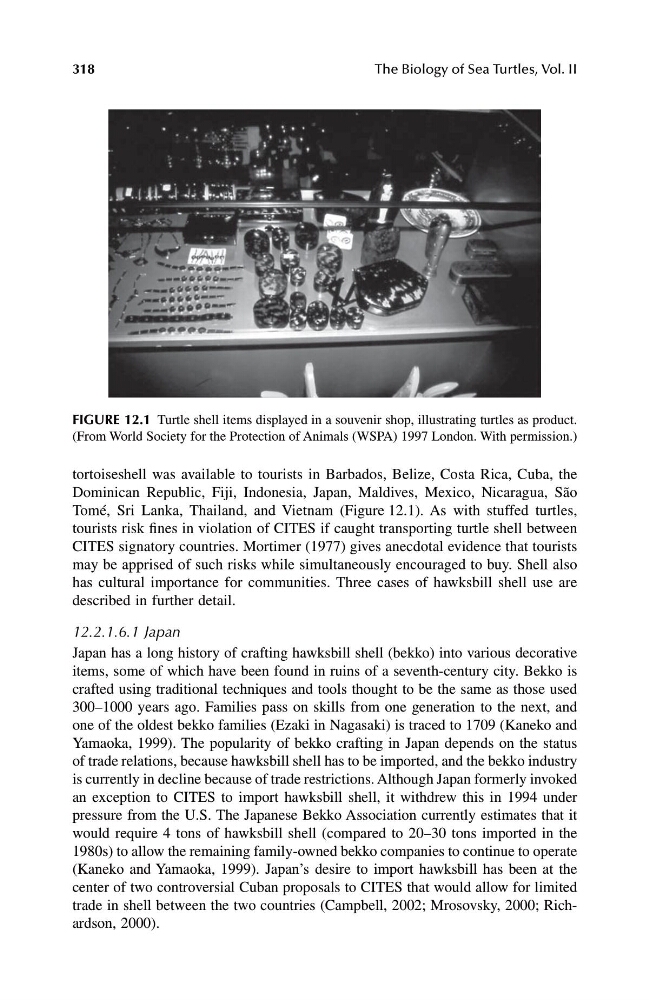
Tomé, Sri Lanka, Thailand, and Vietnam (Figure 12.1). As with stuffed turtles,
tourists risk fines in violation of CITES if caught transporting turtle shell between
CITES signatory countries. Mortimer (1977) gives anecdotal evidence that tourists
may be apprised of such risks while simultaneously encouraged to buy. Shell also
has cultural importance for communities. Three cases of hawksbill shell use are
described in further detail.
12.2.1.6.1 Japan
Japan has a long history of crafting hawksbill shell (bekko) into various decorative
items, some of which have been found in ruins of a seventh-century city. Bekko is
crafted using traditional techniques and tools thought to be the same as those used
300–1000 years ago. Families pass on skills from one generation to the next, and
one of the oldest bekko families (Ezaki in Nagasaki) is traced to 1709 (Kaneko and
Yamaoka, 1999). The popularity of bekko crafting in Japan depends on the status
of trade relations, because hawksbill shell has to be imported, and the bekko industry
is currently in decline because of trade restrictions. Although Japan formerly invoked
an exception to CITES to import hawksbill shell, it withdrew this in 1994 under
pressure from the U.S. The Japanese Bekko Association currently estimates that it
would require 4 tons of hawksbill shell (compared to 20–30 tons imported in the
1980s) to allow the remaining family-owned bekko companies to continue to operate
(Kaneko and Yamaoka, 1999). Japan’s desire to import hawksbill has been at the
center of two controversial Cuban proposals to CITES that would allow for limited
trade in shell between the two countries (Campbell, 2002; Mrosovsky, 2000; Richardson, 2000).
FIGURE 12.1 Turtle shell items displayed in a souvenir shop, illustrating turtles as product.
(From World Society for the Protection of Animals (WSPA) 1997 London. With permission.)
1123 book.book Page 318 Thursday, November 14, 2002 11:50 AM
The Biology of Sea Turtles, Vol. II
tortoiseshell was available to tourists in Barbados, Belize, Costa Rica, Cuba, the
Dominican Republic, Fiji, Indonesia, Japan, Maldives, Mexico, Nicaragua, São
Tomé, Sri Lanka, Thailand, and Vietnam (Figure 12.1). As with stuffed turtles,
tourists risk fines in violation of CITES if caught transporting turtle shell between
CITES signatory countries. Mortimer (1977) gives anecdotal evidence that tourists
may be apprised of such risks while simultaneously encouraged to buy. Shell also
has cultural importance for communities. Three cases of hawksbill shell use are
described in further detail.
12.2.1.6.1 Japan
Japan has a long history of crafting hawksbill shell (bekko) into various decorative
items, some of which have been found in ruins of a seventh-century city. Bekko is
crafted using traditional techniques and tools thought to be the same as those used
300–1000 years ago. Families pass on skills from one generation to the next, and
one of the oldest bekko families (Ezaki in Nagasaki) is traced to 1709 (Kaneko and
Yamaoka, 1999). The popularity of bekko crafting in Japan depends on the status
of trade relations, because hawksbill shell has to be imported, and the bekko industry
is currently in decline because of trade restrictions. Although Japan formerly invoked
an exception to CITES to import hawksbill shell, it withdrew this in 1994 under
pressure from the U.S. The Japanese Bekko Association currently estimates that it
would require 4 tons of hawksbill shell (compared to 20–30 tons imported in the
1980s) to allow the remaining family-owned bekko companies to continue to operate
(Kaneko and Yamaoka, 1999). Japan’s desire to import hawksbill has been at the
center of two controversial Cuban proposals to CITES that would allow for limited
trade in shell between the two countries (Campbell, 2002; Mrosovsky, 2000; Richardson, 2000).
FIGURE 12.1 Turtle shell items displayed in a souvenir shop, illustrating turtles as product.
(From World Society for the Protection of Animals (WSPA) 1997 London. With permission.)
1123 book.book Page 318 Thursday, November 14, 2002 11:50 AM