

Roles of Sea Turtles in Marine Ecosystems: Reconstructing the Past
263
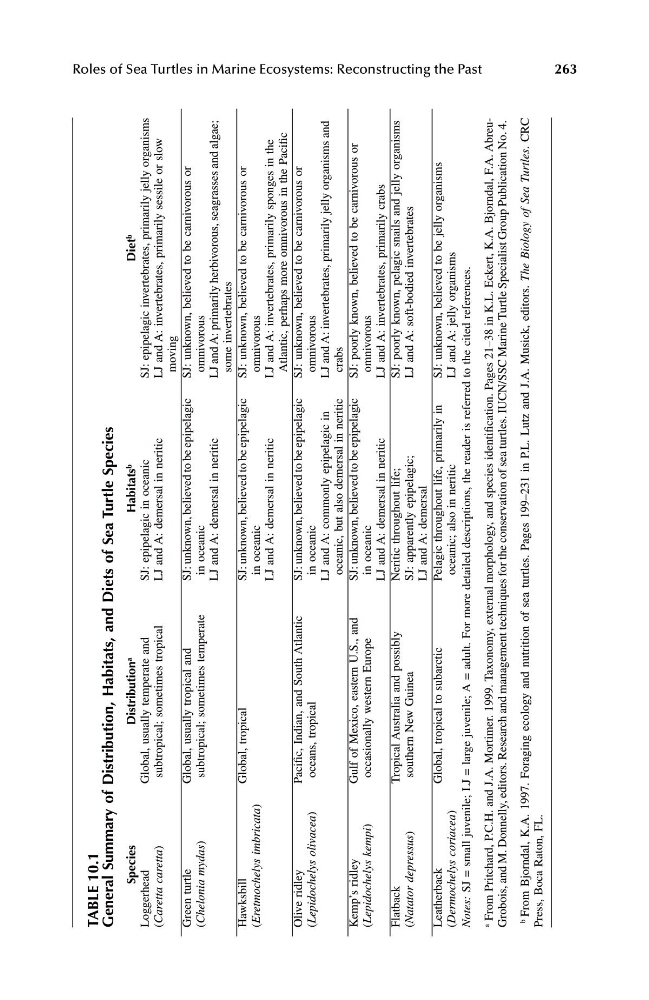
TABLE 10.1
General Summary of Distribution, Habitats, and Diets of Sea Turtle Species
Species
Distribution a
Habitats b
Diet b
Loggerhead
( Caretta caretta
)
Global, usually temperate and
subtropical; sometimes tropical
SJ: epipelagic in oceanic
LJ and A: demersal in neritic
SJ: epipelagic invertebrates, primarily jelly organisms
LJ and A: invertebrates, primarily sessile or slow
moving
Green turtle
( Chelonia mydas
)
Global, usually tropical and
subtropical; sometimes temperate
SJ: unknown, believed to be epipelagic
in oceanic
LJ and A: demersal in neritic
SJ: unknown, believed to be carnivorous or
omnivorous
LJ and A: primarily herbivorous, seagrasses and algae;
some invertebrates
Hawksbill
( Eretmochelys imbricata
)
Global, tropical
SJ: unknown, believed to be epipelagic
in oceanic
LJ and A: demersal in neritic
SJ: unknown, believed to be carnivorous or
omnivorous
LJ and A: invertebrates, primarily sponges in the
Atlantic, perhaps more omnivorous in the Pacific
Olive ridley
( Lepidochelys olivacea
)
Pacific, Indian, and South Atlantic
oceans, tropical
SJ: unknown, believed to be epipelagic
in oceanic
LJ and A: commonly epipelagic in
oceanic, but also demersal in neritic
SJ: unknown, believed to be carnivorous or
omnivorous
LJ and A: invertebrates, primarily jelly organisms and
crabs
Kemp’s ridley
( Lepidochelys kempi
)
Gulf of Mexico, eastern U.S., and
occasionally western Europe
SJ: unknown, believed to be epipelagic
in oceanic
LJ and A: demersal in neritic
SJ: poorly known, believed to be carnivorous or
omnivorous
LJ and A: invertebrates, primarily crabs
Flatback
( Natator depressus
)
Tropical Australia and possibly
southern New Guinea
Neritic throughout life;
SJ: apparently epipelagic;
LJ and A: demersal
SJ: poorly known, pelagic snails and jelly organisms
LJ and A: soft-bodied invertebrates
Leatherback
( Dermochelys coriacea
)
Global, tropical to subarctic
Pelagic throughout life, primarily in
oceanic; also in neritic
SJ: unknown, believed to be jelly organisms
LJ and A: jelly organisms
Notes:
SJ = small juvenile; LJ = large juvenile; A = adult. For more detailed descriptions, the reader is referred to the cited references.
a
From Pritchard, P.C.H. and J.A. Mortimer. 1999. Taxonomy, external morphology, and species identification. Pages 21–38 in K.L. Eckert, K.A. Bjorndal, F.A. AbreuGrobois, and M. Donnelly, editors. Research and management techniques for the conservation of sea turtles. IUCN/SSC Marine Turtle Specialist Group Publication No. 4.
b
From Bjorndal, K.A. 1997. Foraging ecology and nutrition of sea turtles. Pages 199–231 in P.L. Lutz and J.A. Musick, editors. The Biology of Sea Turtles
. CRC
Press, Boca Raton, FL.
1123 book.book Page 263 Monday, November 11, 2002 11:11 AM
263
TABLE 10.1
General Summary of Distribution, Habitats, and Diets of Sea Turtle Species
Species
Distribution a
Habitats b
Diet b
Loggerhead
( Caretta caretta
)
Global, usually temperate and
subtropical; sometimes tropical
SJ: epipelagic in oceanic
LJ and A: demersal in neritic
SJ: epipelagic invertebrates, primarily jelly organisms
LJ and A: invertebrates, primarily sessile or slow
moving
Green turtle
( Chelonia mydas
)
Global, usually tropical and
subtropical; sometimes temperate
SJ: unknown, believed to be epipelagic
in oceanic
LJ and A: demersal in neritic
SJ: unknown, believed to be carnivorous or
omnivorous
LJ and A: primarily herbivorous, seagrasses and algae;
some invertebrates
Hawksbill
( Eretmochelys imbricata
)
Global, tropical
SJ: unknown, believed to be epipelagic
in oceanic
LJ and A: demersal in neritic
SJ: unknown, believed to be carnivorous or
omnivorous
LJ and A: invertebrates, primarily sponges in the
Atlantic, perhaps more omnivorous in the Pacific
Olive ridley
( Lepidochelys olivacea
)
Pacific, Indian, and South Atlantic
oceans, tropical
SJ: unknown, believed to be epipelagic
in oceanic
LJ and A: commonly epipelagic in
oceanic, but also demersal in neritic
SJ: unknown, believed to be carnivorous or
omnivorous
LJ and A: invertebrates, primarily jelly organisms and
crabs
Kemp’s ridley
( Lepidochelys kempi
)
Gulf of Mexico, eastern U.S., and
occasionally western Europe
SJ: unknown, believed to be epipelagic
in oceanic
LJ and A: demersal in neritic
SJ: poorly known, believed to be carnivorous or
omnivorous
LJ and A: invertebrates, primarily crabs
Flatback
( Natator depressus
)
Tropical Australia and possibly
southern New Guinea
Neritic throughout life;
SJ: apparently epipelagic;
LJ and A: demersal
SJ: poorly known, pelagic snails and jelly organisms
LJ and A: soft-bodied invertebrates
Leatherback
( Dermochelys coriacea
)
Global, tropical to subarctic
Pelagic throughout life, primarily in
oceanic; also in neritic
SJ: unknown, believed to be jelly organisms
LJ and A: jelly organisms
Notes:
SJ = small juvenile; LJ = large juvenile; A = adult. For more detailed descriptions, the reader is referred to the cited references.
a
From Pritchard, P.C.H. and J.A. Mortimer. 1999. Taxonomy, external morphology, and species identification. Pages 21–38 in K.L. Eckert, K.A. Bjorndal, F.A. AbreuGrobois, and M. Donnelly, editors. Research and management techniques for the conservation of sea turtles. IUCN/SSC Marine Turtle Specialist Group Publication No. 4.
b
From Bjorndal, K.A. 1997. Foraging ecology and nutrition of sea turtles. Pages 199–231 in P.L. Lutz and J.A. Musick, editors. The Biology of Sea Turtles
. CRC
Press, Boca Raton, FL.
1123 book.book Page 263 Monday, November 11, 2002 11:11 AM